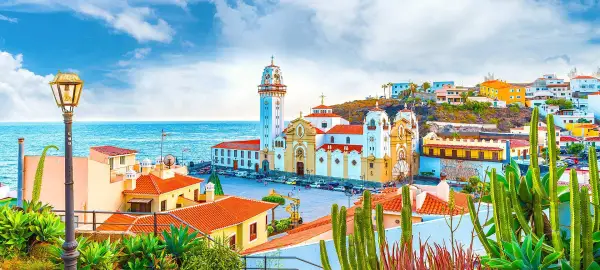
- Off The Beaten Path
- History
- Overview
- Info & Inclusions
- Itinerary
- Map & Hotels
- Photos
- Dates & Prices
- Tour Duration: 14 Days
- Max Group Size 16
- World-class whale watching in nutrient-rich Atlantic waters
- Emerald crater lakes and geothermal springs in volcanic calderas
- Madeira's ingeniously terraced mountainsides and subtropical "floating garden"
- Unique Guanche heritage blending with Spanish island culture
- Endemic flora and fauna found nowhere else on Earth
- Dramatic volcanic panoramas from Teide's peaks to Lanzarote's lunar landscapes
- Singles friendly (view options for single travellers)
- MealsSavour authentic flavours with included daily breakfasts, some lunches, and most dinners at handpicked local restaurants—immersing you in local cuisine without worrying about reservations or budgets.
- Transport & Logistics
Private air-conditioned coaches and included internal ferries and flights—ensuring hassle-free travel so you can focus entirely on the discoveries ahead.
"Adventures Abroad tour leader's management and guest services managed the tour with great skill and dedication. The tour leader was on top of every move and transfer. We have not experienced any issues with logistics and had a great time."
~ JULIA O"The tour leader did an excellent job coordinating some difficult travel logistics, power outage issues and resolving problems and dealing with guests who had unrealistic expectations."
~ CYNTHIA COLLINS - Expert Guidance
Unlock insider secrets at every landmark with your full-time Tour Leader and expert local guides , all gratuities covered—no hidden tipping surprises—so you immerse fully in your destination's stories, worry-free. (Except for the tips to your tour leader at the end of your tour.)
"Amazing tour guide. Our tour guide was very well organized, Her passion, knowledge, and enthusiasm completely transformed the travel experience into something truly unforgettable..."
~ MELANIE LEMAIRE"Highly recommend every trip with Adventures Abroad. It's a well organized and well thought out adventure. The tour leaders are friendly, knowledgeable and experienced professionals. Highly recommend this company."
~ SUSAN WALL - Sightseeing & EntrancesAll entrance fees for sites visited as per the itinerary—no hidden costs—so you can explore ancient ruins and excursions with complete peace of mind.
- AccommodationsUnwind in clean, well-located 3 to 4-star hotels with private en suite facilities—handpicked for comfort and convenience after each day's discoveries—so you can rest easy knowing your stay supports the real adventure, not steals the spotlight.
- Small Group
Discover the world in small groups of up to 16 travellers plus your expert Tour Leader—unlocking spontaneity, off-the-beaten-path adventures, and genuine connections at a relaxed pace, free from crowds.
"Looking Forward to My Next Adventure The best feature of the Adventures tour was the small size that allowed the group to quickly load up, let everyone get acquainted within the first 24 hours, capitalize on unplanned surprises along..."
~ PHILIP BLENSKI"Good value for a great time I have traveled with Adventures Abroad for over 20 years now. Well thought out, interesting itineraries and the other travelers congenial and friendly. The price always seems fair and overall a..."
~ Trusted Customer - Airport Transfers For Land & Air CustomersWe handle hassle-free airport transfers for all our land and air tour customers—plus early arrivals or late departures when you book extra hotel nights directly with us for added peace of mind.
- International airfare to/from the tour.
- Tour Leader gratuities, most lunches, two dinners, drinks, personal items (phone, laundry, etc), international air and air taxes (if applicable), domestic air taxes, visa/entrance fees, and any excursions referenced as 'optional'.
- Airport transfers for Land Only customers.
- Optional trip cancellation insurance.
- Our post-reservation trip notes offer further guidance on shopping, entry fees, and locally-paid departure taxes.
- Seasonality and Weather:
Across the region, April to October is the best time to visit, outside for the hottest/coldest months, when temperatures and rainfall/storminess are mild and conducive to maximizing exploration.
The Azores have a maritime subtropical climate across all islands. Despite this apparently unstable weather conditions, temperatures are quite moderate throughout the year. The average temperature is a comfortable 17C/63ºF. Madeira is similar - strongly influenced by the Gulf Stream and Canary Current, giving mild year-round temperatures. The Canaries are generally drier and hotter, from 15-28 C (60-80 F) at the times that we visit, but far more comfortable than mid-summer or winter.
The key is to be prepared for a WIDE range of conditions. The timing of our visits coincides with late spring when temperatures are relatively mild and rain increasingly unlikely as we approach summer, and fall (Sept/Oct) when Azores and Madeira will be comfortable, and the hotter places (The Canaries) will have cooled by the time we arrive.. - Transport and Travel Conditions:
Generally-speaking, land transport will vary from place to place, possibly with a mini- or mid-sized coach depending on ultimate group size and coach availability. All land transport, however, will be air-conditioned.
Our tour rating #2 refers to the overall ambitious nature of the program and the great deal of moving around that we will be doing. Our sightseeing is not strenuous per se, but you must be steady on your feet and able to manage stairs/slopes and tour sites, some of which are large. We will have several walking tours of towns and cities and short walks to dinner. You will also need to be able to endure some full travel days and possibly some heat in some locations.
We have a couple of ferry crossings, though they are short. That said, however, swells can be considerable even in good weather.
Our internal air connections will likely be with Azores Airlines/SATA and Binter Canarias, who operate mostly Brazilian or Canadian-built turboprop aircraft with very limited space for cabin baggage.
Please note that the best way to fly to this tour is via Azores Airlines/Sata from/via either Toronto or Boston; home-bound you're likely looking at TAP via Lisbon. We regret if these isolated places present a challenge to those who are trying to redeem points or those who have very specific airline preferences, but this factor is not our primary consideration when developing this tour.
PLEASE NOTE: Due to every-changing air schedules, our tour dates and final itinerary are TENTATIVE until we 'guarantee' the tour. The order of places visited and the number of days spent in each place may vary.
Am I suitable for this tour? Please refer to our self-assessment form - Activity Level: 2
These are particularly busy tours that feature a lot of moving around, sometimes by train and short journeys on local transport. Walking tours of towns and cities are leisurely but you should be prepared to be on your feet for several hours. Some of our cultural trips that occur at high altitude and/or require greater independence with baggage handling (at hotels, airports, train stations) also fall into this category.
To learn more about the Activity levels, please visit our tour styles page. - Accommodation:
Our accommodation choices are based on location and are mostly of a 3- or 4-star standard. All are modern, clean, well-appointed, some with views and/or unique local atmosphere. All are air-conditioned and feature private bath, elevators, and baggage handling (though you need to be able to handle your own luggage, especially at airports/ferries).
Please click on "Map & Hotels" tab above for full details. - Staff and Support:
Tour leader throughout, local step-on guides, drivers. - Group Size:
16 plus Tour Leader
- Day 1:Arrival in Horta, Azores, PortugalArrival in Horta, on Faial Island in the Azores. Faial is the third most populous of the Azorean islands and the westernmost of the Triangle Islands, with Pico and Sao Jorge.
Welcome to Macaronesia, four North Atlantic archipelagos belonging to Portugal, Spain and Cape Verde. The name comes from the Greek for "islands of the fortunate".
Horta grew as a watering stop for whaling fleets, then became one of the North Atlantic's great yacht harbours. Sailors from dozens of countries have left painted murals on the harbour wall, an open-air gallery worth a stroll on arrival.
The day is free until this evening, when we gather for our welcome dinner and trip orientation.
Overnight in Horta.
Included Meal(s): Dinner - Day 2:Faial & Pico IslandsWe take the ferry to Pico, about 30 minutes, for a full day on the island.
We start at Furnas Frei Matias, a lesser-known lava tube explored with helmets and flashlights. Few visitors come here, and our group has the cave to itself. Stalactites and lava formations line the chambers, and our guide explains the volcanic activity that shaped the Azores.
In Lajes do Pico, known as the whalers' village, the Whalers' Museum occupies 19th-century boathouses and an old forge where whalers kept their boats and tools. It covers the whaling industry's influence on the island's economy and society. Whaling in the Azores ended in the 1980s, and the whales are now worth far more alive, an important part of local tourism.
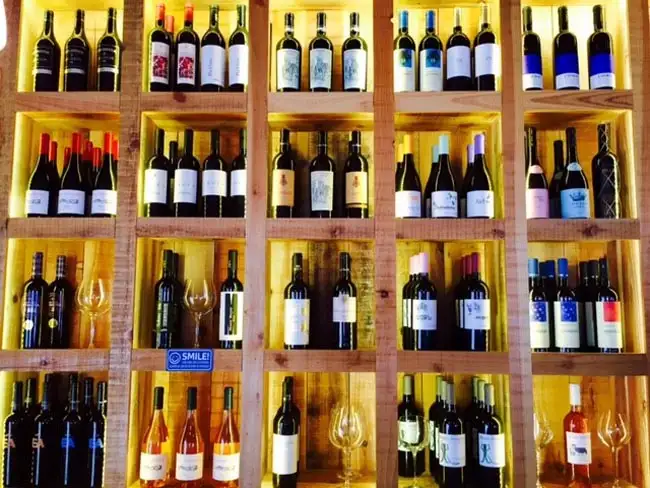
Lunch, included today, features local dishes made from locally sourced ingredients, with a chance to taste the wines Pico is known for.
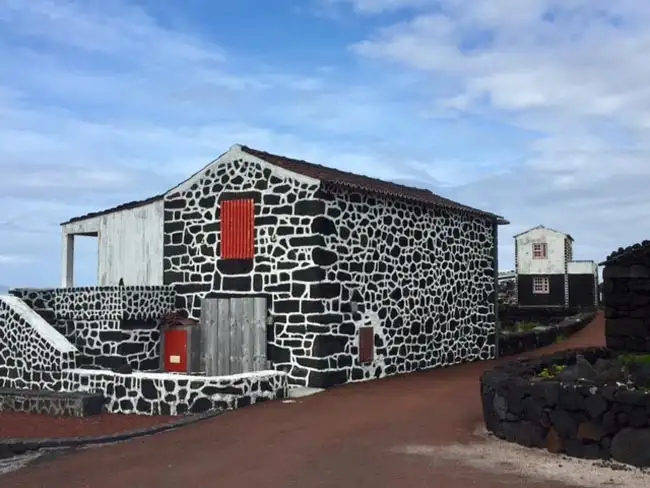
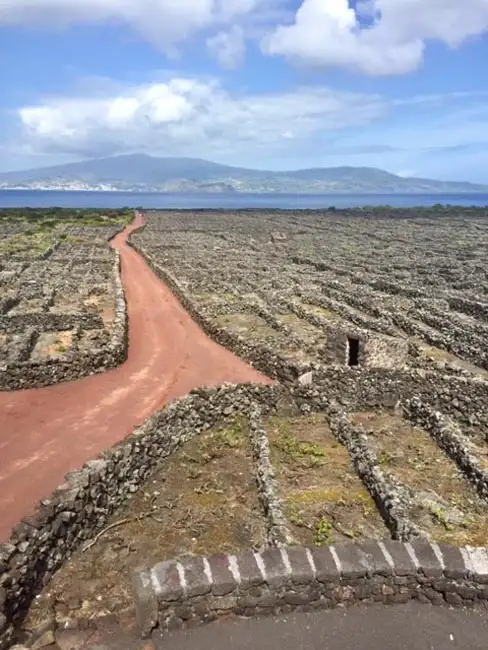
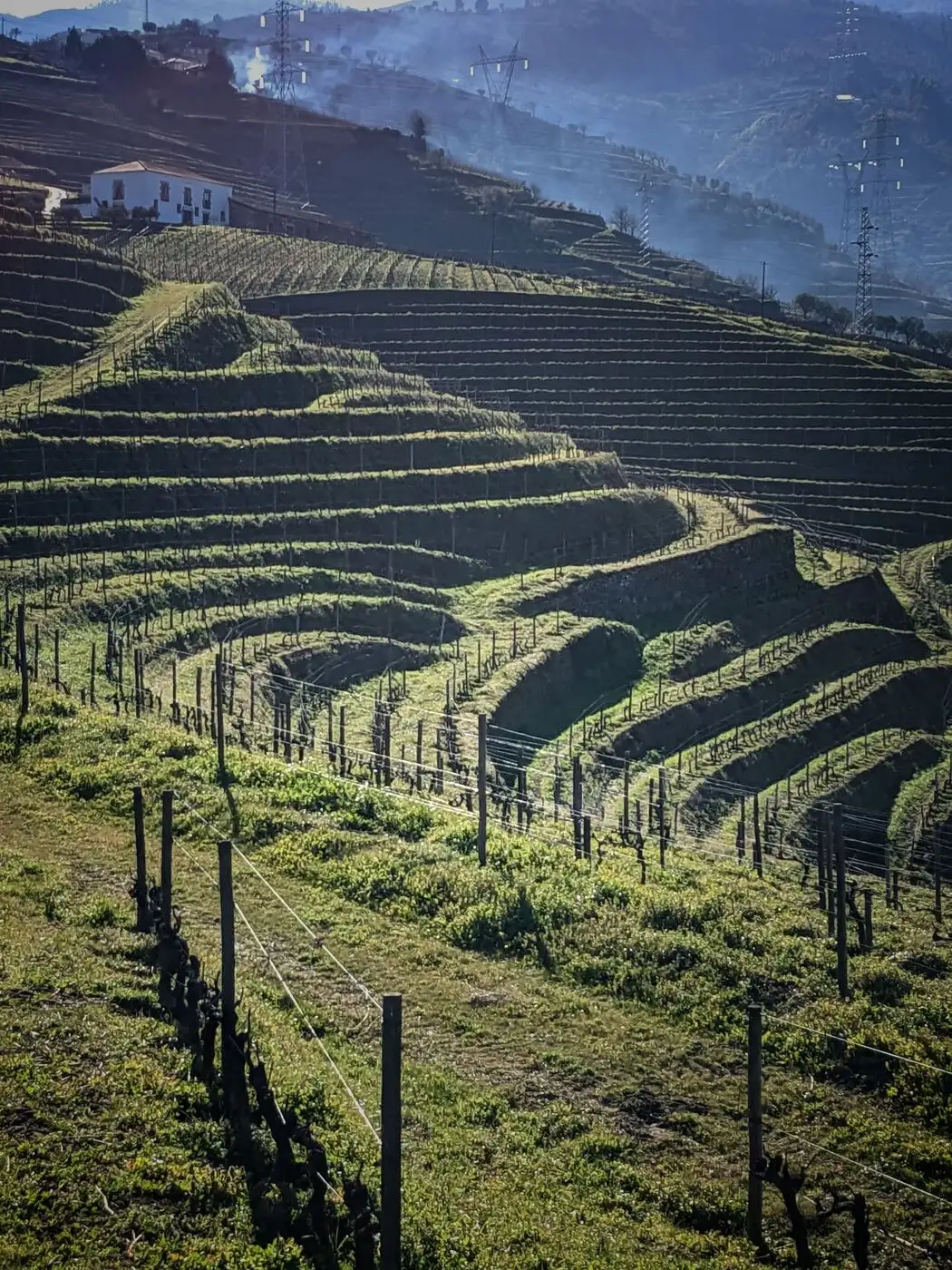
After lunch we take an easy walk through the Criacao Velha vineyards. Vines grow in small plots sheltered by lava stone walls that hold heat and keep out wind and salt spray. UNESCO recognized the method, and the wine tradition around it, in 2004. Our roughly circular route follows the coast, with stops for views and a look at Pico's lava stone houses with their colourful trim. The ferry then returns us to Horta for the night.
NOTE: The ferry crossing is weather-dependent and the order of the day may change.
Overnight in Horta.
Included Meal(s): Breakfast and Lunch - Day 3:Capelinhos Volcano & the Scrimshaw MuseumWe spend the morning at Capelinhos, site of one of the 20th century's most dramatic eruptions. In 1957 an underwater volcano erupted off Faial's western tip for thirteen months, adding a new peninsula to the island. Half of Faial's population emigrated to North America in the aftermath, and the cultural ties to New England remain.
The Capelinhos Volcano Interpretation Centre charts the 1957 eruption and the tectonic forces still shaping the Azores, which sit on the junction of the North American and Eurasian plates. The landscape outside is ash fields and eroded lava.
Back in Horta, we visit the Scrimshaw Museum, above Peter's Sport Cafe, one of the waterfront's best-known meeting places. Scrimshaw, the engraving of whale teeth with ships, mermaids and hunt scenes, was the sailor's craft. The private collection is among the finest in the Azores. After yesterday's Whalers' Museum on Pico, it shows the sailors' side of the trade, when American and European whalers crowded Horta's quays to reprovision.
Overnight in Horta.
Included Meal(s): Breakfast and Dinner - Day 4:Fly to Ponta Delgada: Pineapple & WineA short flight of about 30 minutes takes us east to Sao Miguel, the largest island in the Azores, and Ponta Delgada.
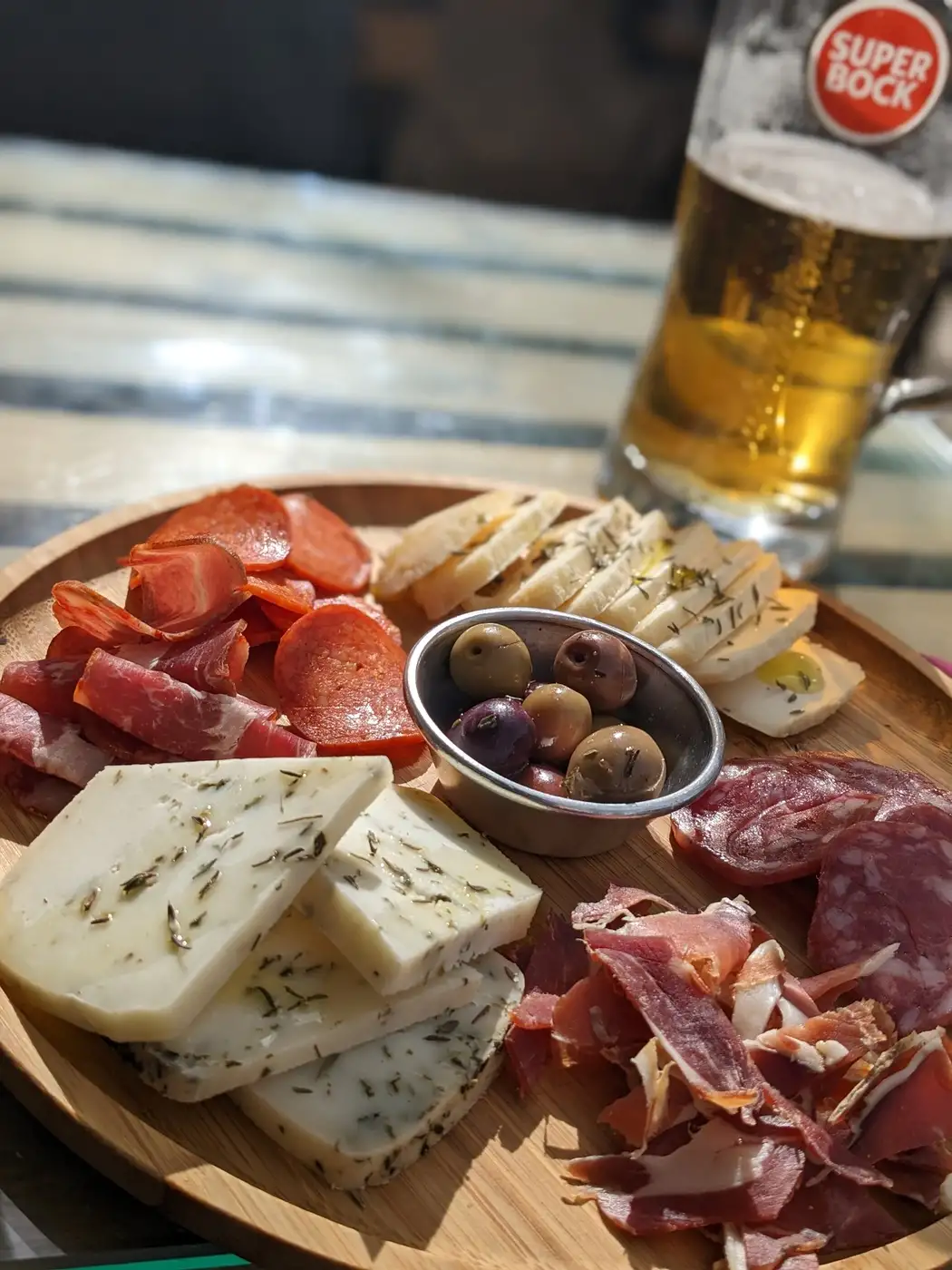
We visit a family-run pineapple plantation that still uses heated greenhouses, a centuries-old method. Each fruit takes two years to grow, which helps explain why Azorean pineapple is considered among the world's finest. The visit ends with local cheeses and the island's pineapple wine.
Time permitting, we explore the historic centre of Ponta Delgada, a graceful town of cobbled streets, squares and gardens built when it was an important trading port in the 18th and early 19th centuries. The Portas da Cidade, or City Gates, a trio of arches from that era, are the city's symbol.
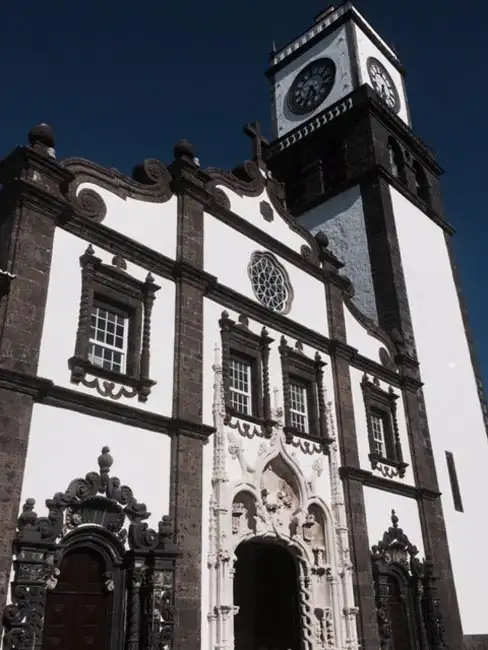
The Igreja Matriz has a baroque interior, and the streets are laid in black and white Portuguese pavement patterns. The marina is lined with restaurants, and a stroll along the harbourfront promenade gives a good overview of the city.
NOTE: Flight times may change the order of the day.
Overnight in Ponta Delgada.
Included Meal(s): Breakfast and Dinner - Day 5:Sao Miguel: Whale Watching & West Island ExplorationA whale watching excursion from Ponta Delgada opens the day. After the Scrimshaw Museum on Faial and the Whalers' Museum on Pico, we see the animals the industry once hunted. Our vessel is large and stable, yet nimble enough to respond to spotters on the hills, some of whom once alerted hunters. Nature guides lead the trip and collect scientific data.
A biologist briefs us first on safety, observation rules and what we may see. The Azores are a home or a passage for more than a third of the world's whale and dolphin species. Sperm whales and dolphins are present year round, and we are here at the right time for blue and fin whales, the two largest.
This afternoon we drive west across the island, stopping at Ponta de Ferraria and Miradouro do Escalvado, where the view takes in the fishing village of Mosteiros and its natural pools.
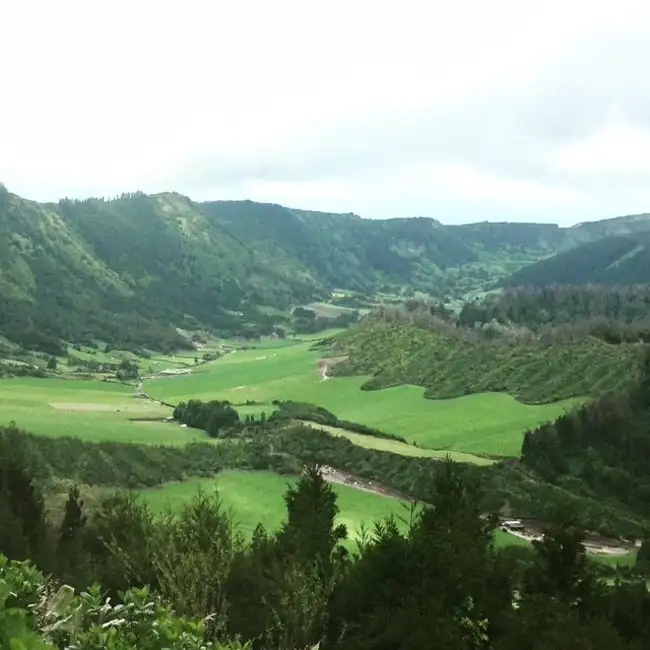
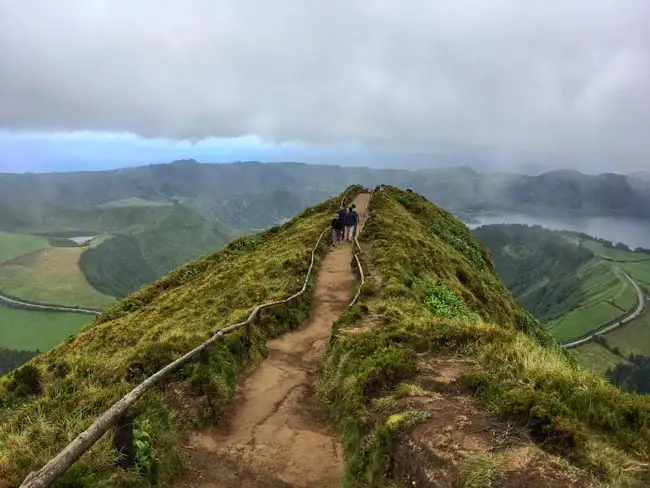
At Vista do Rei, fog permitting, the Sete Cidades caldera opens below us. Two lagoons, one green and one blue, make up the largest freshwater lake in the Azores, nearly 5 km/3 mi long. Cliffs drop 500 m/1,640 ft to the water in places. A short walk to the Boca do Inferno viewpoint gives another angle over the crater. We then visit the farming village of Sete Cidades, on the crater floor.
NOTE: Sightings are not guaranteed, and sea conditions can change the schedule.
Overnight in Ponta Delgada.
Included Meal(s): Breakfast and Dinner - Day 6:Sao Miguel: Furnas & East Island TouringToday's route loops through the east of Sao Miguel, with the geothermal valley of Furnas at its centre.
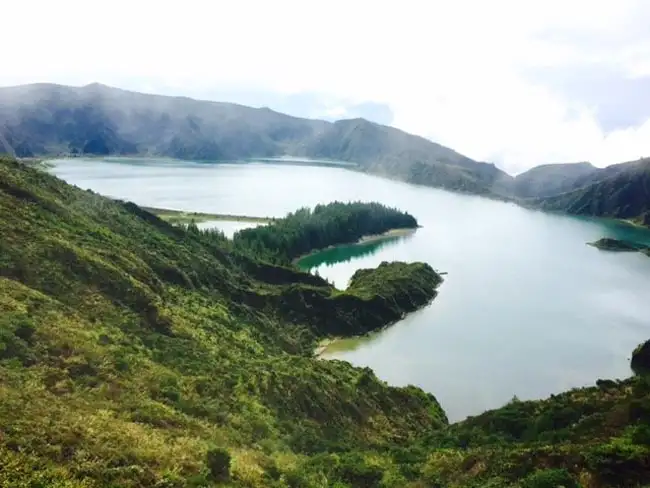
We begin at Pico do Carvao, where the north and south coasts are both in view, then follow the north coast to Ribeira Grande and its historic centre and cliffs. At Caldeira Velha, a waterfall runs down the north slope of Fogo Volcano. Lagoa do Fogo, the Lake of Fire, sits in a crater in a protected reserve, with endemic plants on its walls and no settlements. Pico da Barrosa, 947 m/3,107 ft, gives our last views of the area.
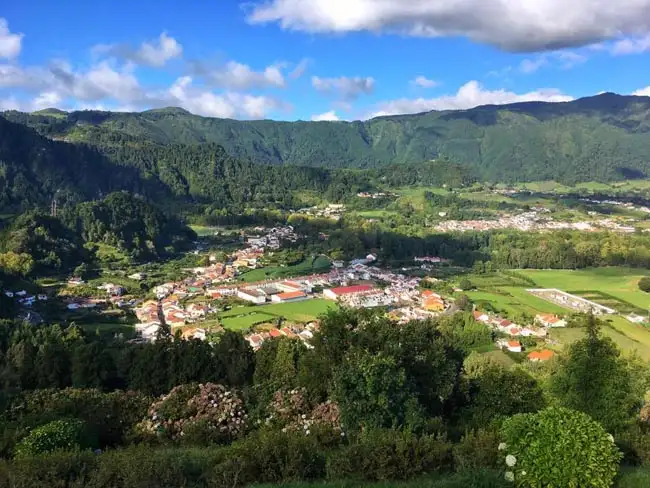
Furnas sits inside a large volcanic caldera, where hot springs and medicinal mud draw bathers. We spend time among its geysers and bubbling pools, and lunch is a cozido, cooked underground in the thermal vents.
At Pico dos Milhos, mist permitting, we look over the Furnas valley. We then climb to a panorama of Vila Franca do Campo, the island's former capital, and its lagoon, the crater of a submarine volcano about 5,000 years old. A stop in the historic centre follows.
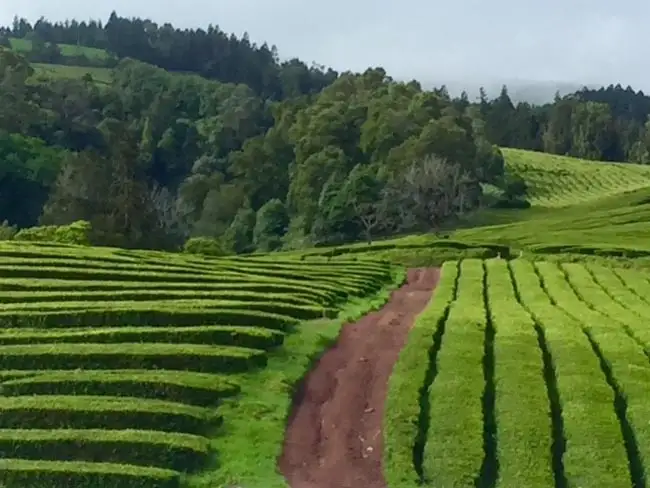
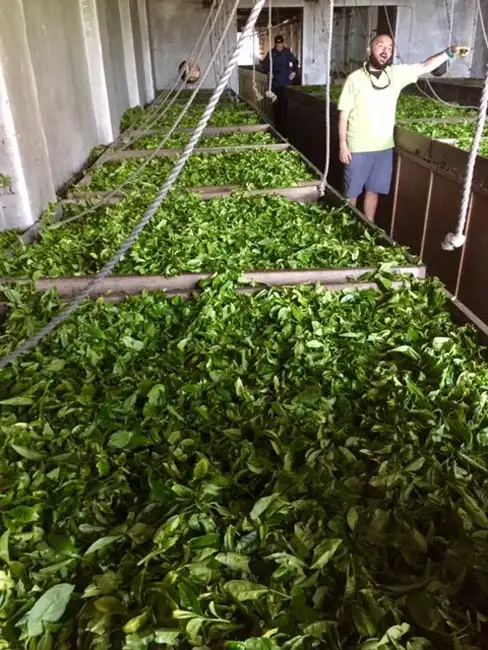
Crossing to the north coast, Miradouro de Santa Iria looks over the shore and, weather permitting, to Sete Cidades and Pico da Vara, the island's highest point at 1105 m/3,625 ft. The Gorreana plantation is one of the few tea estates in Europe.
We end in the northeast at Parque Natural da Ribeira dos Caldeiroes, with waterfalls and gardens, then Vista dos Barcos, where the Arnel lighthouse, built in 1876, is the oldest in the Azores. Ponta do Sossego is a garden lookout, and Pico Longo looks over Povoacao, first settled in 1432.
Overnight in Ponta Delgada.
Included Meal(s): Breakfast and Lunch - Day 7:Ponta Delgada, Azores - Fly to Madeira IslandEarly this morning we transfer to the airport to fly to the island of Madeira, also part of Portugal.
With a subtropical climate warmed by the Gulf Stream, this volcanic outcrop off the coast of Africa is Portugal’s own floating garden. The richvolcanic soil promotes an astonishingly verdant array of flowers, plants, and trees, both in the wild and in some beautifully-cultivated gardens. Here we discover a lush and vertical landscape with a wild terraced terrain. This 36 mile by 14 mile island (70% is national park) packs more into its chaotic terrain than most areas 5 times its size.
Funchal, the capital of the Madeira archipelago, was declared a city in the 1500s and became an important point between the old and new worlds. The laid-back city owes much of its historical prominence to the white gold, the Madeiran sugar.
Today we will tour the city of Funchal, including the 'Old Town', one of the most attractive areas of the city. Portuguese settlers colonized the coast in the early 1400's, and over the years the population grew as international trade attracted the attention of much of Europe. Today we discover a modern city with over 110,000 inhabitants. Located right in the center of Funchal is a busy and colourful covered market (Mercado dos Lavradores). Here we discover a great variety of fresh fish, tropical fruits, spices, colourful flowers and some local crafts. This is also the place to find local delicacies such as Madeira wine or honey cake.
The narrow and cobbled Rua de Santa Maria is the oldest street in Funchal, dating back to the 15th century. When the heavy storms of 2010 severely damaged the old town, the municipality launched the project ‘Art Open Doors’ in order to revitalize the area. They invited local artists to paint the doors in the street and the result is a vibrant, colourful, artistic street, full of energy. For the best view of Funchal we will take the cable car (Teleferico do Funchal) to the Monte Village. The 15-minute journey takes us 560 meters above the city, with a 360º panoramic view of Funchal, the dramatic mountain landscape, and the shimmering Atlantic Ocean. Nearby is the Madeira Story Centre, an excellent museum that charts the history and culture of the Madeira archipelago.
Monte Village was built in 1565 as a summer refuge for Funchal’s aristocracy. Constructed in 1741, the Church of Our Lady of the Monte is the resting place of Charles I, the last ruler of the Austro-Hungarian Empire. Those who climb to the bell tower terrace are rewarded with a spectacular view.
Overnight in Funchal.
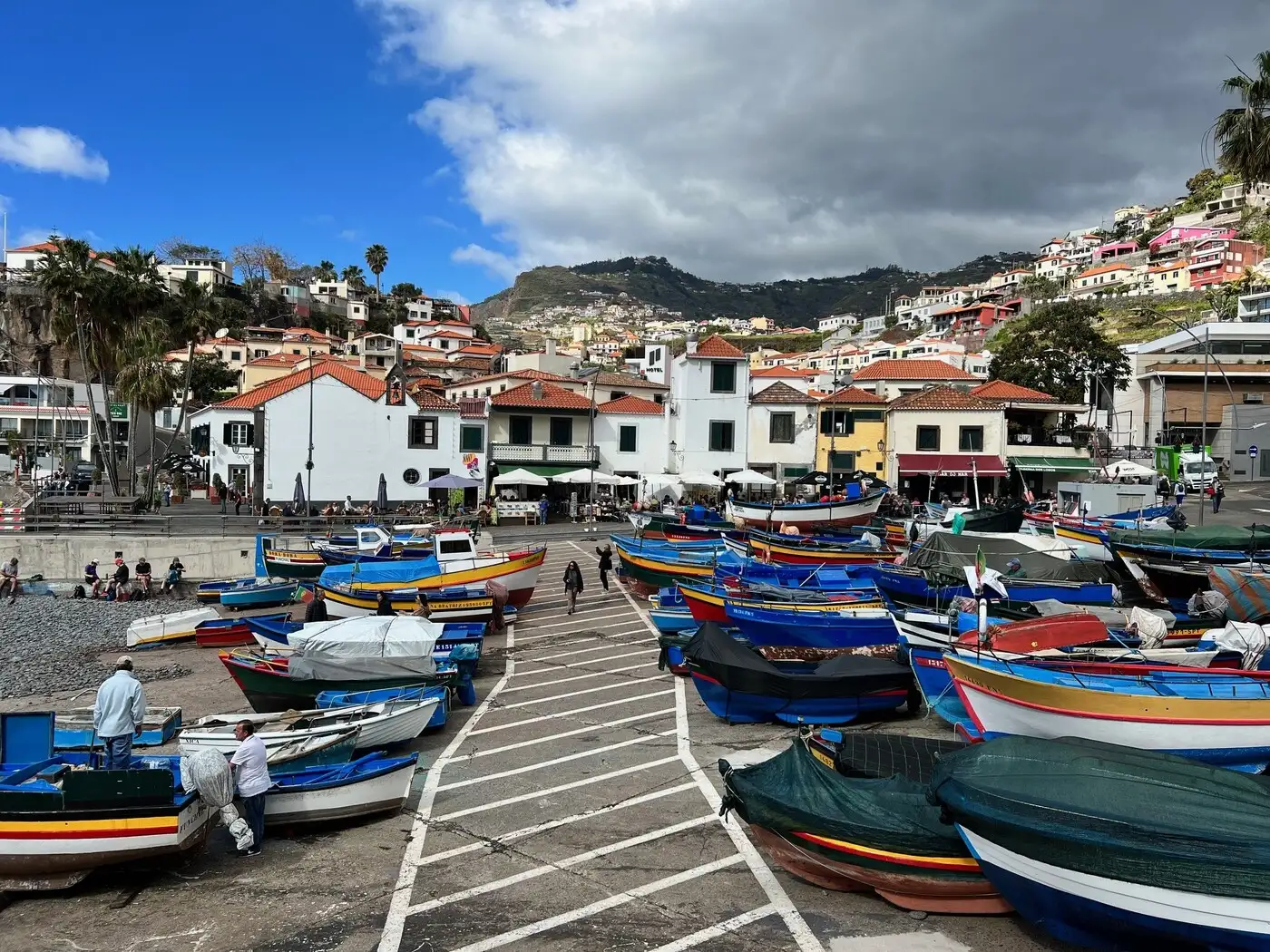
Included Meal(s): Breakfast and Dinner - Day 8:Madeira: West Island TouringToday we explore the west, crossing mountain passes and traversing Madeira's highest plateau. Prepare for some spectacular panoramas! We first pass through the traditional fishing village of Camara de Lobos, and make a stop at the Pico da Torre viewpoint. Here the port is really just a small creek, with a beach, a harbour and houses heaped up around the bay. We will continue up to the lofty sea cliffs of Cabo Girao, the highest sea cliffs in Europe (580m) / the second highest sea cliffs in the world. From here you can enjoy some beautiful views.
A glass bottomed skywalk hangs out over the top of the cliff! Sea erosion has led to the formation of caves and terraces along the coastline, and the local population have created small plots for crops, forming an incredible watercolour landscape.
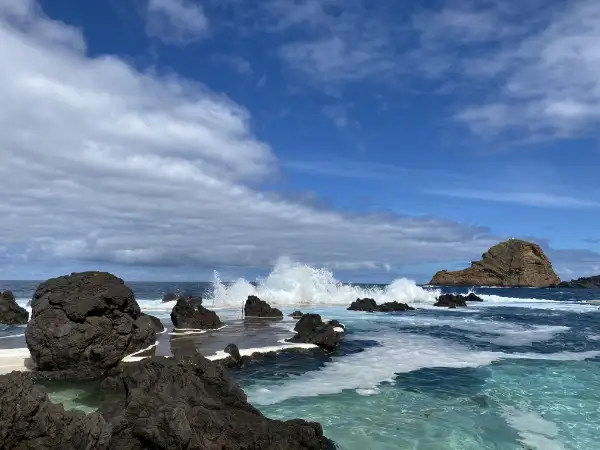
In Ribeira Brava we will see the 16th century mother church. Along the promenade we will pass by the town’s landmark, the fort of São Bento. We then visit what many consider to be the most beautiful village on the island, Ponta do Sol (point of the sun). The town, with its old restored buildings, was once described as a 'quiet and pretty little village shoe-horned into the folds of a steep valley'. We continue to make our way up through the Laurissilva forest, and reach the plateau of Paul da Serra, which translated roughly is "mountain plain". This is Madeira’s biggest and highest plateau, situated at 1400m (4,593 ft), and here we can enjoy another 'Levada walk'. Our next stop is the village of Porto Moniz on the north coast, which is famous for its natural volcanic rock pools. This is Madeira's most north-western valley, and the dramatic village is situated at the foot of the mountain.
Our next stop is at the picturesque village of Seixal where local vegetable gardens and vineyards are surrounded by heather broom. We will see the famous "Brides Vale" falls which plummets directly into the sea. Our scenic coastal route then brings us to the charming fishing village of São Vicente.
Overnight in Funchal.
Included Meal(s): Breakfast and Dinner - Day 9:East Madeira ExplorationToday we explore the eastern side of the island with its dramatic mountain, forest and coastal views. Just a short distance from the capital is the cultural village of Camacha, known as ‘the village of basket makers’, and the centre of Madeira's willow craft industry.
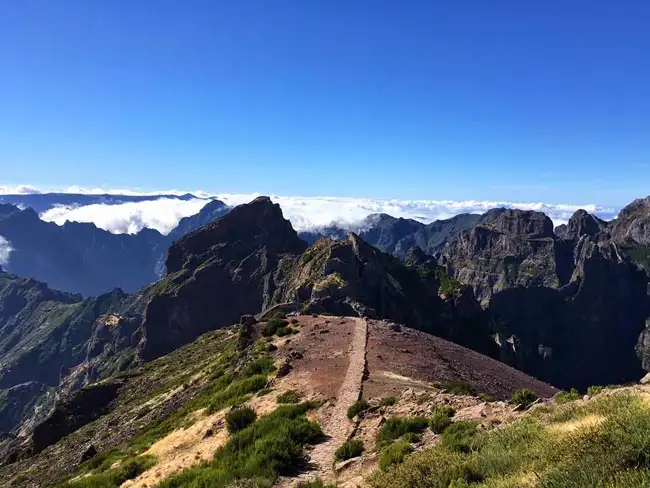
Our journey then takes us up to Pico do Arieiro (1818 meters/5,965 ft), one of the island's highest peaks with spectacular views. After visiting the highest (drivable) peak in Madeira, we will head towards Ribeiro Frio, a popular starting point for 'levada' walks. Madeira was once completely covered by laurel 'Laurissilva' forest, a relic from prehistoric times. Laurel forest, also called laurisilva or laurissilva, is a type of subtropical forest found in areas with high humidity and relatively stable, mild temperatures. This region still has much of its original vegetation, and here we will enjoy an easy walk. As UNESCO put it... "an outstanding relict of a previously widespread laurel forest type. It is the largest surviving area of laurel forest and is believed to be 90% primary forest.". This is one of the best places to really appreciate Madeira's natural heritage.
We then visit Santana, which is famous for its typical A-framed cottages with thatched roofs. We then make our way to Porto da Cruz, Caniçal, and Ponta de São Lourenço - with some of the best views you can get on the island. From here you can see both coasts as well as Porto Santo and the Desertas Islands. We also stop in Curral das Freiras ('Nuns Valley'), a small village nestled between almost perpendicular mountains in the heart of the island.
Overnight in Funchal.
Included Meal(s): Breakfast and Dinner - Day 10:Madeira, Portugal - Fly to Tenerife, SpainToday we fly from Madeira to Tenerife (North) in the Canary Islands.
The Canary Islands (Islas Canarias), also known as the Canaries (Canarias), are an archipelago and autonomous community of Spain located 100 kilometres (62 miles) west of Morocco. The Canaries are among the outermost regions of the European Union proper; it is also one of the eight regions with special consideration of historical nationality recognized as such by the Spanish Government. The Canary Islands are the most southerly region of Spain and the largest and most populated archipelago of the Macaronesia region.
We land on the largest island and begin (flight time-permitting) a sightseeing program in Santa Cruz de Tenerife, a city and capital (jointly with Las Palmas) of the Canary Islands. This good looking and wholly Spanish city is home to evocative, brightly-painted buildings, sophisticated and quirky shops, excellent museums, and a tropical oasis of birdsong, fountains, and greenery in the city park. Our last stop will be the small town of Cristobal de la Laguna (likely a quick stop only), widely considered to be the most beautiful in Tenerife. The historic town centre is a gem, with narrow poker-straight streets flanked by pastel-hued historic mansions, inviting bars, and idiosyncratic small shops. Its layout provided the model for many colonial towns in the Americas and, in 1999, La Laguna was added to the Unesco list of World Heritage sites.
We’ll also visit the interior the impressive and unique Auditorio de Tenerife. A marvel of the architectural avant-garde, created by Santiago Calatrava, which has become the cultural, social, and symbolic engine for the Canary Islands.
We the head to the Palmetum, a 12-hectare botanical garden that specializes in palm trees and a project unique in the world. It has transformed a municipal rubbish dump into a recreational space for plant lovers, bursting with spectacular plant life brought here through partnerships with institutions from all over the world. The gardens are home to the greatest collection of palms in Europe, thought to be the largest botanical collection of tropical island palms in the world.
Overnight in Santa Cruz de Tenerife.
Included Meal(s): Breakfast and Dinner - Day 11:Santa Cruz de Tenerife: City TouringToday we’ll have a city tour of Santa Cruz de Tenerife.
Santa Cruz de Tenerife is a beautiful port situated on Tenerife, the largest of the western islands in the Canary archipelago. Around its important port are wide avenues, squares and exotic landscaped areas, and some beautiful examples of modernist architecture. We start at the Museum of Nature and Man (MNH), located in the Old Civil Hospital, an emblematic building in the island's capital and a fine example of the islands' typical neoclassical architecture. The museum offers the chance to learn more about the natural riches of the Canary Islands, and also to discover the most important collection existing on the culture of the "guanches", a native people who inhabited the island of Tenerife before the arrival of the first European settlers.
We’ll walk to the parish mother church of Nuestra Señora de La Concepción, the main Catholic church in the city, built where a chapel used to stand that was erected by the conquerors of Santa Cruz. The tower was raised in 1786 and is one of the most easily recognizable landmarks in the old quarter. Because of the extension work carried out over the years, it is the only church with five naves on the entire archipelago and a fine example of Canarian Baroque architecture.
Overnight in Santa Cruz de Tenerife.
Included Meal(s): Breakfast and Dinner - Day 12:Tenerife Island TouringToday we take a panoramic route along Monte Esperanza towards the Teide National Park, including photo stops.*
Teide National Park, located in the centre of the island of Tenerife, is the largest and oldest of the four national parks on the Canary Islands. From its surface area of 190 km2 (18,990 hectares), Mount Teide rises up to a height of 3718 m, which makes it the highest peak in Spain. There are many services organized for visitors so that they can discover and enjoy this area: a convenient road network across the entire park, two visitor centres that reveal some of the park’s secrets, a bar and restaurant area for refreshment, and abundant vantage points to gain a panoramic view of the whole park. Our program today is informal and weather-dependent, but will concentrate on the unique flora, fauna, and landscape of this special place.
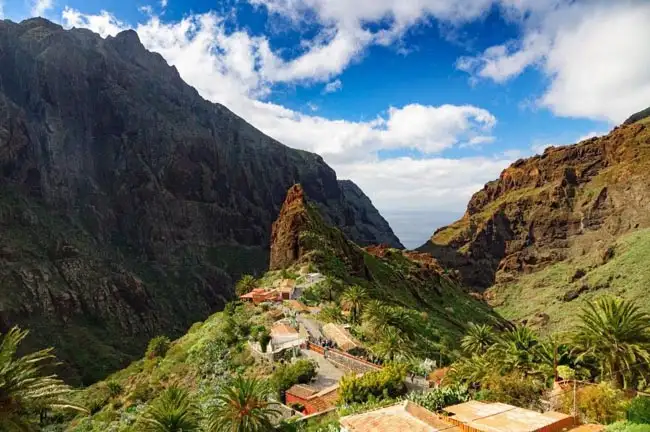
We continue to the spectacular Barranco de Masca with a brief stay in the picturesque village before returning to Santa Cruz de Tenerife.
* Please note that we do not include the cable car on our trip, as it is often closed due to weather and takes quite a chunk of time out of our day. Past travellers have also noted that time could be better spent down in the park, rather than removed far above it.
Overnight in Santa Cruz de Tenerife.
Included Meal(s): Breakfast and Dinner - Day 13:Tenerife & La Laguna - Ferry to Gran Canaria: Island TouringThis morning we board the ferry to Gran Canaria (approx 3 hours).
Crowning an island of tall cliffs to the north and extensive beaches to the south, Las Palmas de Gran Canaria is a city which offers sun, sea and an exceptional historic legacy. The combination of the aboriginal Guanche culture, its colonial past, and the fact that it is only 90 miles from the coast of Africa create a distinctive character resulting from the mix of Europe, America, and Africa.
We’ll head to the center of the Island: Tejeda is the home of the Nublo rock, the symbol of Gran Canary. The Tejeda depression arose from a volcanic crater, standing over which is a mountain crowned by several rocky promontories, such as the Nublo rock, an enormous chunk of basalt which is the symbol of Gran Canary, and the Bentayga rock, where you will find the Caves of the King, a sacred site in pre-Hispanic times which contains cave paintings. The landscape of the area features forests of Canary Islands pine and almond trees.
Then we’ll head to Artenara. Almost the entire municipality of Artenara forms part of the Tamadaba Nature Reserve. In this setting framed by the massifs of Altavista and Tamada stands the Tejeda Crater, the biggest volcanic basin on the island. Outstanding in the town is the hermitage of the Virgen de La Cuevita and the surrounding area, in which there are major archaeological sites. The inhabitants still make ceramics, which means the local handicrafts are another of the area's tourist attractions.
After a break for lunch, we'll visit Teror, an important centre of religion and pilgrimage. The faithful from the entire Canary Islands archipelago come to this place to worship the patron of the diocese, the Virgen del Pino. The festival in her honour is held every September with a traditional pilgrimage and popular dances. A tour of the historic quarter of the town lets you see religious buildings and ancestral homes which have sprung up around the sanctuary of the Virgin.
Overnight in Las Palmas.
Included Meal(s): Breakfast and Dinner - Day 14:DepartDeparture from Las Palmas.
BUEN VIAJE!
Included Meal(s): Breakfast
Countries Visited: Portugal and Spain
*The red tour trail on the map does not represent the actual travel path.
Book This Tour
- Final payment: Due 90 days prior to departure.
- Deposit: A non-refundable $1000 CAD Deposit is required at booking.
- Internal Flight Taxes: An extra $220 CAD applies for taxes and fees on tour flights. The internal airfares are included, but taxes are listed separately as they may change. Exceptions are noted in Red.
- Optional Single Supplement: $1930 CAD (number of singles limited).
(View options forsingle travellers) - $1000 deposit required; once the tour is 'guaranteed' we will require an additional $2000 to secure internal air. Once paid, your deposit and additional pre-payment becomes 100% non-refundable/non-transferable. Due to every-changing air schedules, our tour dates and final itinerary are TENTATIVE until we 'guarantee' the tour. The order of places visited and the number of days spent in each place may vary.
Prices below are per person, twin-sharing costs in Canadian Dollars (CAD). Pricing does not include airfare to/from the tour and any applicable taxes.
Frequently Asked Questions
- What is the maximum number of participants on a trip?Most of our tours carry a maximum of 18 participants; some tours (ie hiking tours) top out at 16. In the event that we do not achieve our minimum complement by our 90-day deadline, we may offer group members the option of paying a "small-group surcharge" as an alternative to cancellation. If all group members agree, we will confirm the trip at existing numbers; this surcharge is refundable in the event that we ultimately achieve our regular minimum. If the small group surcharge is not accepted, we will offer a refund of your deposit or a different trip of your choice.
- Can I extend my tour either at the beginning or end? What about stopovers?Yes, you can extend your tour either at the beginning or the end and we can book accommodation in our tour hotel. Stopovers are often permitted, depending on air routing. Stopovers usually carry a "stopover" fee levied by the airline.
- How do I make a reservation? How and when do I pay?The easiest way to make a reservation is via our website; during office hours, you are also more than welcome to contact us by telephone.
A non-refundable deposit is payable at the time of booking; if a reservation is made within 90 days, full payment is required. Some trips require a larger deposit. If international airline bookings require a non-refundable payment in order to secure space or the lowest available fare, we will require an increase in deposit equal to the cost of the ticket(s).
Early enrolment is always encouraged as group size is limited and some trips require greater preparation time.
Once we have received your deposit, we will confirm your space and send you a confirmation package containing your trip itinerary, any visa/travel permit related documents, invoice, clothing and equipment recommendations, general information on your destination(s), and forms for you to complete, sign and return to us. Your air e-tickets (if applicable), final hotel list, final trip itinerary, and instructions on how to join your tour, will be sent approximately 2-3 weeks prior to departure. - What about cancellations, refunds, and transfers?Please review our cancellation policy page for details.
- I am a single who prefers my own room. What is a single supplement?All of our tours have a single supplement for those who want to be guaranteed their own room at each location.
This supplement is a reflection of the fact that most hotels around the world do not discount the regular twin-share rate for a room by 50% for only one person occupying a room. Most hotels will give a break on the price, but usually in the range of 25-30% of the twin-share rate. This difference, multiplied by each night, amounts to the single supplement.
The conventional amount can also vary from country to country and some destinations are more expensive than others for single occupancy. In order to be "single friendly," the supplements we apply are not a profit centre for us and we do our best to keep them as reasonable as possible.
On most tours we limit the number of singles available, not to be punitive, but rather because many hotels allow for only a limited number of singles; some smaller hotels at remote locations also have a limited number of single rooms available.
Please note that most single rooms around the world are smaller than twin-share rooms and will likely have only one bed. - Do you have a shared accommodation program?Yes! If you are single traveller and are willing to share, we will do our best to pair you with a same-gender roommate. Please note that should we fail to pair you, we will absorb the single supplement fee and you will default to a single room at no extra charge.