In his latest blog post, Dale Dunlop, The Maritime Explorer, shares a few unexpected delights he encountered during a road trip to Erfoud - Into the Sahara Desert. If you are interested in what Adventures Abroad has to offer, please check out our Small Group Tours to Morocco.
This is my seventh post from the October 2025 Quintessential Tour of Morocco by Canadian tour company Adventures Abroad. In the first six, our group of 17 spent our time exploring three of the four Imperial cities of Morocco, all of which are located in the northwest corner of the country. In this post, we will switch gears completely and head southwest almost to the Algerian border, where we will spend the next few days exploring that portion of the Sahara Desert that makes up most of southern Morocco. Our initial destination is the small city of Erfoud, from where we will visit the ancient caravan town of Rissani. There will be some interesting stops along the way, so hop on the bus and join the group.
Here is a map of Morocco. You can see that for the first part of the tour, we have been concentrated into a relatively small area stretching from Casablanca to Fes, a distance of less than 300 km (185 miles). Today we will drive from Fes to Erfoud, which you can see in the southeast of the map near the Algerian border, a distance of 408 km (253 miles). We will stop first in Ifrane, just south of Fes, then at Cèdre Gouraud Forest to mingle for a while with the Barbary macaques that are native to the forest. About halfway between Fes and Erfoud, we will stop for an al fresco lunch in an apple orchard. Then at the end of the day, we'll check in at the first of three kasbah hotels that we will stay at during our time in the Sahara region.
Take another look at the map and note the green areas that represent forests. It's not much. In fact, almost 80% of the land in Morocco is considered desert or semi-arid. However, just south of Fes, the highway climbs to over 1,665 metres (5,463 feet) into the Middle Atlas mountains, which are home to beautiful cedar forests that are unlike anything we have yet seen on this trip. Here we stop at the resort town of Ifrane for a refreshment break. Built in the 1920s by the French as both a summer and winter retreat, it looks far more like a town in the French Alps than anything else in Morocco. It is actually a ski resort and the king has a winter palace in Ifrane where he indulges in apparently one of his favourite pastimes. Who knew, a skiing Moroccan king?
If someone showed you this photo and asked you what country it was taken in, Morocco would be about the last place you would guess.

Or this.

The most interesting thing in Ifrane is this creature, the Lion of Ifrane, which first appeared on the scene in the 1930s, but nobody knows who actually sculpted it. Lonely Planet wrongly attributes it to a WWII prisoner of war, but there are photos of it that predate the war, which makes you wonder about how accurate that publication is in other aspects.

The really sad thing is that lions once roamed the mountains of Morocco, with the last one being shot in the 1920's.
Continuing on our way to Erfoud, we soon enter the Cèdre Gouraud Forest, which is home to a small population of Barbary macaques, aka Barbary apes. I first encountered them in Gibraltar years ago, but the Atlas Mountains are their natural home. There are estimated to be less than 9,000 of them left in Morocco, with habitat loss and kidnapping of young ones for the pet trade, putting their future at risk. We will see them being used as tourist props later on this trip.
Our driver Hassan knows exactly where to find them, and we pull over to observe, but not feed, a small troop headed up by this alpha male.

The Barbary macaques are quite unique in that they are alloparental, which means that both the males and females collectively look after all the young in the group, instead of each parent looking after only its own offspring. In other words, they are one big happy family.
Insects are one staple in their diet, and this youngster has found an easy way to find them – pick them off the bumpers of the parked vehicles.

After about 15 minutes, we get back on the bus and continue southeast on highway N13 towards Erfoud, soon leaving behind the cedar forest and entering a much drier environment with few trees. The landscape is very stark and monochromatic with everything a variation of rust. There is little wildlife other than the occasional herd of sheep or goats, all of which have someone tending them, even miles away from the nearest sign of human habitation or drinking water. Being a shepherd is still a real profession in this part of the world.
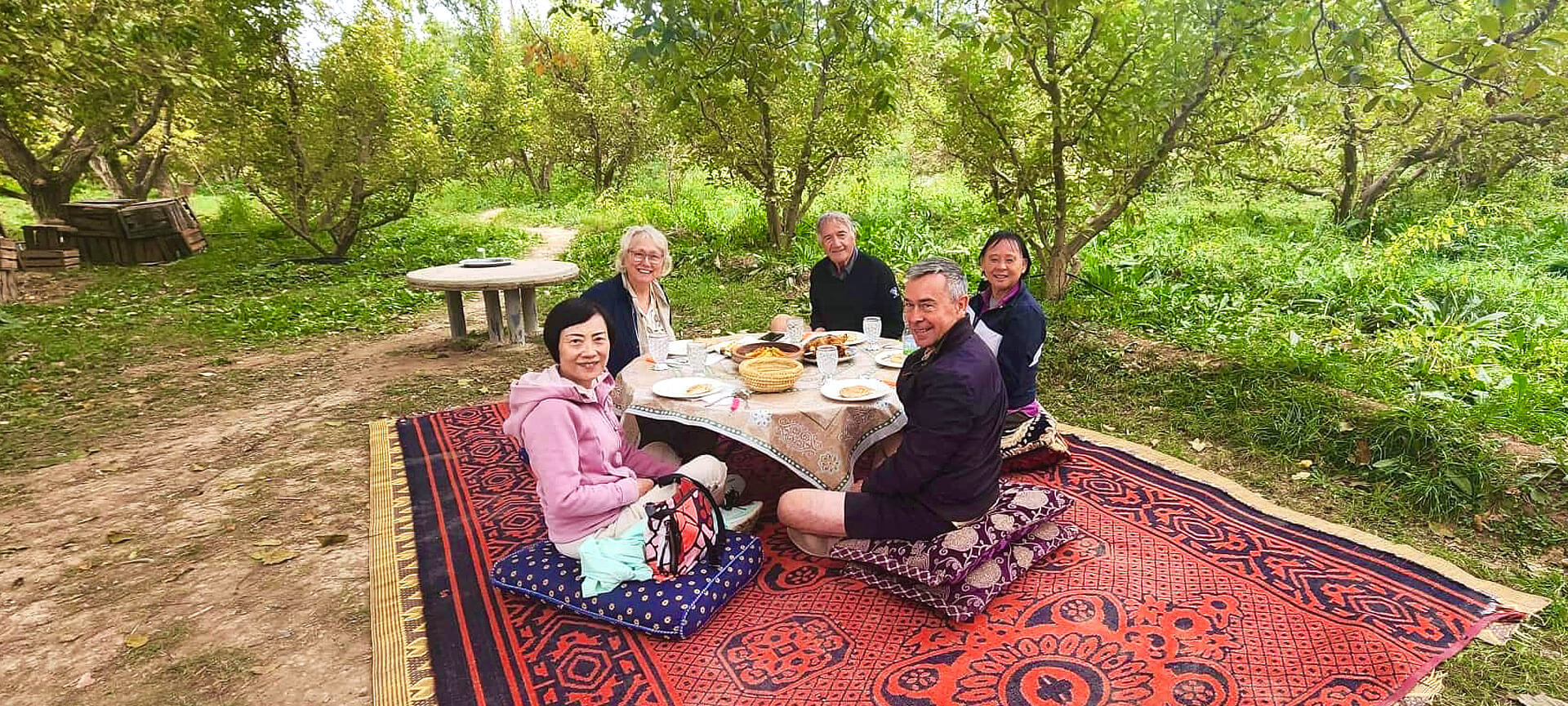
After about two hours, Hassan pulls off onto a side road, and we are soon parked in a farmyard where we are greeted by the owner and shown into an apple orchard where we are seated for lunch. After miles and miles of nothing but barren rock, this is a pleasant and unexpected surprise. You can see from what we are wearing that this is still at a fairly high elevation, requiring sweaters. It's hard to believe that we are actually on the edge of the Sahara Desert.

There is quite the feast laid out for us, but before indulging, each of us engages in the traditional pre-meal ablution.

This is our Moroccan al fresco lunch. I took the picture prematurely because there was a huge plate of roast lamb yet to come.

Continuing our journey to Erfoud, we had a few stops for photo opportunities, but I think this video I took from the front of the bus gives a better idea of what the landscape looked like. Watch until the end, and you'll see that I have to put the camera down as we come to one of the ubiquitous police checkpoints you find on Moroccan highways. The last thing you want to do is to get caught filming anything to do with the police or military. The closer we got to the Algerian border, the more checkpoints there were.
Oh, and yes, it was drizzling. I kept up my unerring ability to bring rain to some of the driest spots on earth.
Not long after this, we got our first look at a genuine Saharan desert oasis. Literally thousands of date palms turn the valley of this underground river into an explosion of green. It's unlike anything I have ever seen. Nothing in my travels to the Atacama, Sonoran, Chihuahuan, Mojave or Cappadocian deserts looked like this. There is a place in California called Twenty-Nine Palms, which represents the extent of an oasis in the Mojave Desert. This place is more like 29,000 palms.

Finally, we rumbled into the small city of Erfoud, which has a look completely different than those in the north of Morocco. This is the Morocco of the French Foreign Legion, with the classic red mud plastered buildings that add an air of romance and mystery to the place.
The Kasbah Hotel Xaluca perfectly embodied this with its grand entrance and huge rooms. The term 'oasis' is wildly overused in reference to hotels that are nowhere near a true oasis, but this place really was an oasis.

And I was very pleased to see that our three days of dry meals in Fes were now supplanted with an excellent wine list in Erfoud.
This, which was really mostly a travel day, turned out to have more than enough highlights to write about. In the next post, we'll explore this area of Morocco and end the day with a camel ride. It should be a blast.
View all