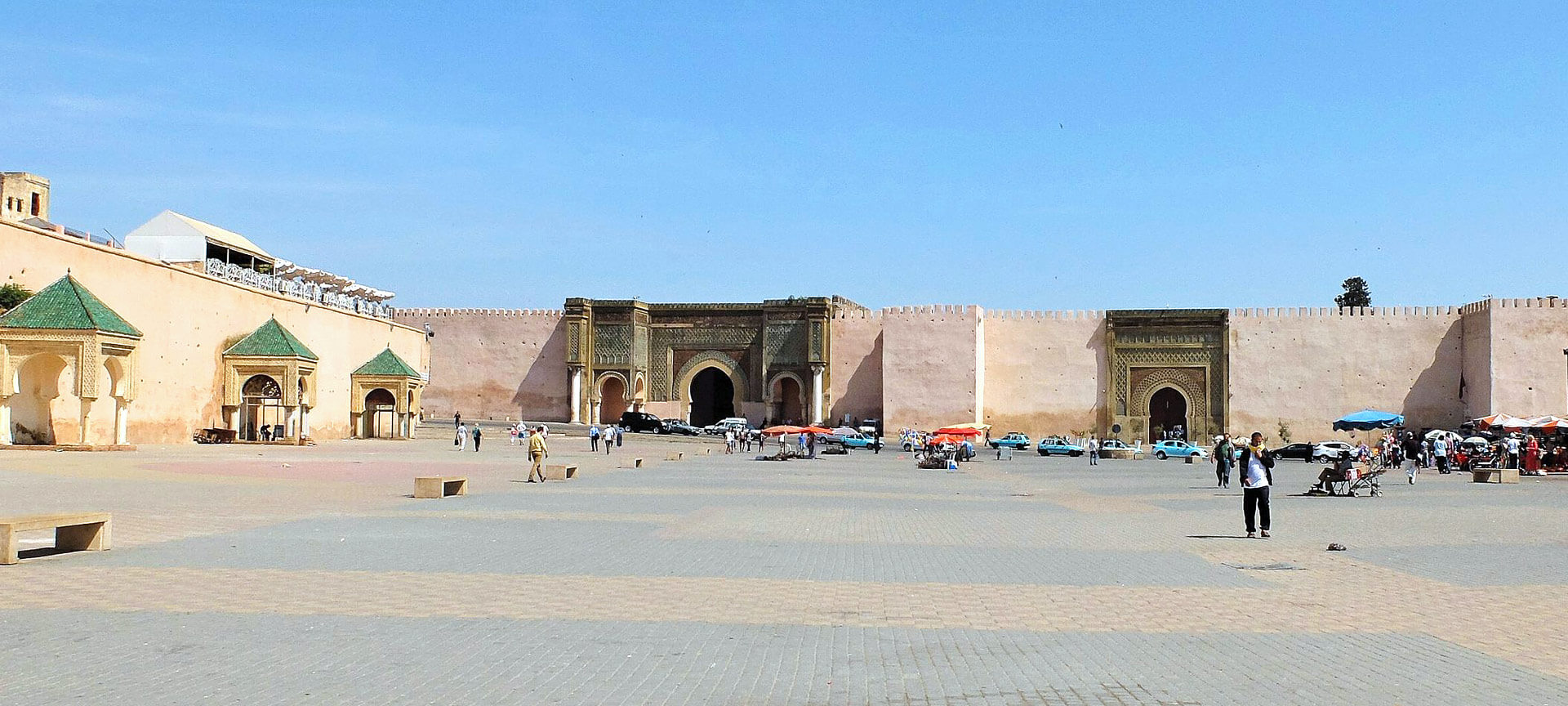
In his latest blog post, Dale Dunlop, The Maritime Explorer, next stop takes in one of Morocco's four imperial cities and a UNESCO World Heritage Site, Meknes - Morocco’s Overlooked Imperial City. If you are interested in what Adventures Abroad has to offer, please check out our Small Group Tours to Morocco.
Morocco is an unusual country in that it has had four different capital cities over the course of its history. We've already visited the current capital Rabat on this Adventures Abroad Quintessential Tour of Morocco and found it to be a very quiet, green and clean contrast to the hustle and bustle of Casablanca. In the last post, we visited what could arguably be called the first capital of Morocco, Volubilis, where Moulay Idriss, the man who brought Islam to Morocco, first settled until his assassination there in 791. After his death, his son Idriss II moved the capital to Fes, where it remained until 1672, when it was moved to Meknes for 63 years under the reign of one man, Sultan Moulay Ismail, the longest reigning monarch in Moroccan history and depending on your viewpoint, one of the country's most famous or infamous characters. Please join our group as we make a brief visit to this often overlooked Imperial city.
Before arriving in Meknes from Volubilis, we passed through the small city of Moulay Idriss Zerhoun, where the man who brought Islam to Morocco is entombed in a mausoleum. It is considered the holiest site in Morocco. Although we didn't stop to see the mausoleum, we did get this view of the city.

History of Meknes
Meknes owes its name and origins to a Berber tribe known as the Miknasa, who moved into the area not far from the ancient and decaying city of Volubilis in the 10th century and built a series of fortified settlements. In the 11th century, the Almoravids invaded the area and built a fortress that became the beginning of the city, first called Tagrart, which later became Meknes. As I outlined in my introductory post on Morocco, the history of the country is one of one dynasty taking control for a few centuries only to eventually be overthrown by a successor dynasty right up until the Alaouites, from whom the current King Mohammed VI traces his ancestry. Meknes is a perfect example of waxing and waning fortunes depending on whatever dynasty happened to be in control.
Thus, in the 12th century, along came the Almohads who attacked the city, took it after a long siege and destroyed most of it, only to try to rebuild what they had just wrecked. There was a brief period of prosperity until the next group, the Marinids, invaded in 1244 and stayed in control for several hundred years until they were supplanted by their former allies, the Wattasids in 1472, who in turn were ousted by the Saadians in 1510. While the city had grown under the previous three dynasties, the Saadians were more interested in Marrakech than the northern cities of Meknes and Fes, and they both began to decline in importance until, you guessed it, the Saadians were given the boot by the Alaouites in the mid 17th century. Sultan Moulay Rashid restored Fes as the capital, and his brother Moulay Ismail was appointed governor of Meknes. When Rashid died in 1672, Ismail succeeded him and, having grown fond of Meknes, made it his capital for the 55 years he reigned.
This was the golden age of Meknes, with Ismail undertaking massive construction projects that included the citadel and palace, as well as the 40 km (25 miles) of massive walls and ramparts with nine monumental gates that surround the old city to this day. Ismail was the personification of everything that European Christians feared and loathed about their North African neighbours. He was the one who made Rabat into the corsair haven from whence thousands of Christians were captured, enslaved and usually killed after being forced to work on his grandiose projects. He had an army of black slaves known as the Black Guard, who were the equivalent of the Roman Praetorian Guard, fiercely loyal and a powerful political force in their own right. He had a harem of over 500 women and fathered over 800 children, so there's a good chance you're related to him.
Not surprisingly, with over 450 sons, all hell broke loose after Ismail's death as they struggled for control, and Meknes kind of fell by the wayside. The capital was moved back to Fes, and Meknes once again began a period of decline, exacerbated by the Great Earthquake of Lisbon in 1755. When the French arrived, they built a new city outside the walls and, of all thing,s made Meknes the centre of wine production in Morocco. Despite being a Muslim country, Meknes continues to produce excellent local wines to this day. Trust me, if you can find a Moroccan chenin blanc, go for it.
In 1996, Meknes was inscribed as a UNESCO World Heritage Site with this criterion:
Meknès is distinctive by the monumental and voluminous aspect of its ramparts reaching 15 metres in height. It is considered as an exemplary testimony of the fortified towns of the Maghreb. It is a property representing a remarkably complete urban and architectural structure of a North African capital of the 17th century, harmoniously combining Islamic and European conceptual and planning elements. Endowed with a princely urbanism, the Historic City of Meknes also illustrates the specificities of earthen architecture (cobwork) of sub-Saharan towns of the Maghreb.
It's the third World Heritage Site so far on this visit, so let's go check it out. However, a small disclaimer – since the big deal about Meknes is basically its walls and gates, that's what I mostly have pictures of.
Our local guide in Meknes is Atimah, the only female guide we had on the trip and by far the most open about some of the problems facing Morocco today.


This is the Bab el-Khemis or Thursday Gate, so named for the market that still takes place inside every Thursday. It also marks the entrance to the former Jewish Quarter or mellah, as they are known in Morocco. On our tours of Meknes, Fes and Marrakech, we were all shown the mellahs as important historical places, which I found a bit ironic as next to no Jews live there anymore. In 1936, there were over 10,000 Jews in Meknes. Today, there are less than 250.
Aside from the city gates leading into the old city, there are a lot more that lead into the kasbah or royal palace, of which Bab Mansur is the most famous. That's it on the left in this public domain photo I used as the header to this post. Behind it is the Great Mosque of Meknes, which non-Muslims are not permitted to enter.

Some of these Meknes gates are truly works of art, like this one. Note the design of the hinges at the bottom. Doorways were considered not only places of entrance and egress for humans and their animals, but also entry points for evil spirits. These types of hinges were specifically designed to keep them out.

This is a close-up of the opening mechanism. What's interesting is that it is on the outside rather than inside, as you might expect.

Here is a smaller doorway in classic Islamic style.

And while we were not permitted to go inside an active mosque, we were allowed to take photos looking in. This is the mihrab, which indicates the direction of Mecca in every mosque. Note the marble columns on each side with Corinthian capitals. Remnants of Volubilis, maybe?

One thing I have always liked about travelling with Adventures Abroad is that they do not take you to rip-off tourist joints hoping you'll buy something for which they will get a kickback. However, they will take you to genuine artists' workshops and stores if you ask. Meknes is known for a number of specialty handicrafts, including damascene metalwork, marquetry, ceramics and textiles. At the conclusion of our short walking tour of Meknes, Atimah asked if we were interested in visiting a co-op where these types of handicrafts were available, at prices to be bargained for. Pretty well, everyone in the group was interested, including Alison. I decided to walk around a bit and not interfere with the bargaining process, at which she is pretty good.
The first thing I noticed was the number of storks in the old city. I forgot to photograph them in the King's palace grounds in Rabat, but not today.

I also got the obligatory cute cat photo.

When I returned, Alison had indeed acquired her signature souvenir of the trip, a damascene dove which now joins many other beautiful pieces from our twenty or so trips with Adventures Abroad.

In the next post, we'll move on to the fabled city of Fes, where we will have our first stay in a riad.
View all