- Off The Beaten Path
- Classic
- History
- Overview
- Info & Inclusions
- Itinerary
- Map & Hotels
- Photos
- Dates & Prices
- Tour Duration: 14 Days
- Max Group Size 16
- Standing before the Tang Dynasty Three Pagodas of Dali
- Walking the ancient pilgrimage circuit of Barkhor Street in Lhasa
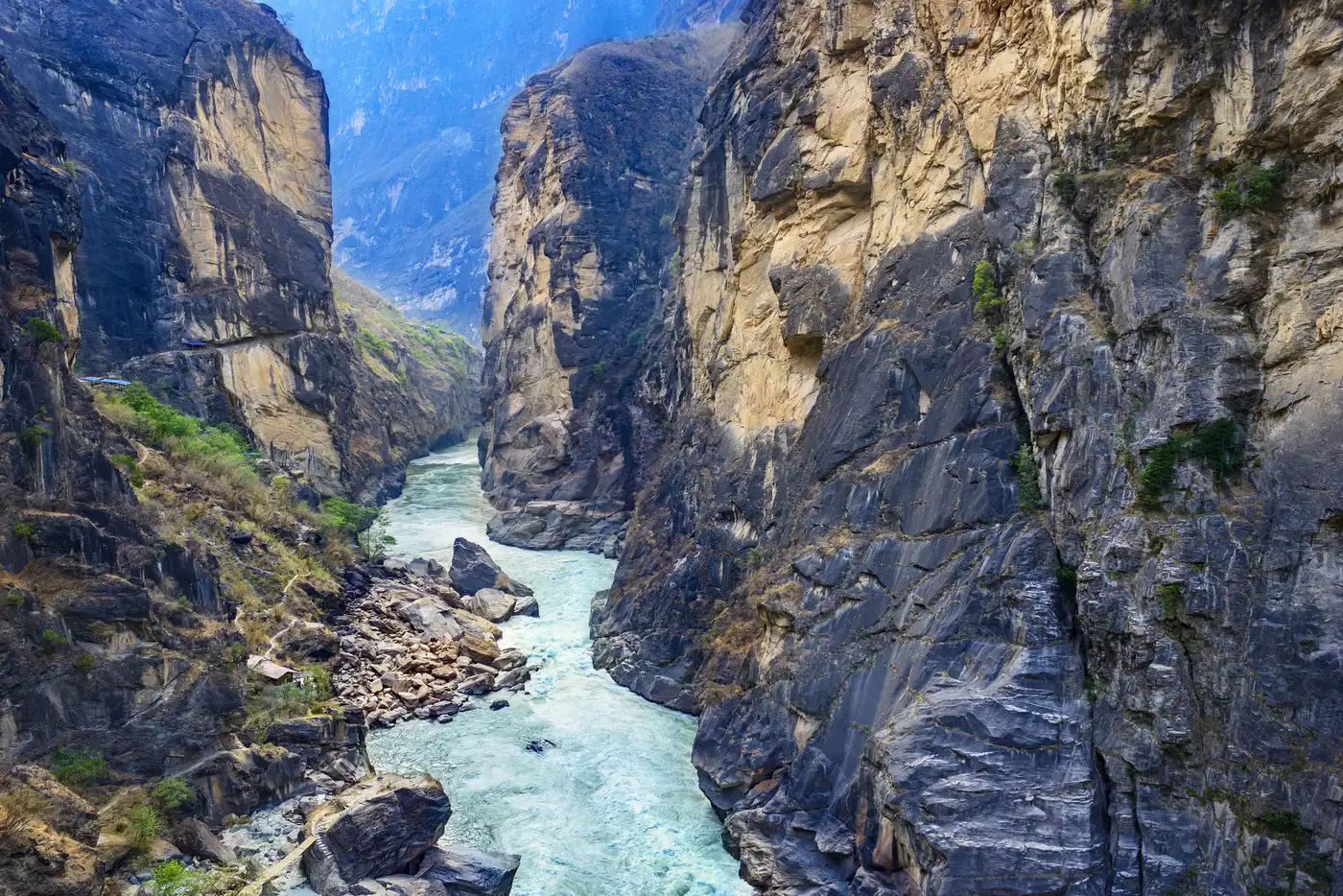
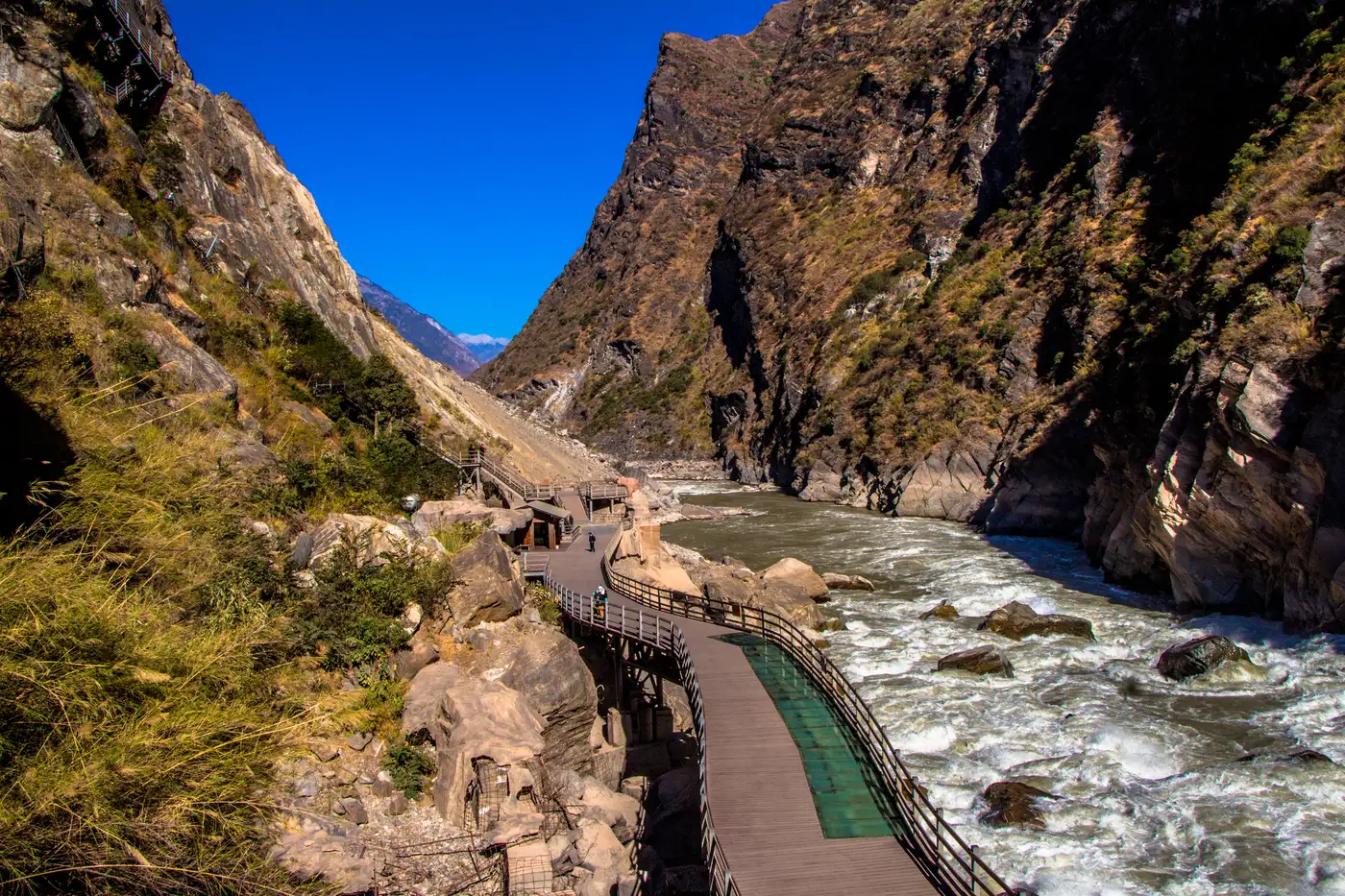
- Descending into Tiger Leaping Gorge — one of the world's deepest canyons
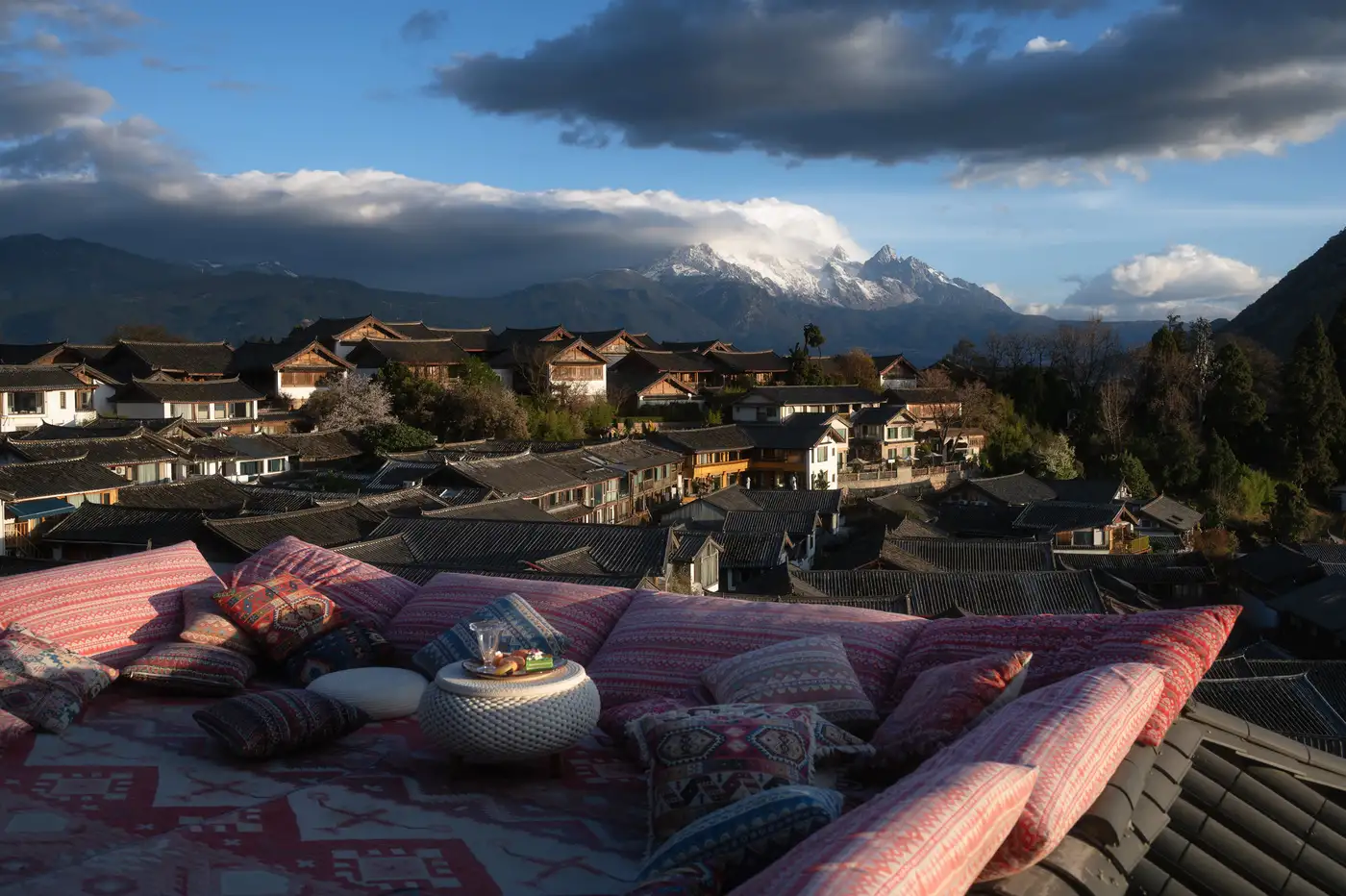
- Exploring the whitewashed lanes and murals of the oldest Naxi settlement at the foot of Jade Dragon Snow Mountain
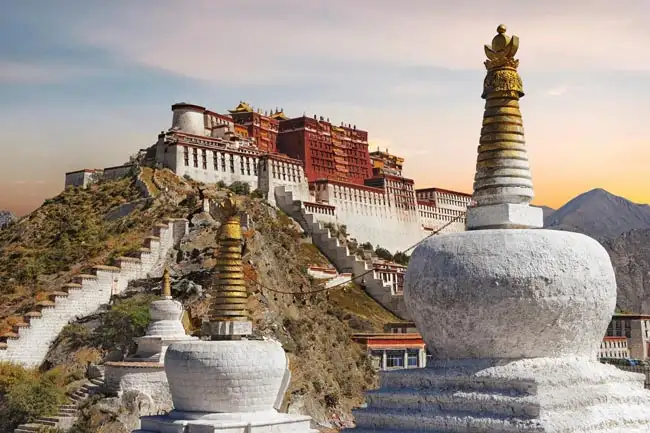
- Standing before the Potala Palace, seat of the Dalai Lamas for three centuries
- Visiting Yungdrung Ling, one of Tibet's great Bon monasteries
- Singles friendly (view options for single travellers)
We begin in Kunming — the City of Eternal Spring, sitting at 1900m/6,234 ft on the edge of Southeast Asia — and travels without doubling back through two weeks of deepening altitude, deepening remoteness, and deepening culture. By the time Lhasa appears, we have earned it.
The route follows the ancient Tea-Horse Road through Yunnan's minority heartland: Bai culture in Dali, Naxi in Lijiang, proto-Tibetan in Shangri-La. Each stop is distinct, each one a step further from the familiar. Tiger Leaping Gorge marks the halfway point with appropriate drama — one of the world's deepest canyons, the Jinsha River thundering below peaks that top 5000 m/16,404 ft.
Shangri-La is where the myth dissolves into something better. James Hilton invented his hidden paradise with this region in mind.
Then the flight to Lhasa, where the air is thin and the light is extraordinary. But we arrive not as altitude tourists dropped in from sea level, but as travellers who have spent a week climbing here. The Potala, the Jokhang, the sacred circuit of Barkhor Street — all of it lands differently when you have travelled to it rather than simply arrived.
- 13 nights accommodation at 4-star hotels
- Daily breakfast and dinner throughout
- Tour Leader services plus English-speaking local guides
- Private air-conditioned vehicle for all transfers and excursions as per itinerary
- Gratuities for local guides, drivers, hotel staff, hotel porters if available
- All entrance fees for sites listed in the itinerary
- Internal flight Shangri-La to Lhasa, airport transfers for 'Land & Air' participants
- International airfare to Kunming and from Lhasa
- Lunches, alcoholic and bottled beverages
- Tour Leader gratuities
- Optional activities not listed in the itinerary
- Airport transfers for "Land-only" participants
- Trip cancellation insurance
- Please refer to pre-departure notes for further guidance on personal expenses and optional activities
- Seasonality and Weather:
We operate in October, which represents the optimal window for both Yunnan and Tibet. The summer monsoon has cleared by late September, leaving skies across the region at their clearest and most stable. Temperatures are comfortable at lower elevations and brisk but manageable on the Tibetan Plateau.
Yunnan's minority villages and old towns are at their most photogenic in autumn, with harvest colours in the terraced fields around Lijiang and in Potatso National Park. Tibet's high plateau is dry and clear throughout October, with exceptional visibility toward the Himalayan peaks. - Transport and Travel Conditions:
Ground transport throughout Yunnan is by private air-conditioned coach. The single internal flight — Shangri-La to Lhasa — takes approximately two hours, after which ground transport in Tibet continues by private vehicle for all excursions.
Altitude is the most important physical consideration on this tour. Kunming sits at 1900 m/6,234 ft; Lhasa at 3650 m/11,975 ft; Potatso National Park reaches 4159 m/13,645 ft. The itinerary ascends gradually through Yunnan over seven days before the flight to Lhasa — a significant advantage over tours that fly guests directly to Tibet from sea level. Altitude affects people differently regardless of fitness, and guests are required to complete a self-assessment form prior to travel.
Walking surfaces vary — cobblestone lanes, stone staircases at monastery sites, uneven terrain at glacier and lake viewpoints. No day involves strenuous hiking. This is a cultural journey at altitude — rewarding, unhurried, and well within reach of active travellers in good health.
Am I suitable for this tour? Please refer to our self-assessment form - Activity Level: 2
These are particularly busy tours that feature a lot of moving around, sometimes by train and short journeys on local transport. Walking tours of towns and cities are leisurely but you should be prepared to be on your feet for several hours. Some of our cultural trips that occur at high altitude and/or require greater independence with baggage handling (at hotels, airports, train stations) also fall into this category.
To learn more about the Activity levels, please visit our tour styles page. - Accommodation:
Accommodation throughout is at 4-star hotels, combining comfortable facilities with locations that place guests close to the historic centres of each city. Properties have been selected for quality, reliability, and their fit with the character of each destination. More information available via the Map & Hotels tab. - Staff and Support:
Full-time Tour Leader plus local guide support at various locations. - Group Size:
Group size is capped at 16 guests, reflecting both the operational realities of regional travel and the experiential character of the tour.
- Day 1:Arrival in Kunming, ChinaYunnan's capital receives us gently. Known as the City of Eternal Spring for its mild climate and year-round bloom, Kunming sits at 1900m/6,530 ft on the southeastern edge of the Tibetan Plateau — though nothing here yet suggests what lies ahead.
Tonight is for arrival, orientation, and the particular pleasure of a first evening in a city that is entirely new.
Overnight in Kunming.
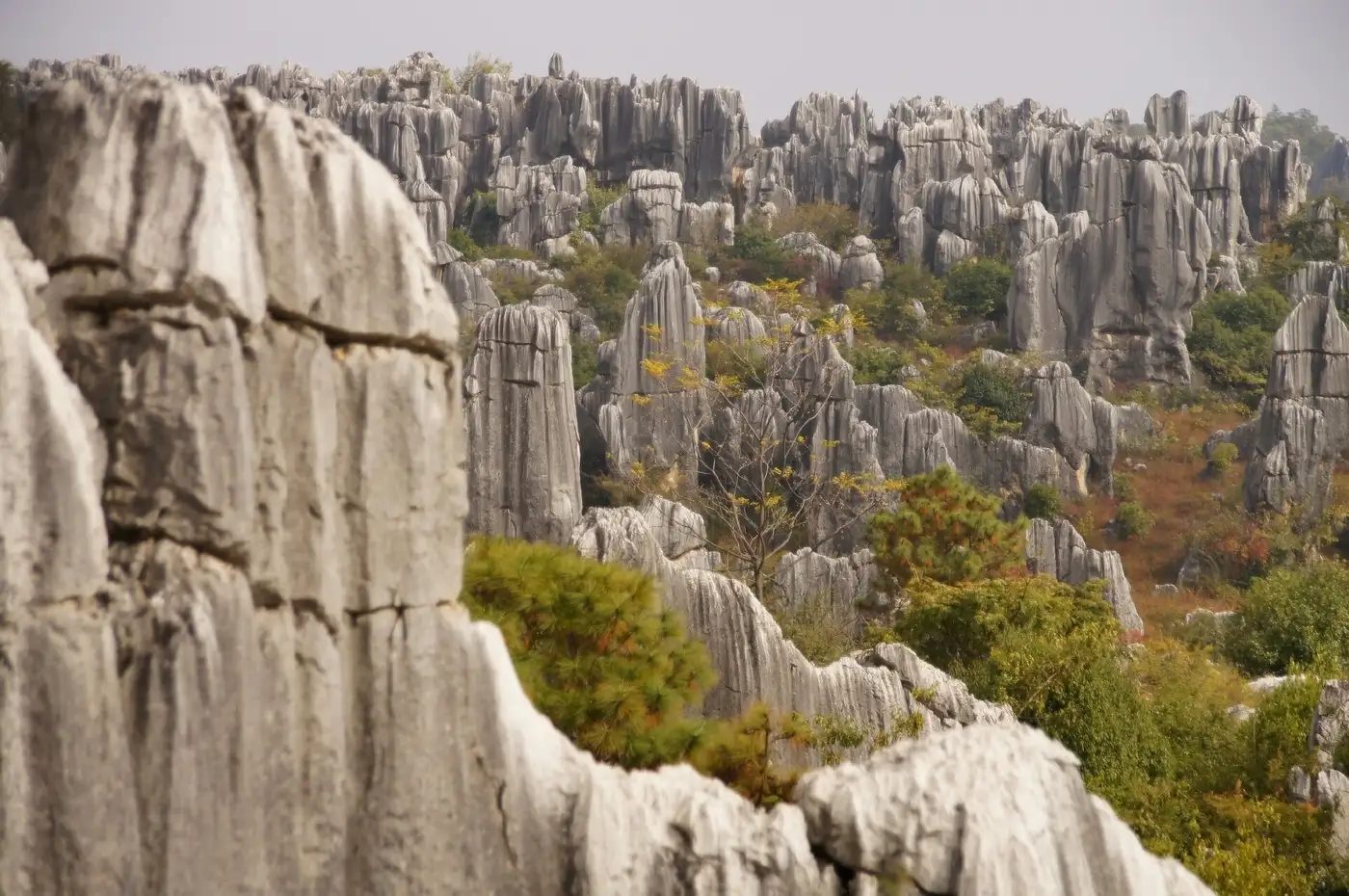
Included Meal(s): Dinner - Day 2:Kunming: Stone Forest, Green Lake Park & Jinma Biji Old TownWe begin with one of Yunnan's most singular landscapes. The Stone Forest — 270 million years of limestone karst sculpted by wind and water into a petrified woodland of towers, pinnacles and hidden caves — lies an hour from the city and rewards the early start.
Back in Kunming, Green Lake Park offers a different register entirely: a former royal garden where locals practice tai chi at the water's edge and red-crowned cranes arrive in winter to the considerable excitement of everyone present. We end in the old city around the Jinma and Biji Archways — Golden Horse and Jade Rooster facing each other across a Ming Dynasty street, still trading in pu'er tea and tie-dye as they have for centuries.
Overnight in Kunming.
Included Meal(s): Breakfast and Dinner - Day 3:Kunming - Dali: West Hill & Dragon Gate GrottoesBefore leaving Kunming we make one final ascent — Dragon Gate Grottoes, carved by hand into the cliffs of West Hill over 72 years of the Qing Dynasty. The narrow stone tunnels and shrine pavilions cling to sheer precipices above Dianchi Lake, and from the highest point the entire Kunming skyline spreads below us: a last look at the city that launched this journey before we turn west toward Erhai Lake and the Bai heartland.
The drive to Dali crosses the central Yunnan plateau, the landscape opening into a wide basin ringed by mountains. Dali has been a capital twice — first of the Nanzhao Kingdom, then the Dali Kingdom — and the old city carries that history lightly, its cobblestone lanes lined with white-wall grey-tile Bai architecture, red lanterns strung between the eaves, the 4,000-metre peaks of Cangshan Mountain rising directly behind.
Overnight in Dali.
Included Meal(s): Breakfast and Dinner - Day 4:Dali - Lijiang: Three Pagodas, Dali Old Town & Xizhou VillageDali rewards an early start. The Three Pagodas stand at the foot of Cangshan Mountain — three Tang Dynasty towers arranged in a perfect triangle, their reflection caught in the pool before them on calm mornings. Built over 1,200 years ago, they are among the finest surviving examples of Buddhist architecture in southwest China, and the most enduring symbol of the Nanzhao and Dali Kingdoms that once made this city a regional power.
From the pagodas we move into Dali Old Town itself, a walled city of cobblestone lanes and Bai-style white-wall grey-tile buildings where the pace slows considerably. A short drive brings us to Xizhou Village on the western shore of Erhai Lake — far less visited than the old town, its courtyard mansions and painted screen walls offering a more intimate encounter with Bai domestic life. The Yan Family Compound is the most celebrated of these, but the village streets themselves are the real draw.
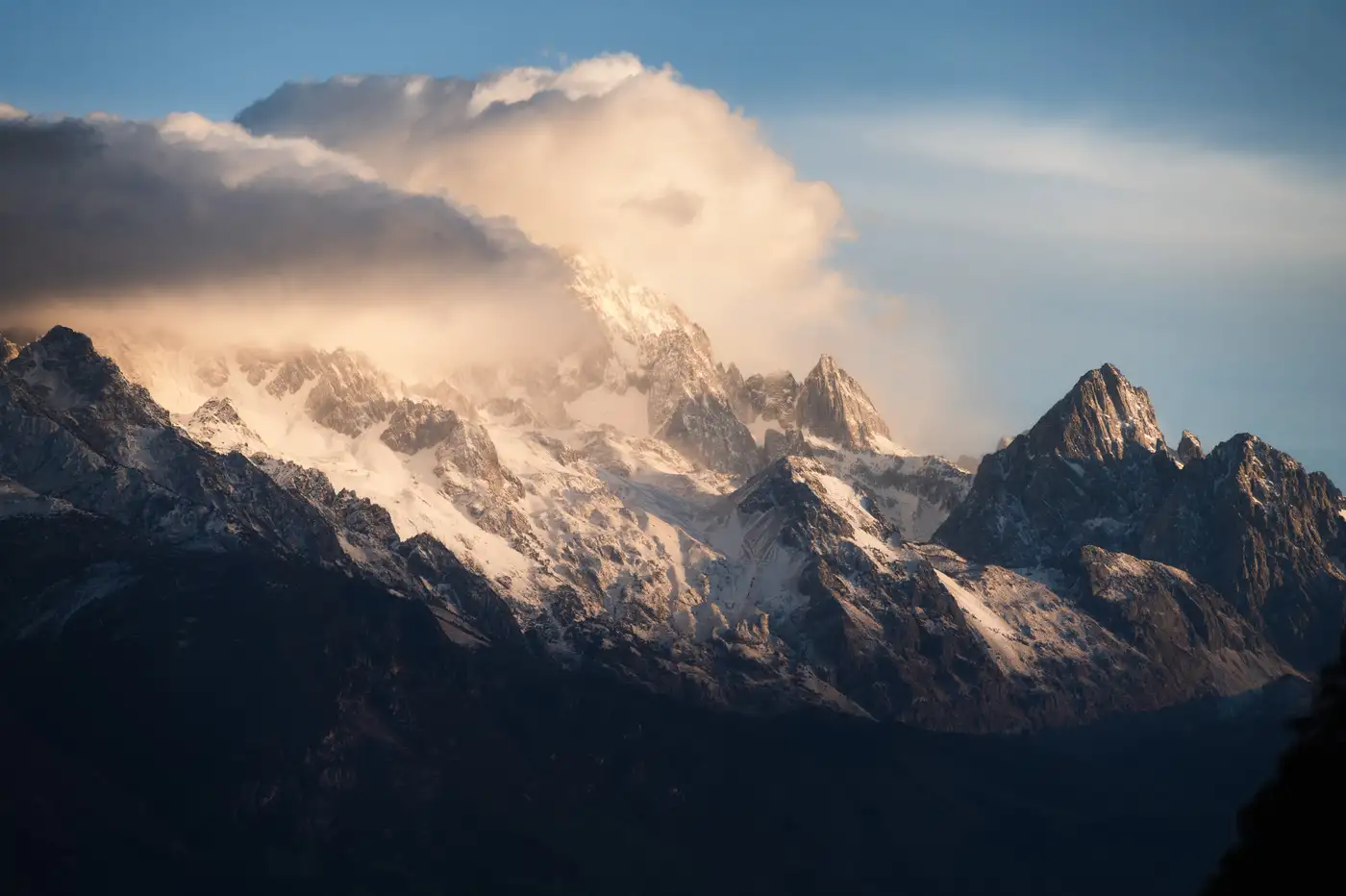
By afternoon we are on the road to Lijiang, the altitude climbing as Erhai Lake recedes behind us and the Jade Dragon Snow Mountain begins to appear ahead — a first glimpse of the high terrain that will define the days to come.
Overnight in Lijiang.
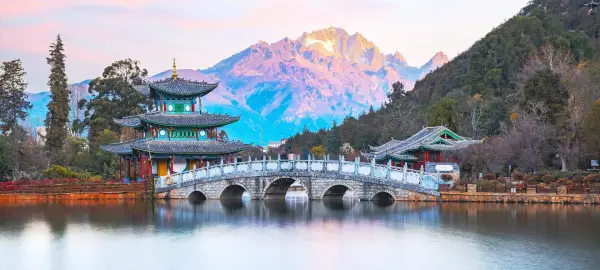
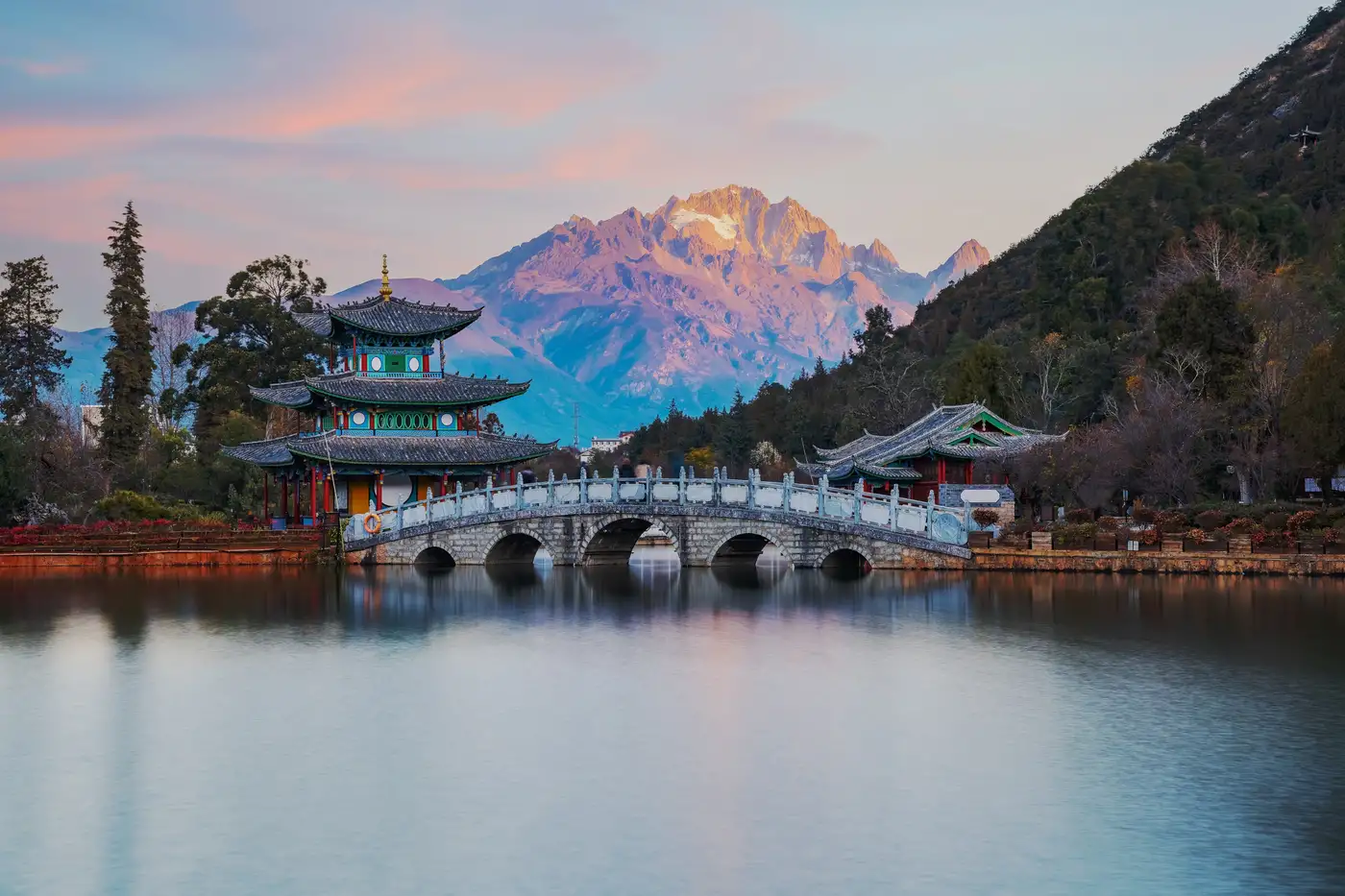
Included Meal(s): Breakfast and Dinner - Day 5:Lijiang: Black Dragon Pool, Mu Family Mansion & Baisha VillageLijiang Old Town earned its UNESCO World Heritage listing honestly. Built in the late Song and early Yuan dynasties, its 800-year-old canal system still runs clear through cobblestone streets lined with Naxi wooden architecture — a city designed around water, oriented by it, sustained by it. We begin at Black Dragon Pool, where the Jade Dragon Snow Mountain reflects in still water beside the Ming Dynasty Five-Phoenix Temple, one of those compositions that arrives fully formed and needs no improvement.
From the pool we make our way into the old town to visit Mu Family Mansion, the seat of the Naxi Tusi clan who governed this region through three successive dynasties — Yuan, Ming, and Qing. At its height the compound covered 16 acres and nearly one hundred buildings, earning comparisons to a miniature Forbidden City. Most was destroyed in the Qing Dynasty; what stands today is a faithful reconstruction, and a telling portrait of how much power this remote mountain kingdom once commanded.
The afternoon takes us north to Baisha Village, oldest of the Naxi settlements and birthplace of the Mu clan itself. Far less visited than Lijiang's old town, Baisha preserves centuries-old murals in its ancient temples — rare works that weave Naxi Dongba, Tibetan Buddhist, and Taoist imagery into a single artistic tradition, a reminder that cultural boundaries here have always been porous.
Overnight in Lijiang.
Included Meal(s): Breakfast and Dinner - Day 6:Lijiang - Shangri-La: Tiger Leaping GorgeThe morning offers free time in Lijiang Old Town before we head north toward Shangri-La. The road climbs steadily, and within an hour we reach Tiger Leaping Gorge — one of the world's deepest canyons, where the Jinsha River forces itself through a gap barely 30 metres wide between the Jade Dragon and Haba snow mountains. The gorge drops nearly 3900 m/12,800 ft from peak to river; the scale takes a moment to absorb. We stop at the lower gorge viewpoint where the river's force is most viscerally felt before continuing north.
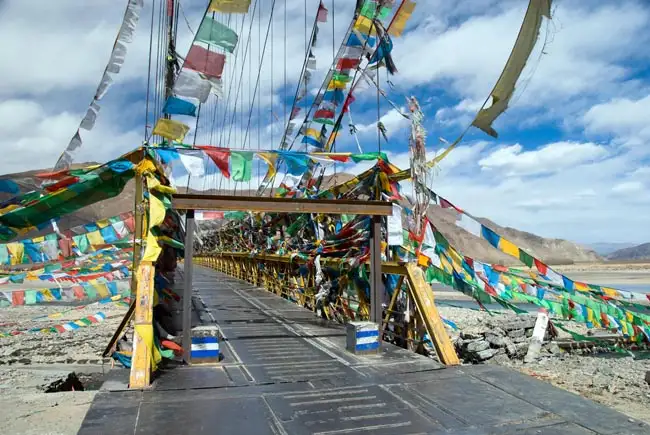
The landscape transforms as we gain altitude. Terraced fields give way to open plateau, the architecture shifts from Naxi timber to Tibetan stone, and the prayer flags begin to appear. By the time Shangri-La comes into view it is already clear that something has changed — not just the scenery but the cultural gravity of the place.
James Hilton invented his hidden paradise with this region in mind. Shangri-La is where the myth dissolves into something better.
Overnight in Shangri-La.
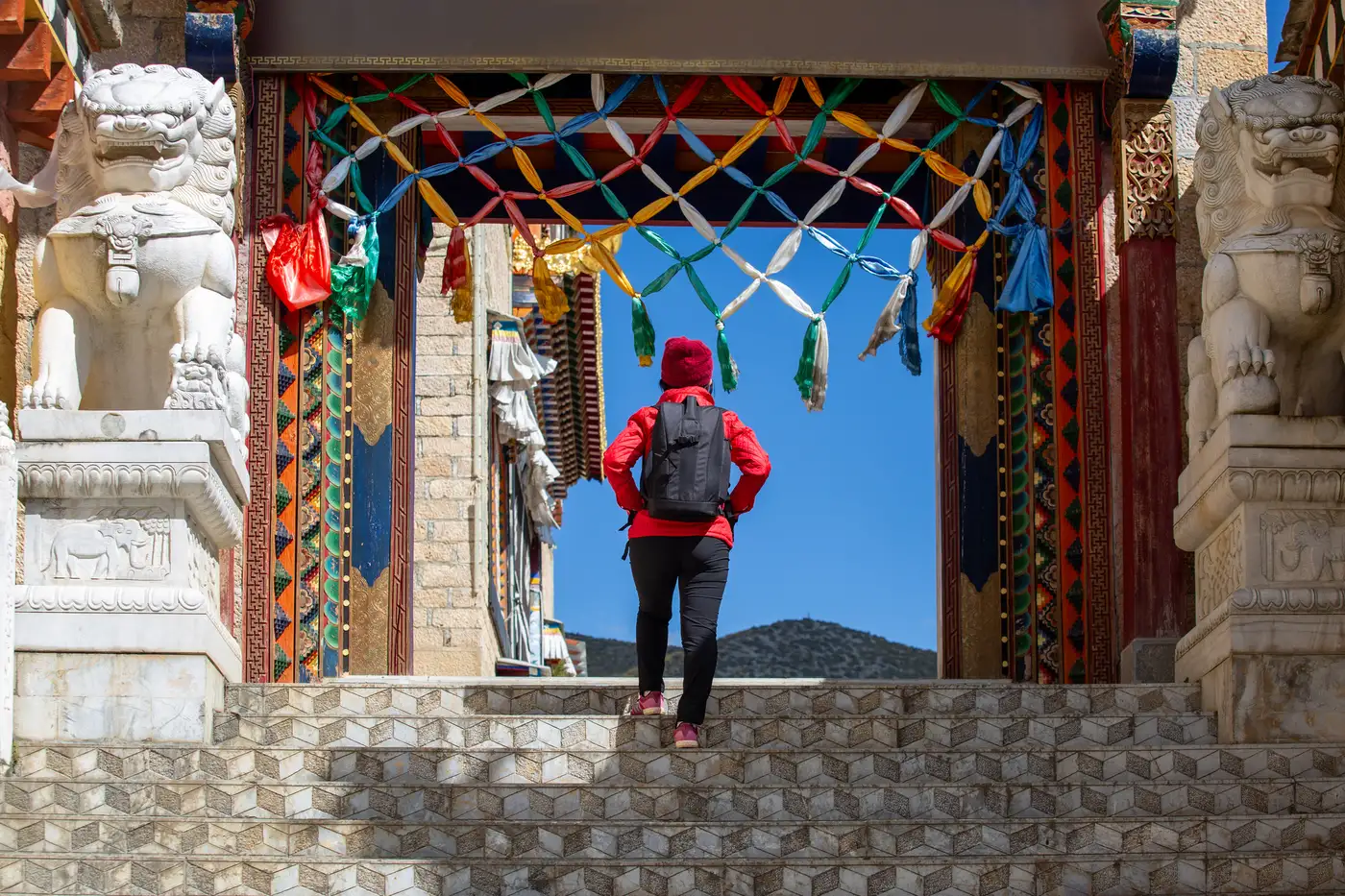
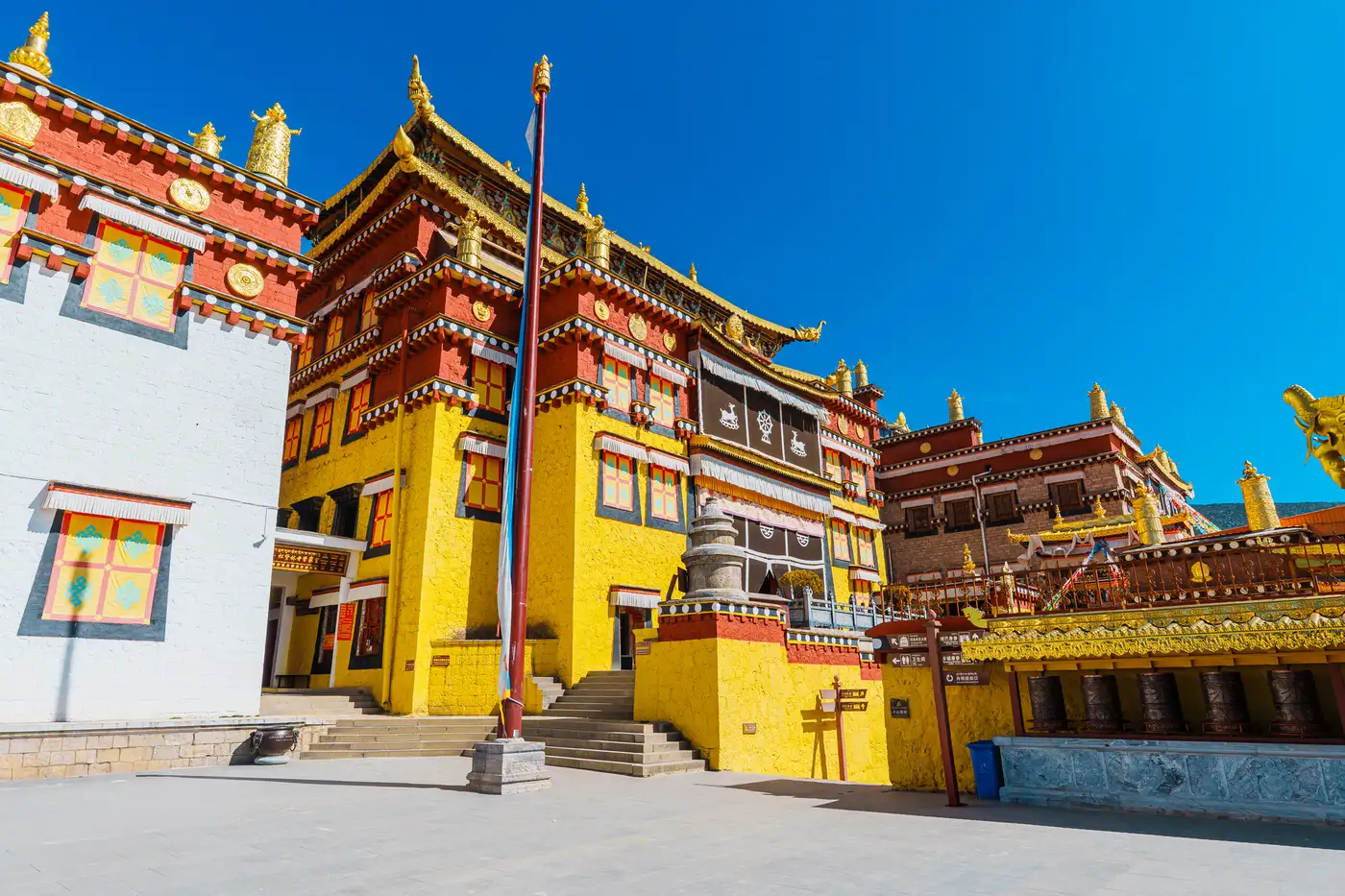
Included Meal(s): Breakfast and Dinner - Day 7:Shangri-La: Songzanlin Monastery, Potatso National Park & Dukezong Ancient TownSongzanlin Monastery announces itself before we arrive. Built in 1679 and housing over 700 monks, it is the largest Tibetan Buddhist monastery in Yunnan — a complex of golden roofs and whitewashed walls rising above the plateau in tiers, its silhouette closer to a fortified city than a place of worship. Inside, the assembly halls preserve thangkas, statues, and religious texts accumulated over three centuries. This is the first monastery of genuine Tibetan Buddhist scale we encounter, and it sets a standard that even Lhasa will need to meet.
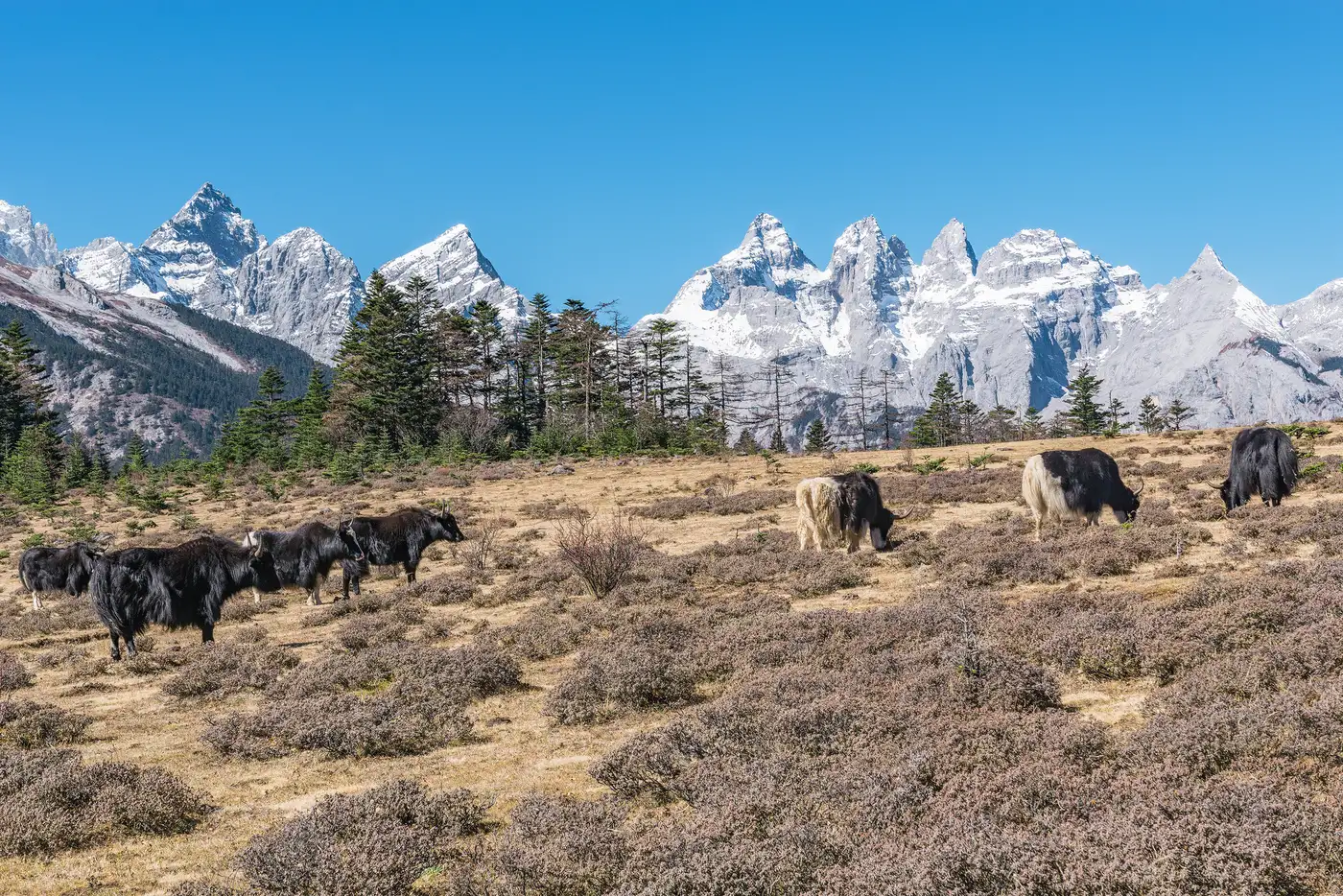
Potatso National Park lies 22 km south of town at an altitude of 3500-4159 m/11,483-13,645 ft — the first national park established on the Chinese mainland and a core section of the Three Parallel Rivers World Heritage Site. Wooden boardwalks trace the edges of Shudu and Bita Lakes through primeval fir forest and alpine meadow where yaks graze in unhurried silence. The air is noticeably thinner here, a quiet reminder of how high we have climbed since Kunming.
We end the day in Dukezong Ancient Town, whose white clay-painted houses earned it the name City of Moonlight. An important stop on the ancient Tea-Horse Trail that connected Yunnan's tea gardens with Tibet's high plateau, Dukezong was the cultural hinge between Han and Tibetan worlds for over 1400 years — and tomorrow we cross that hinge entirely.
Overnight in Shangri-La.
Included Meal(s): Breakfast and Dinner - Day 8:Shangri-La - Fly to Lhasa, TibetThe flight from Shangri-La to Lhasa takes less than two hours. What it crosses is considerably more significant — the eastern edge of the Tibetan Plateau, a geological upheaval so vast it altered Asia's weather systems and created the watersheds that feed a billion people. We land at 3650 m/11,975 ft into air that is noticeably thin and light that is extraordinarily clear.
The rest of the day is intentionally unscheduled. Altitude affects people differently, and Lhasa rewards patience — a gentle walk near the hotel, an early dinner, time to let the body adjust. Those who have spent a week climbing through Yunnan will find the transition easier than most, but Tibet operates on its own terms and today we accept them.
Overnight in Lhasa.
Included Meal(s): Breakfast and Dinner - Day 9:Lhasa: Tibet Museum, Drepung Monastery, Sera Monastery & Norbulingka ParkWe begin at the Tibet Museum, founded in 1999 and housing over 520,000 cultural relics — statues, thangkas, and ancient documents spanning millennia of Tibetan civilisation. It is a useful orientation before the monasteries, providing context that the coming days will fill with lived experience.
Drepung Monastery was once the largest monastery in the world, housing 7,700 monks at its peak across 61 acres of whitewashed buildings that give it the appearance, from a distance, of a vast heap of rice — the literal meaning of its Tibetan name. Founded in 1416, it became the intellectual centre of Tibetan Buddhism, its four colleges each presided over by abbots appointed by the Dalai Lama. Today several hundred monks remain, and the debating courtyards still ring with the percussive clapping that punctuates formal Buddhist argument.
Sera Monastery, a short distance north, shares Drepung's scholarly tradition — both are among Tibet's three great Gelugpa university monasteries. The afternoon debates at Sera are among the most vivid encounters available to visitors in Lhasa: monks in burgundy robes testing each other's doctrinal knowledge with theatrical intensity, the courtyard alive with motion and sound.
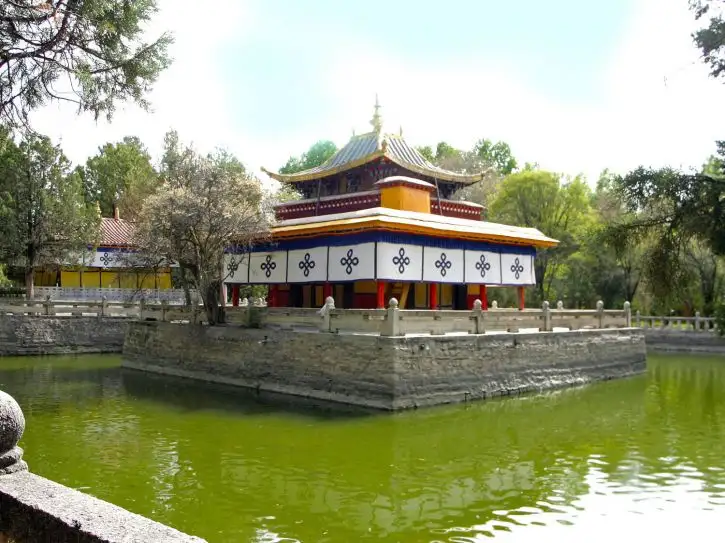
We end at Norbulingka Park, the summer palace of the Dalai Lamas since the 1740s — a walled garden complex of palaces, temples, and forested grounds that offers a quieter counterpoint to the day's monastic intensity.
Overnight in Lhasa.
Included Meal(s): Breakfast and Dinner - Day 10:Lhasa: Potala Palace, Jokhang Temple & Barkhor StreetEverything in Tibet points toward the Potala. Rising 13 stories above Marpo Ri — Red Hill — and more than 300 m/985 ft above the valley floor, it was the seat of the Dalai Lamas from the 17th century until 1959, when the 14th Dalai Lama fled into exile following a failed uprising. Over 1,000 rooms, 10,000 shrines, and 200,000 statues accumulate across its red and white facades — less a building than a civilisation made vertical. Tickets require advance arrangement and entry is timed; we have planned accordingly.
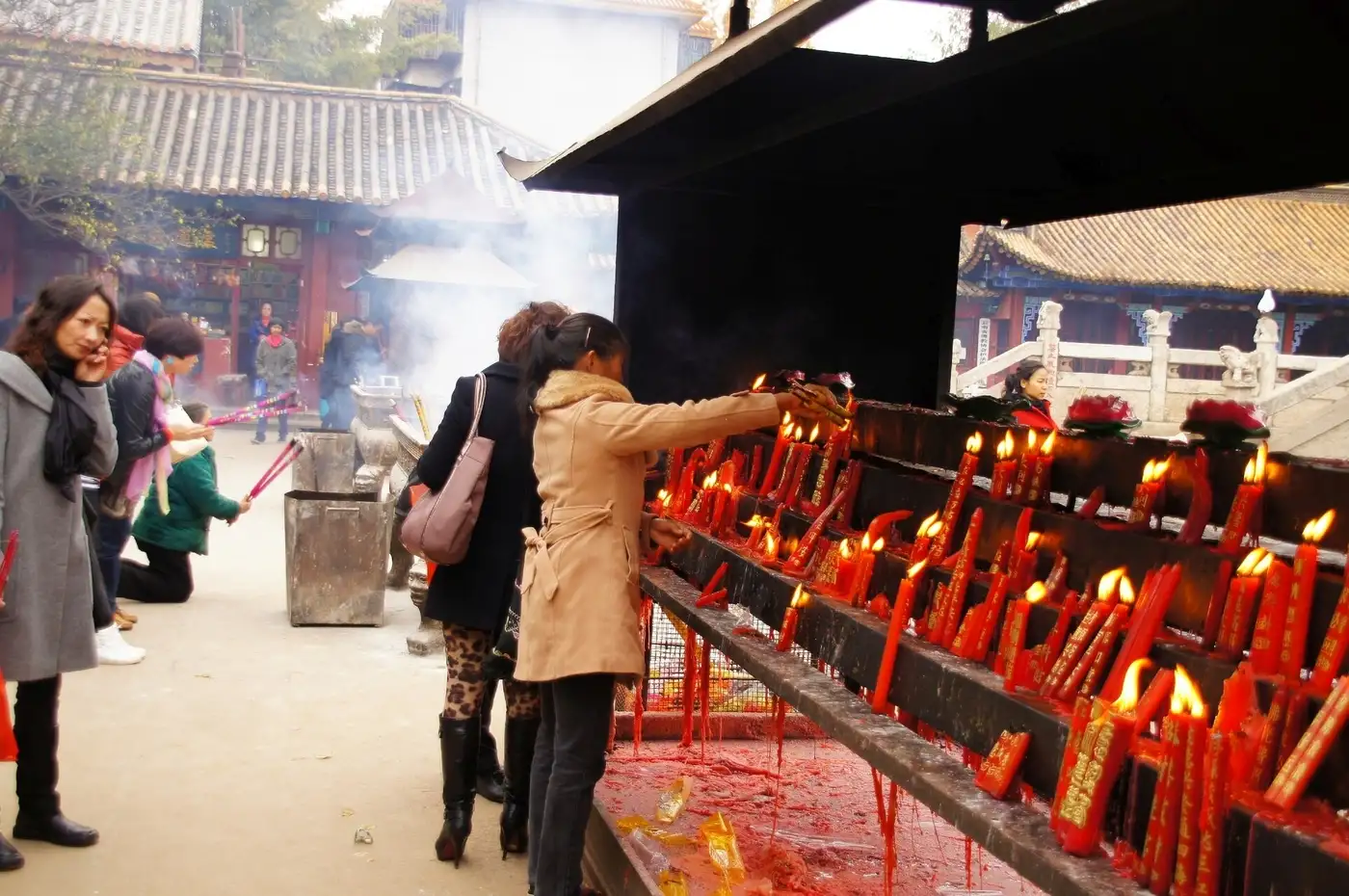
Below the Potala, the Jokhang Temple is Tibet's most sacred site — built in 647 AD by craftsmen from Tibet, China, and Nepal at the instruction of King Songtsen Gampo's Tang Dynasty bride, Princess Wencheng. The result is an architectural hybrid unlike anything else in Lhasa, its interior glowing with butter lamps and the accumulated devotion of 1,400 years. Pilgrims who have walked for weeks to reach it prostrate themselves on the stone apron outside; the worn hollows in the paving speak to the weight of that faith.
Barkhor Street circles the Jokhang in the traditional clockwise direction of Tibetan pilgrimage. We join the circuit — past incense braziers, market stalls, and elderly Tibetans turning prayer wheels — completing the day's journey in the most human way available.
Overnight in Lhasa.
Included Meal(s): Breakfast and Dinner - Day 11:Lhasa - Gyantse - Shigatse: Yamdrok Lake, Karola Glacier & Pelkor Chöde MonasteryLeaving Lhasa we climb almost immediately to the Kamba La pass, where Yamdrok Lake appears below — one of Tibet's three sacred lakes, its turquoise waters extending in two long arms across 638 sq km of high plateau. The Tibetan name means Turquoise Lake Resembling a Coral Rosary, and from the pass the comparison is apt. Sacred lakes in Tibet are not merely scenic; they are believed to hold the life force of the land, and Yamdrok is among the most venerated.
The road continues to Karola Glacier, whose ice field descends to within metres of the highway — an unusually intimate encounter with one of Tibet's diminishing glaciers at 5560 m/18,241 ft. We stop briefly before continuing to Gyantse, where Pelkor Chöde Monastery and its remarkable Kumbum stupa await. The Kumbum — meaning One Hundred Thousand Images — is a nine-storey structure containing 108 chapels decorated with 15th-century murals and statues, one of the most complete examples of Tibetan Buddhist art remaining in Tibet.
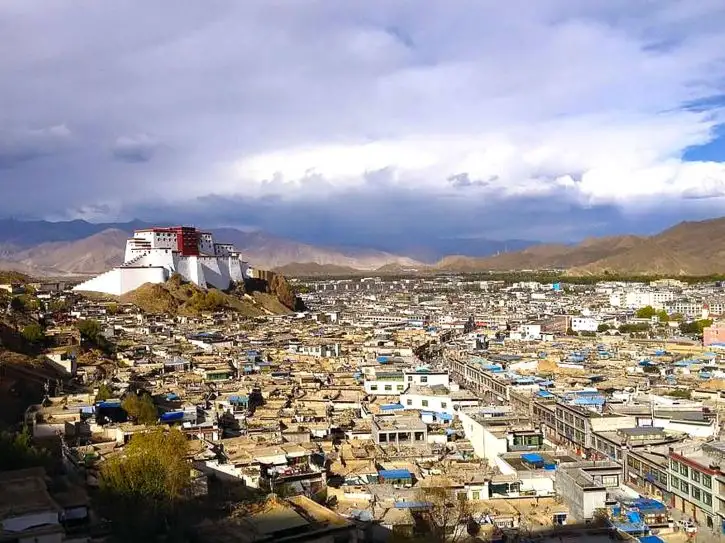
By evening we reach Shigatse, Tibet's second city, settled into the broad Yarlung Tsangpo valley at 3840 m/12,598 ft.
Overnight in Shigatse.
Included Meal(s): Breakfast and Dinner - Day 12:Shigatse: Tashilhunpo MonasteryIf Drepung belongs to the Dalai Lama, Tashilhunpo belongs to the Panchen Lama — the second-highest figure in Tibetan Buddhism, and in some traditions the more spiritually authoritative of the two. Founded by the First Dalai Lama in 1447 and expanded by successive Panchen Lamas, Tashilhunpo covers nearly 300,000 sq m at the foot of Drolmari — Tara's Mountain — its golden rooftops visible from across the valley. The Maitreya Chapel houses a 26 m/85 ft gilded statue of the Future Buddha, one of the largest such figures in existence.
The monastery remains active, its monks going about their routines with the unhurried confidence of an institution that has survived considerable history. The afternoon is free — time to explore Shigatse at your own pace, or simply to sit with what the past four days in Tibet have offered.
Overnight in Shigatse.
Included Meal(s): Breakfast and Dinner - Day 13:Shigatse - Lhasa: Yungdrung Ling MonasteryThe return drive to Lhasa follows the Yarlung Tsangpo — Tibet's great river, which becomes the Brahmaputra as it crosses into India — through a valley that widens and narrows in alternating rhythms of farmland and cliff. En route we stop at Yungdrung Ling, one of Tibet's most significant Bön monasteries and a striking counterpoint to the Tibetan Buddhist sites that have defined our time here.
Bön predates Buddhism on the Tibetan Plateau by centuries, and while the two traditions have influenced each other profoundly, Yungdrung Ling preserves its distinctions: prayer wheels turn counterclockwise here, and the swastika — ancient symbol of the Yungdrung Bön faith, turning in the opposite direction to the Nazi appropriation — appears on walls and textiles throughout the complex. The assembly hall preserves over 1,300 iron statues of Tonpa Shenrab, the founder of Bön, alongside scriptures of considerable antiquity.
It is a quietly unexpected final site — one that adds a layer to Tibet that most visitors never encounter, and a reminder that even here, at the end of a journey that has crossed from Yunnan's subtropical valleys to the high plateau, there is still something new to discover.
Overnight in Lhasa.
Included Meal(s): Breakfast and Dinner - Day 14:Lhasa: DepartureWe depart from the Roof of the World having travelled to it — not flown in and out, but arrived overland through two weeks of ascending country, culture, and altitude. Safe travels onward.
Zhu nin yilu shunfeng!
Included Meal(s): Breakfast
Countries Visited: China and Tibet
*The red tour trail on the map does not represent the actual travel path.
Book This Tour
- Final payment: Due 90 days prior to departure.
- Deposit: A non-refundable $500 CAD Deposit is required at booking.
- Internal Flight Taxes: An extra $45 CAD applies for taxes and fees on tour flights. The internal airfares are included, but taxes are listed separately as they may change. Exceptions are noted in Red.
- Optional Single Supplement: $950 CAD (number of singles limited).
(View options forsingle travellers) - Transfering Tour or Date: Transferring to another tour or tour date is only permissible outside of 120 days prior to departure and is subject to a $100 CAD change fee.
(Read our cancellation policy)
Prices below are per person, twin-sharing costs in Canadian Dollars (CAD). Pricing does not include airfare to/from the tour and any applicable taxes.
Frequently Asked Questions
- What is the maximum number of participants on a trip?Most of our tours carry a maximum of 18 participants; some tours (ie hiking tours) top out at 16. In the event that we do not achieve our minimum complement by our 90-day deadline, we may offer group members the option of paying a "small-group surcharge" as an alternative to cancellation. If all group members agree, we will confirm the trip at existing numbers; this surcharge is refundable in the event that we ultimately achieve our regular minimum. If the small group surcharge is not accepted, we will offer a refund of your deposit or a different trip of your choice.
- Can I extend my tour either at the beginning or end? What about stopovers?Yes, you can extend your tour either at the beginning or the end and we can book accommodation in our tour hotel. Stopovers are often permitted, depending on air routing. Stopovers usually carry a "stopover" fee levied by the airline.
- How do I make a reservation? How and when do I pay?The easiest way to make a reservation is via our website; during office hours, you are also more than welcome to contact us by telephone.
A non-refundable deposit is payable at the time of booking; if a reservation is made within 90 days, full payment is required. Some trips require a larger deposit. If international airline bookings require a non-refundable payment in order to secure space or the lowest available fare, we will require an increase in deposit equal to the cost of the ticket(s).
Early enrolment is always encouraged as group size is limited and some trips require greater preparation time.
Once we have received your deposit, we will confirm your space and send you a confirmation package containing your trip itinerary, any visa/travel permit related documents, invoice, clothing and equipment recommendations, general information on your destination(s), and forms for you to complete, sign and return to us. Your air e-tickets (if applicable), final hotel list, final trip itinerary, and instructions on how to join your tour, will be sent approximately 2-3 weeks prior to departure. - What about cancellations, refunds, and transfers?Please review our cancellation policy page for details.
- I am a single who prefers my own room. What is a single supplement?All of our tours have a single supplement for those who want to be guaranteed their own room at each location.
This supplement is a reflection of the fact that most hotels around the world do not discount the regular twin-share rate for a room by 50% for only one person occupying a room. Most hotels will give a break on the price, but usually in the range of 25-30% of the twin-share rate. This difference, multiplied by each night, amounts to the single supplement.
The conventional amount can also vary from country to country and some destinations are more expensive than others for single occupancy. In order to be "single friendly," the supplements we apply are not a profit centre for us and we do our best to keep them as reasonable as possible.
On most tours we limit the number of singles available, not to be punitive, but rather because many hotels allow for only a limited number of singles; some smaller hotels at remote locations also have a limited number of single rooms available.
Please note that most single rooms around the world are smaller than twin-share rooms and will likely have only one bed. - Do you have a shared accommodation program?Yes! If you are single traveller and are willing to share, we will do our best to pair you with a same-gender roommate. Please note that should we fail to pair you, we will absorb the single supplement fee and you will default to a single room at no extra charge.