- Wildlife
- History
- Overview
- Info & Inclusions
- Itinerary
- Map & Hotels
- Photos
- Dates & Prices
- Tour Duration: 12 Days
- Max Group Size 18
- The Namib, world's oldest desert
- Apricot dunes at sunrise
- Kaleidoscope of cultures
- Swakopmund: charming seaside town
- Rugged Skeleton Coast
- Etosha: Africa's undiscovered wildlife gem
- Singles friendly (view options for single travellers)
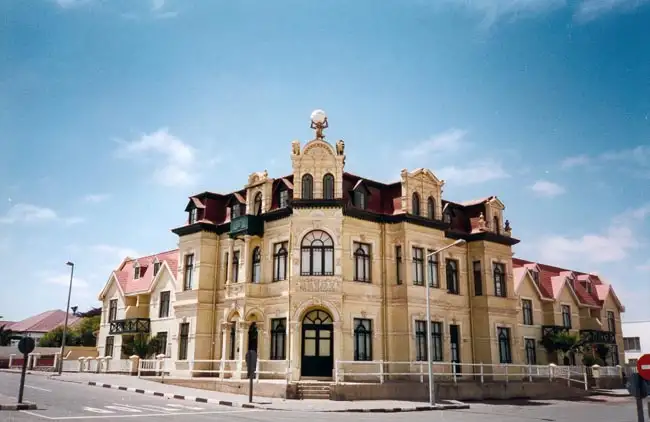
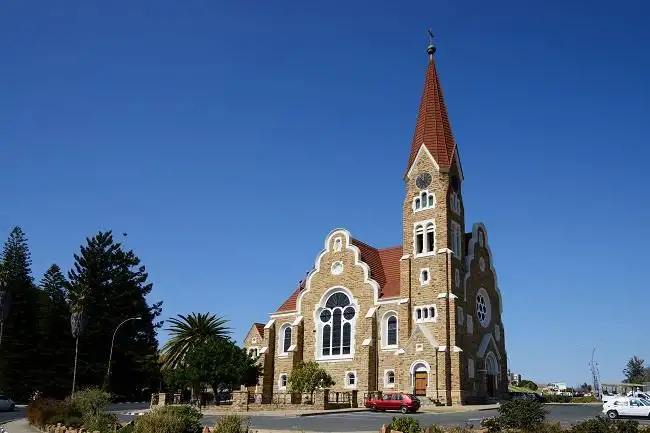
This country's captivating history shines through its architecture from the turn of the century, but a sense of modernism is kept alive through its vibrant culture.
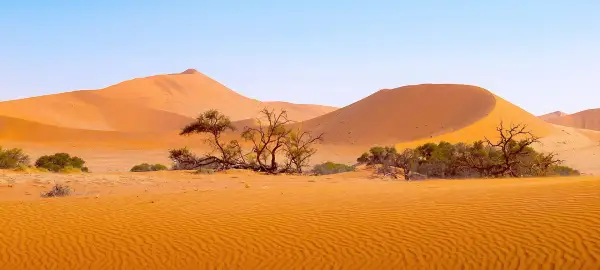
Once we're outside of the city, the colourful Sossusvlei sand dunes tower above us with their record-breaking heights of 300 metres.
What would a trip to Africa be without a day spent game-viewing? Etosha National Park's "salt desert" is an important resource for the mixture of wildlife that inhabits this land.
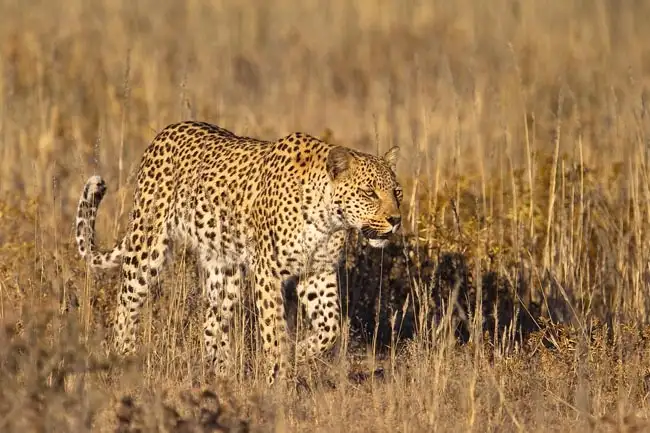
Namib-Naukluft National Park yields an excellent display of animals as diverse as the baboon, rock hyrax or leopard. Our time on Botswana features the incredible wildlife diversity of both Chobe Park and the Okavango Delta.
This is a perfect adventure through a region that serves as an excellent showcase of what makes Africa such a compelling continent for so many travellers.
- MealsSavour authentic flavours with included daily breakfasts, some lunches, and dinners at hotels or handpicked local restaurants—immersing you in local cuisine without worrying about reservations or budgets.
- Transport & Logistics
Private air-conditioned coaches and included internal ferries and flights—ensuring hassle-free travel so you can focus entirely on the discoveries ahead.
"Adventures Abroad tour leader's management and guest services managed the tour with great skill and dedication. The tour leader was on top of every move and transfer. We have not experienced any issues with logistics and had a great time."
~ JULIA O"The tour leader did an excellent job coordinating some difficult travel logistics, power outage issues and resolving problems and dealing with guests who had unrealistic expectations."
~ CYNTHIA COLLINS - Expert Guidance
Unlock insider secrets at every landmark with your full-time Tour Leader and expert local guides , all gratuities covered—no hidden tipping surprises—so you immerse fully in your destination's stories, worry-free. (Except for the tips to your tour leader at the end of your tour.)
"Amazing tour guide. Our tour guide was very well organized, Her passion, knowledge, and enthusiasm completely transformed the travel experience into something truly unforgettable..."
~ MELANIE LEMAIRE"Highly recommend every trip with Adventures Abroad. It's a well organized and well thought out adventure. The tour leaders are friendly, knowledgeable and experienced professionals. Highly recommend this company."
~ SUSAN WALL - Sightseeing & EntrancesAll entrance fees for sites visited as per the itinerary—no hidden costs—so you can explore ancient ruins and excursions with complete peace of mind.
- AccommodationsUnwind in clean, well-located 3 to 4-star hotels with private en suite facilities—handpicked for comfort and convenience after each day's discoveries—so you can rest easy knowing your stay supports the real adventure, not steals the spotlight.
- Small Group
Discover the world in small groups of up to 18 travellers plus your expert Tour Leader—unlocking spontaneity, off-the-beaten-path adventures, and genuine connections at a relaxed pace, free from crowds.
"Looking Forward to My Next Adventure The best feature of the Adventures tour was the small size that allowed the group to quickly load up, let everyone get acquainted within the first 24 hours, capitalize on unplanned surprises along..."
~ PHILIP BLENSKI"Good value for a great time I have traveled with Adventures Abroad for over 20 years now. Well thought out, interesting itineraries and the other travelers congenial and friendly. The price always seems fair and overall a..."
~ Trusted Customer - Airport Transfers For Land & Air CustomersWe handle hassle-free airport transfers for all our land and air tour customers—plus early arrivals or late departures when you book extra hotel nights directly with us for added peace of mind.
- International airfare to/from the tour.
- Tour Leader gratuities, some lunches, drinks, personal items (phone, laundry, etc), international (if applicable) air and airport taxes.
- Optional trip cancellation insurance.
- Our post-reservation trip notes offer further guidance on shopping and not included meals.
- Our Namibia/Botswana tours are an EXCEPTION to our usual policies around airport transfers, which we INCLUDE for all passengers regardless of whether you book your air through us or not.
- Seasonality and Weather:
November to April: The ‘rainy’ season is during the summer months, from November to April. The weather tends to be hot and humid with dramatic afternoon thunderstorms. However, the downpours are short and heavy, so it's unlikely that the rain will disrupt your travel plans -- meaning that you don't have to worry about when to go to Namibia because even the rainy season is a great time to visit. March can also be a good time to visit Namibia's Etosha National Park; following the birthing season in January and February, you will be able to see young animals taking their first steps in the wild. That said, the lush vegetation seen in March to May can make game viewing more challenging.
June to October: The ‘dry’ season takes place during the winter months from May to October and the weather is typically warm and sunny, albeit with very cold nights. These months are considered to be the best time to go to Namibia, as you can enjoy uninterrupted blue skies and plenty of sunshine, except along the coast where there is often a fog. The daytime temperatures during these months are moderate, however it can get very cold in the evenings.
In terms of wildlife, the dry winter months (June-August) are ideal for game viewing in Etosha National Park because the vegetation is sparse and water sources dry out. Therefore, the local wildlife gathers around the permanent water holes, making animals easier to locate, observe and photograph. - Transport and Travel Conditions:
Land transport in Namibia is via specialized 4x4 safari vehicles, equipped with air-conditioning and fridges for drinks and snacks.
All vehicles are equipped with:
• Roof pop-tops for better photography and game viewing vantage points
• Air-conditioning
• Onboard fridge/freezers and plenty of water.
• Personal library, which includes a series of guidebooks, maps, stationery and checklists.
• 220-volt electrical charging point, to charge electrical devices whilst travelling.
• Guaranteed window seat on every safari.
• VHF inter-vehicle radios that allow multi vehicle groups to communicate with each other while ‘on the road’
Namibia is a huge, sparsely-populated country with great distances between facilities. We stop for breaks as often as possible, but you must be prepared for some long days and some early starts.
Our transport in Botswana will be of a similar nature for our game drives in Chobe and road journeys.
Am I suitable for this tour? Please refer to our self-assessment form - Activity Level: 1
No particular physical activity is involved other than town/city walks and short walks to dinners and sites of interest, some of which are large.
To learn more about the Activity levels, please visit our tour styles page. - Accommodation:
Well-located, air-conditioned, 3&4-star hotels and lodges with en suite toilet and bath throughout. There is no camping on this trip.
Please click on the "Map & Hotels" tab for more information on accommodation typically used on this trip. - Staff and Support:
Local Tour Leader throughout, drivers, local guides at various locations. - Group Size:
Maximum 18 plus Tour Leader
- Day 1:Arrival in NamibiaArrival in Windhoek, the capital of Namibia. Founded in 1840 as a hot springs settlement, Windhoek grew into a colonial administrative centre and today serves as the country's political and economic heart. The city's architecture reflects its German colonial past, with Lutheran churches and turn-of-the-century buildings standing alongside modern office blocks.
This evening we meet our Namibia-based Tour Leader and fellow travellers for a welcome dinner.
NOTE: Due to space availability and other considerations, our Namibia itinerary may run in reverse order (Windhoek to Windhoek).
Overnight in Windhoek.
Included Meal(s): Dinner - Day 2:Windhoek - Namib-Naukluft National ParkAfter breakfast we leave the interior plateau and head southwest through the Gamsberg Pass toward the Namib Desert. The landscape shifts dramatically as we descend — from grasslands to rock formations and eventually to the dunes that define this ancient desert. The Gamsberg Pass itself offers sweeping views across multiple climate zones, a reminder of the elevation we're losing as we drop from the central highlands toward the coast.
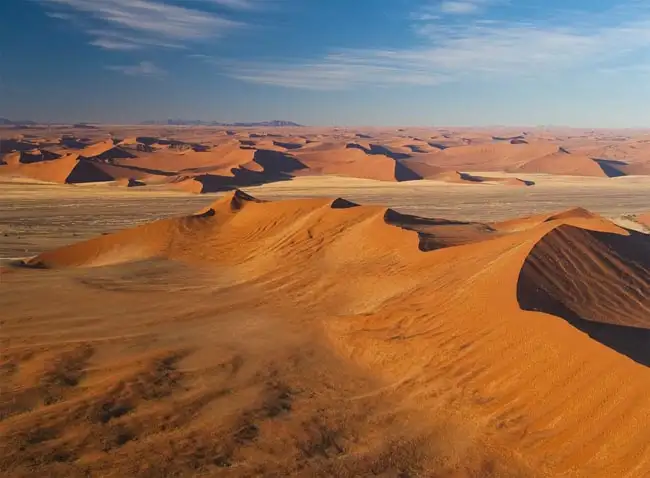
In the Nama language, Namib means "vast" — an apt description for this expanse of sand that stretches along Namibia's entire 1,500-kilometre (930-mile) coastline. The Namib is considered one of the world's oldest deserts, with arid or semi-arid conditions persisting for at least 55 million years. The Sossusvlei dunes, at 300 metres (1,000 feet), rank among the world's highest — considerably taller than their nearest rivals in Arabia.
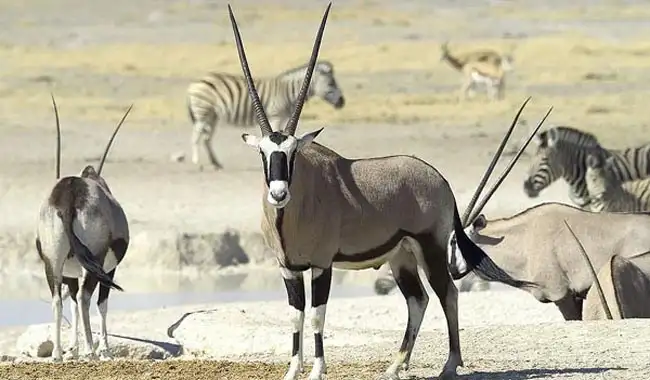
Animals, insects, and plants have adapted remarkably to survive here. The Namib beetle collects moisture by standing on its head in the early morning fog, allowing water droplets to run down its back to its mouth. The welwitschia plant, which can live over 1,000 years, survives on fog alone. En route we watch for kudu, springbok, gemsbok, and black eagles against the desert backdrop.
We stop several times for photos before arriving at our lodge this afternoon. The surrounding landscape — multi-hued sands, twisted acacia trees, and expansive views — offers excellent sunset-watching opportunities. We'll have a picnic lunch en route.
Overnight in the vicinity of Namib-Naukluft National Park.
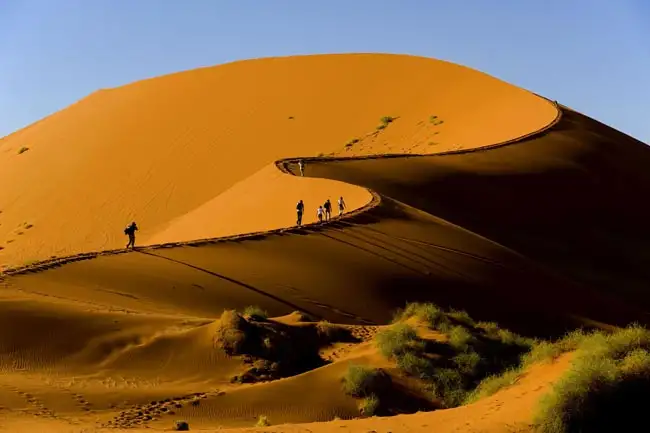
Included Meal(s): Breakfast, Lunch and Dinner - Day 3:Namib-Naukluft National ParkVery early this morning we drive into the park to Sossusvlei, a dried-up pan at the base of the Namib's most impressive dunes. The morning sun illuminates the apricot-coloured sands, with long shadows emphasizing the graceful curves of the dune crests. The older the dune, the richer its colour — the result of slow iron oxidation and minute garnet fragments.
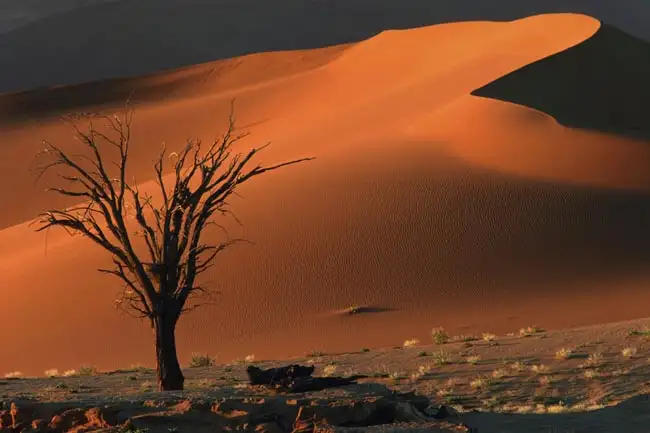
We have plenty of time to walk among the dunes, scale one or two for panoramic views, and visit Dead Vlei. This surreal pan takes its name from the blackened dead acacia trees that rise from its white surface, set against towering orange dunes — a photographer's dream. The scale dwarfs human presence; footprints look like insect trails, and each step creates a mini sand-slide. Possible wildlife sightings include oryx antelope, springbok, and ostrich.
On our return we stop at Sesriem Canyon near the park entrance. Early inhabitants relied on this water source during dry periods, when deep clefts in the rock reduced evaporation. The name comes from the Afrikaans "ses" (six) and "riem" (thong) — explorers needed six leather thongs tied together to lower a bucket to the water. The canyon was carved by the Tsauchab River over millions of years, leaving ledges now inhabited by pigeons, pied crows, and starlings.
We'll have a picnic breakfast en route and likely a late lunch upon return to our lodge.
Overnight in the vicinity of Namib-Naukluft National Park.
Included Meal(s): Breakfast, Lunch and Dinner - Day 4:Namib-Naukluft Park - SwakopmundThis morning we continue north through Namib-Naukluft Park via Solitaire, a tiny settlement that serves as the last fuel stop before the dunes. The journey takes us through the rocky Kuiseb Canyon, carved by the Kuiseb River as it cuts through ancient rock formations on its way to the Atlantic. We make photo stops en route and watch for baboons, rock hyraxes clinging to cliff faces, and, if fortunate, leopards that inhabit these rocky outcrops.
Our destination is Swakopmund, Namibia's second-largest town and traditional "summer capital." The drive is approximately 350 kilometres (220 miles), with the landscape transforming from desert interior to the foggy coastal zone. Approaching Swakopmund through the Namib Desert creates one of travel's more surreal impressions — Bavarian spires and Germanic architecture emerge through the fog banks that typically blanket the town in morning and late afternoon. The Atlantic surf pounds the notorious Skeleton Coast beyond, an ever-present reminder of the ocean's power.
The town blends old Bavaria with contemporary Africa in unexpected ways. Herero women in Victorian dress — a legacy of 19th-century missionary influence — share the streets with descendants of German settlers, artists, miners, and safari operators. The architecture ranges from elaborate turn-of-the-century buildings to modern shops and restaurants. Palm-lined streets and carefully tended gardens give the town an almost Mediterranean feel, despite the chilly ocean currents offshore.
We'll have time for a stroll before dinner, perhaps along the jetty where anglers try their luck, or through the craft markets near the lighthouse.
Overnight in Swakopmund.
Included Meal(s): Breakfast, Lunch and Dinner - Day 5:Swakopmund: Leisure Time & Optional ActivitiesToday is free to explore Swakopmund at your own pace. The town offers an intriguing contrast — a corner of old Bavaria wedged between one of the world's harshest deserts and its most treacherous coastlines. Browse the shops along the main street, relax at a café, or visit the local museum to learn more about the region's history.
Optional activities include "Living Desert" excursions to explore the Namib's surprising biodiversity, marine cruises on Walvis Bay lagoon to see seals and dolphins, scenic flights over the desert and coast, or camel rides along the beach. Your Tour Leader can advise on current pricing and help arrange bookings.
Overnight in Swakopmund.
Included Meal(s): Breakfast and Dinner - Day 6:Swakopmund - DamaralandAfter an early breakfast we head north and east into Damaraland, one of Namibia's most geologically diverse regions. We pass Namibia's highest mountain, the Brandberg, which peaks at 2,573 metres (8,442 feet) above sea level. The massif is named for its glowing appearance at sunrise and sunset, when the granite reflects shades of red and orange. The mountain is also home to Namibia's most famous rock art site — the "White Lady" painting, though we won't visit it today.
We take time to watch for wildlife and absorb the vastness of the scenery as we make our way to Huab Under Canvas, our specially erected tented camp for the next two nights. This semi-permanent camp offers comfortable accommodation in the heart of the wilderness, allowing us to minimize our environmental footprint while maximizing our safari experience.
Damaraland displays remarkable geological diversity — table-top mountains, rock formations, and hardy vegetation create a landscape shaped by wind, water, and millennia of erosion. Rolling hills give way to dunes, gravel plains, and ancient river terraces. The region takes its name from the Damara people who have lived here for centuries, adapting to one of Africa's harshest environments. It's the variety and remoteness of the area, as much as its scenic grandeur, that provides an authentic wilderness experience.
If time permits this afternoon (or tomorrow if we're running late), we'll visit the pre-historic Twyfelfontein rock engravings, recently declared a UNESCO World Heritage Site. These engravings, created over thousands of years, depict animals, human figures, and abstract designs. We arrive in the late afternoon with time to enjoy sundowners before dinner.
Overnight in Damaraland.
Included Meal(s): Breakfast, Lunch and Dinner - Day 7:Damaraland TouringToday we explore this remarkable region with our guides. After an early breakfast we embark on a 4x4 excursion along the ephemeral Aba Huab River valleys to search for desert-adapted elephants and other wildlife. Damaraland's hidden treasures include various desert-adapted species that have evolved to survive in this harsh environment.
The elephants are most active in the mornings, giving us the best chance to observe them before returning to camp for lunch. However, if all travellers are in agreement, we could take a picnic lunch and stop in the shade of a large ana tree by the riverbed — ideally while watching a herd of elephants browsing nearby. On return to camp there should be time to relax and enjoy sundowners while watching the sunset over this dramatic landscape.
Overnight in Damaraland.
Included Meal(s): Breakfast, Lunch and Dinner - Day 8:Damaraland - Etosha National ParkThis morning after breakfast we continue our safari to Etosha National Park, one of Africa's premier wildlife destinations. The drive takes us through changing landscapes as we leave the rocky terrain of Damaraland and enter the flatter bushveld that characterizes the approaches to Etosha. Located in northwestern Namibia, the park centres on the vast Etosha Pan — a 130-kilometre (80-mile) long salt pan that dominates the landscape and can even be seen from space.
This pan is the remnant of an ancient lake that dried up thousands of years ago, leaving behind a crust of salt and minerals. During rare good rainy seasons, the pan fills with a few centimetres of water, attracting thousands of flamingos and other water birds. Most years, however, it remains a shimmering white expanse that creates mirages and reflects the intense African sun. The name "Etosha" comes from the Oshiwambo language and means "great white place" — an accurate description of the pan's appearance.
The park was established as a game reserve in the early 20th century and declared a national park in 1970. Today it ranks among Namibia's most popular destinations, attracting visitors with its unique landscapes and abundant wildlife. The park covers 22,270 square kilometres (8,600 square miles) and supports 114 mammal species and over 340 bird species.
We have lunch en route, and if time permits this afternoon, our guide will take us on a game drive into Etosha, exiting before the gates close at sunset. The rest of the evening can be spent watching wildlife at our camp's floodlit waterhole — a peaceful way to end the day as animals come to drink under the stars.
Overnight at Etosha (West).
Included Meal(s): Breakfast, Lunch and Dinner - Day 9:Etosha National Park WestToday we embark on a full-day safari through the central and western sections of Etosha National Park from the comfort of our private vehicle. The park's landscape seamlessly blends grasslands, savannas, and woodlands, each supporting different wildlife communities. Grasslands with scattered acacias provide habitat for grazing animals like zebras and antelopes, while the savannas' open woodlands shelter giraffes, elephants, lions, and hyenas. Denser woodlands offer shade and cover for leopards and cheetahs.
Etosha is renowned for its wildlife diversity, with over 114 mammal species calling the park home. We watch for iconic species like elephants, lions, giraffes, and zebras, as well as the endangered black rhinoceros and elusive leopard. The park also hosts over 340 bird species, including eagles, vultures, and ostriches. The unique geology and hydrology have created varied habitats — from salt pans and waterholes to rocky outcrops and sandy dunes — that support this remarkable biodiversity.
As we explore, we focus on the numerous springs and waterholes where multiple species often gather simultaneously, providing excellent viewing opportunities.
Overnight at Etosha (West).
Included Meal(s): Breakfast, Lunch and Dinner - Day 10:Etosha National Park EastToday we bid farewell to our current camp and travel eastward across Etosha National Park. With a full day of game viewing ahead, we take our time navigating the park's diverse landscape of grassland, woodland, and savannah. The eastern section of the park tends to be less visited than the central and western areas, often providing more solitary wildlife encounters.
We focus on the numerous springs and waterholes where wildlife congregates — often multiple species at once — providing fantastic photographic opportunities. Etosha's waterholes are legendary among wildlife photographers. Each has its own character: some attract primarily elephants, others are favoured by predators, and still others become gathering places for plains game. The dry season (May through October) offers the most concentrated wildlife viewing as animals must visit water daily.
We might spot an elephant's massive frame silhouetted against the horizon, a pride of lions resting in the shade during the heat of the day, or a giraffe browsing acacia leaves with its characteristic grace. Other wildlife we might encounter includes blue wildebeest, eland, kudu, and the distinctive gemsbok with its rapier-straight horns. Etosha is also one of the best places in Africa to see the endangered black rhinoceros, which has been successfully protected here for decades.
Bird life is equally impressive, with secretary birds stalking through the grasslands, martial eagles surveying from treetops, and, if we're lucky, ostriches striding across the plains with their awkward yet effective gait.
Tonight we overnight at a camp in the eastern sector of the park.
Overnight at Etosha (East).
Included Meal(s): Breakfast, Lunch and Dinner - Day 11:Etosha - WindhoekAfter a leisurely breakfast, we bid farewell to the wilderness and journey back to Windhoek through the central highlands. The scenic road takes us through rolling hills, verdant valleys, and commercial farmlands that showcase Namibia's agricultural sector. Along the way we pass unique rock formations, streams, and rural villages.
We stop at Lake Otjikoto, a tranquil oasis in the highlands where we might spot herons, egrets, kingfishers, and other water birds. The serene atmosphere provides a peaceful break from our journey.
Next we visit the town of Okahandja to explore the local woodcarver's craft market. This marketplace offers unique souvenirs, handmade crafts, and authentic Namibian artifacts — an excellent opportunity to browse for last-minute mementos of your safari.
As we arrive in Windhoek this evening, we'll have time to reflect on our unforgettable experiences.
Overnight in Windhoek.
Included Meal(s): Breakfast, Lunch and Dinner - Day 12:DepartureToday we depart from Windhoek.
PLEASE NOTE: From 2027 onward this tour will become one day long, ending one day later. Once our 2026 tours conclude, this itinerary and pricing will be updated.
BON VOYAGE!
Included Meal(s): Breakfast
Countries Visited: Namibia
*The red tour trail on the map does not represent the actual travel path.
Book This Tour
- Final payment: Due 90 days prior to departure.
- Deposit: A non-refundable $500 CAD Deposit is required at booking.
- Optional Single Supplement: $1705 CAD (number of singles limited).
(View options forsingle travellers) - Once our tour becomes 'guaranteed,' we will require an additional non-refundable pre-payment of $1000 per person at which point your initial deposit and extra payment become 100% non-refundable/non-transferrable.
Prices below are per person, twin-sharing costs in Canadian Dollars (CAD). Pricing does not include airfare to/from the tour and any applicable taxes.
Frequently Asked Questions
- What is the maximum number of participants on a trip?Most of our tours carry a maximum of 18 participants; some tours (ie hiking tours) top out at 16. In the event that we do not achieve our minimum complement by our 90-day deadline, we may offer group members the option of paying a "small-group surcharge" as an alternative to cancellation. If all group members agree, we will confirm the trip at existing numbers; this surcharge is refundable in the event that we ultimately achieve our regular minimum. If the small group surcharge is not accepted, we will offer a refund of your deposit or a different trip of your choice.
- Can I extend my tour either at the beginning or end? What about stopovers?Yes, you can extend your tour either at the beginning or the end and we can book accommodation in our tour hotel. Stopovers are often permitted, depending on air routing. Stopovers usually carry a "stopover" fee levied by the airline.
- How do I make a reservation? How and when do I pay?The easiest way to make a reservation is via our website; during office hours, you are also more than welcome to contact us by telephone.
A non-refundable deposit is payable at the time of booking; if a reservation is made within 90 days, full payment is required. Some trips require a larger deposit. If international airline bookings require a non-refundable payment in order to secure space or the lowest available fare, we will require an increase in deposit equal to the cost of the ticket(s).
Early enrolment is always encouraged as group size is limited and some trips require greater preparation time.
Once we have received your deposit, we will confirm your space and send you a confirmation package containing your trip itinerary, any visa/travel permit related documents, invoice, clothing and equipment recommendations, general information on your destination(s), and forms for you to complete, sign and return to us. Your air e-tickets (if applicable), final hotel list, final trip itinerary, and instructions on how to join your tour, will be sent approximately 2-3 weeks prior to departure. - What about cancellations, refunds, and transfers?Please review our cancellation policy page for details.
- I am a single who prefers my own room. What is a single supplement?All of our tours have a single supplement for those who want to be guaranteed their own room at each location.
This supplement is a reflection of the fact that most hotels around the world do not discount the regular twin-share rate for a room by 50% for only one person occupying a room. Most hotels will give a break on the price, but usually in the range of 25-30% of the twin-share rate. This difference, multiplied by each night, amounts to the single supplement.
The conventional amount can also vary from country to country and some destinations are more expensive than others for single occupancy. In order to be "single friendly," the supplements we apply are not a profit centre for us and we do our best to keep them as reasonable as possible.
On most tours we limit the number of singles available, not to be punitive, but rather because many hotels allow for only a limited number of singles; some smaller hotels at remote locations also have a limited number of single rooms available.
Please note that most single rooms around the world are smaller than twin-share rooms and will likely have only one bed. - Do you have a shared accommodation program?Yes! If you are single traveller and are willing to share, we will do our best to pair you with a same-gender roommate. Please note that should we fail to pair you, we will absorb the single supplement fee and you will default to a single room at no extra charge.