- Off The Beaten Path
- History
- Overview
- Info & Inclusions
- Itinerary
- Map & Hotels
- Photos
- Dates & Prices
- 13 Days
- Max Group Size 18
- Koblenz's Deutsches Eck, where the Moselle meets the Rhine
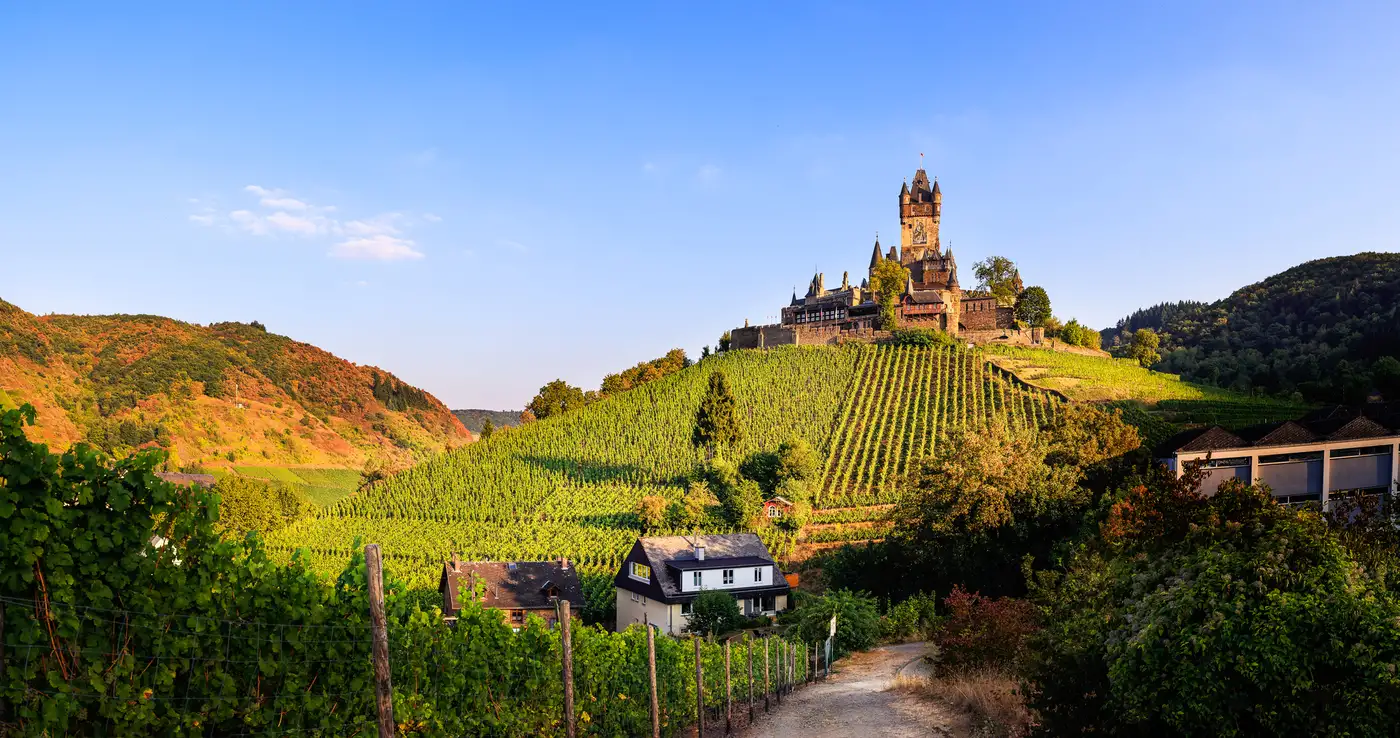
- Reichsburg Cochem and a panoramic river cruise through the valley's most dramatic landscapes
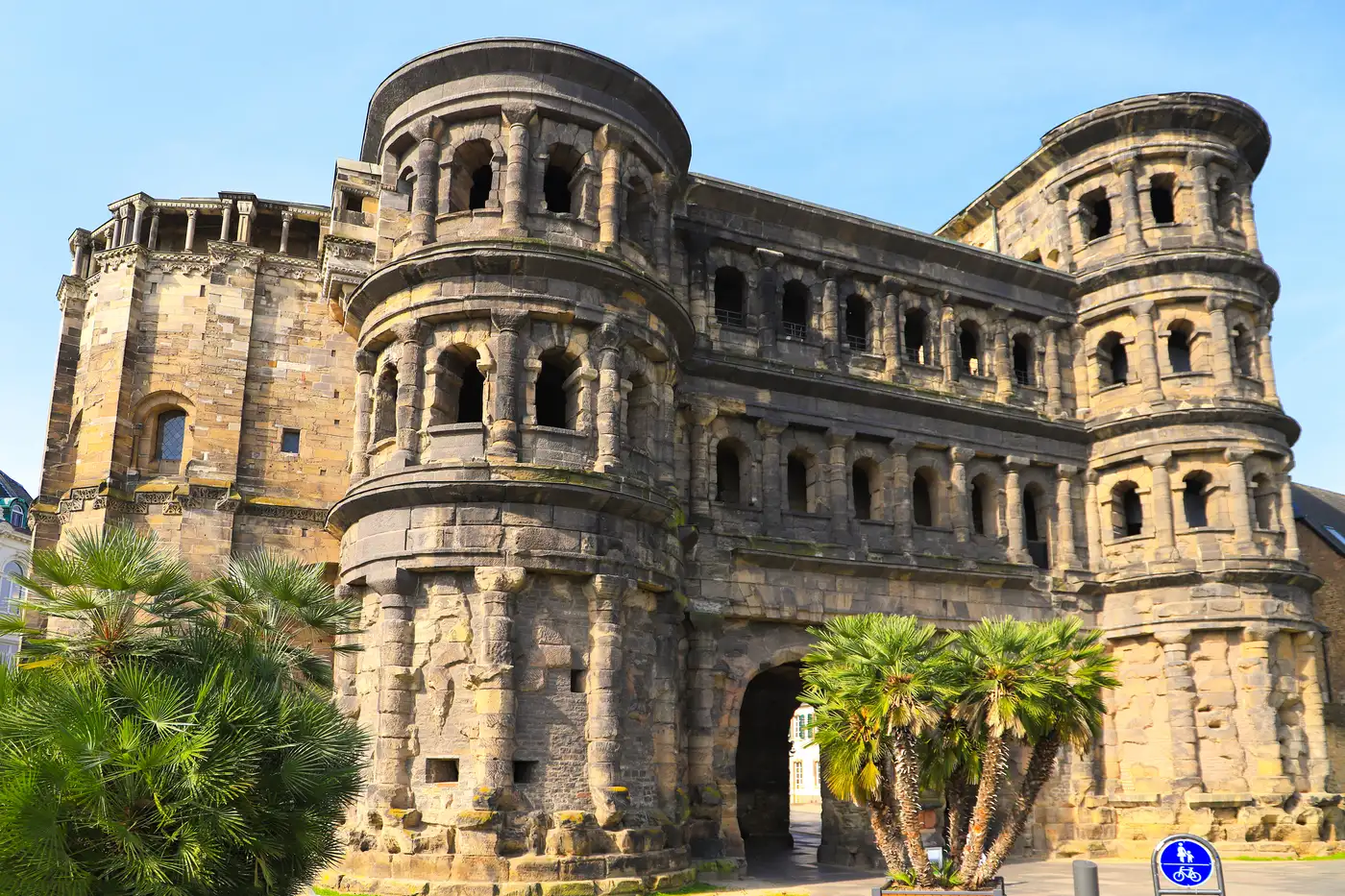
- Roman Trier — Augusta Treverorum — once capital of the Western Roman world
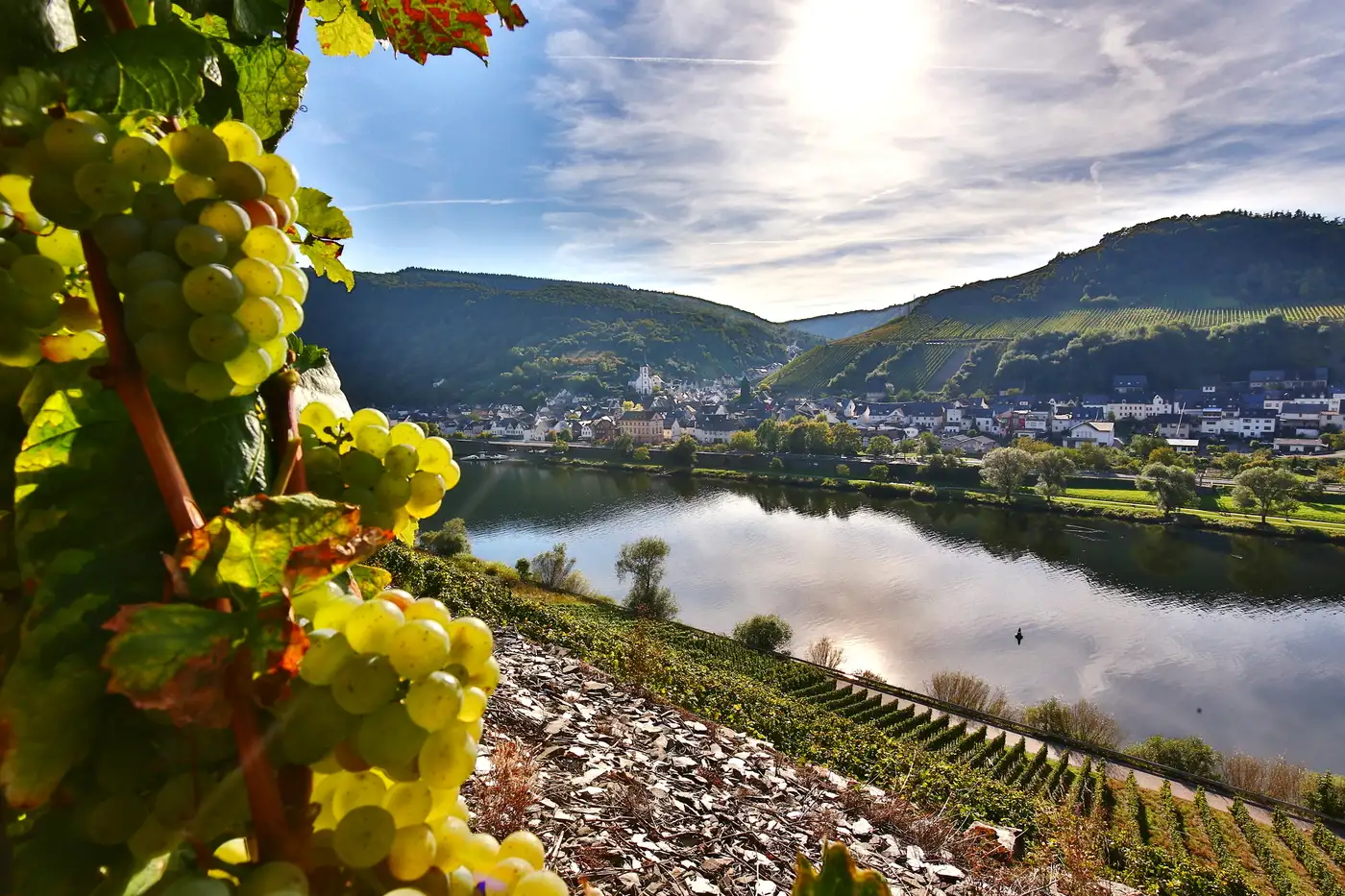
- Moselle Riesling at its source, with a winery visit and tasting lunch in Bernkastel-Kues
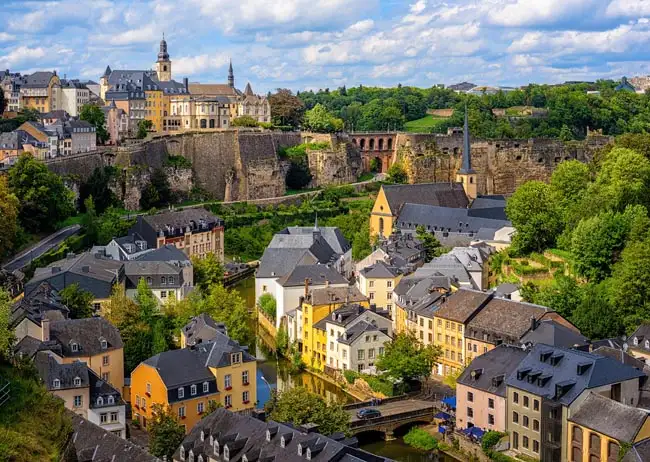
- Luxembourg City, the "Gibraltar of the North," its cliff-top fortress and UNESCO-listed skyline revealing a thousand years of improbable sovereignty
- Medieval Bruges by train from Brussels, a city so perfectly preserved it seems the 15th century simply forgot to leave.
- Singles friendly (view options for single travellers)
Travel writers who know Europe well tend to keep the Moselle to themselves. The Rhine gets the tourists, the Danube gets the cruises, and the Moselle — quieter, less travelled, and arguably more beautiful than either — gets the afternoons. If you haven't heard of it, you're in good company. You're also about to join a much smaller one.
What connects every stop on this thirteen-day journey is a shared condition: these are places that survived, and often thrived, by being smarter than their size suggested they had any right to be. Trier administered an empire from a provincial river bank. Luxembourg turned cliff-top geology into a thousand years of sovereignty. Bruges channelled the wool of English sheep and the silk of Italian merchants into the wealth that funded Flemish painting's golden age. And Brussels became the capital of a united Europe not despite being small and caught between larger powers, but because of it.
We follow this arc from Roman foundations to medieval wine culture to Belle Époque architecture to the glass towers of the European Quarter — a single coherent argument, written in stone and slate and Riesling, about how geography makes history.
- MealsSavour authentic flavours with included daily breakfasts, some lunches, and most dinners at handpicked local restaurants—immersing you in local cuisine without worrying about reservations or budgets.
- Transport & Logistics
Private air-conditioned coaches and included internal ferries and flights—ensuring hassle-free travel so you can focus entirely on the discoveries ahead.
"Adventures Abroad tour leader's management and guest services managed the tour with great skill and dedication. The tour leader was on top of every move and transfer. We have not experienced any issues with logistics and had a great time."
~ JULIA O"The tour leader did an excellent job coordinating some difficult travel logistics, power outage issues and resolving problems and dealing with guests who had unrealistic expectations."
~ CYNTHIA COLLINS - Expert Guidance
Unlock insider secrets at every landmark with your full-time Tour Leader and expert local guides , all gratuities covered—no hidden tipping surprises—so you immerse fully in your destination's stories, worry-free. (Except for the tips to your tour leader at the end of your tour.)
"Amazing tour guide. Our tour guide was very well organized, Her passion, knowledge, and enthusiasm completely transformed the travel experience into something truly unforgettable..."
~ MELANIE LEMAIRE"Highly recommend every trip with Adventures Abroad. It's a well organized and well thought out adventure. The tour leaders are friendly, knowledgeable and experienced professionals. Highly recommend this company."
~ SUSAN WALL - Sightseeing & EntrancesAll entrance fees for sites visited as per the itinerary—no hidden costs—so you can explore ancient ruins and excursions with complete peace of mind.
- AccommodationsUnwind in clean, well-located 3 to 4-star hotels with private en suite facilities—handpicked for comfort and convenience after each day's discoveries—so you can rest easy knowing your stay supports the real adventure, not steals the spotlight.
- Small Group
Discover the world in small groups of up to 18 travellers plus your expert Tour Leader—unlocking spontaneity, off-the-beaten-path adventures, and genuine connections at a relaxed pace, free from crowds.
"Looking Forward to My Next Adventure The best feature of the Adventures tour was the small size that allowed the group to quickly load up, let everyone get acquainted within the first 24 hours, capitalize on unplanned surprises along..."
~ PHILIP BLENSKI"Good value for a great time I have traveled with Adventures Abroad for over 20 years now. Well thought out, interesting itineraries and the other travelers congenial and friendly. The price always seems fair and overall a..."
~ Trusted Customer - Airport Transfers For Land & Air CustomersWe handle hassle-free airport transfers for all our land and air tour customers—plus early arrivals or late departures when you book extra hotel nights directly with us for added peace of mind.
- International airfare to/from the tour
- Tour Leader gratuities, most lunches/some dinners (see tour itinerary), drinks, personal items
- International air taxes (if applicable), any excursions referenced as 'optional'
- Airport transfers for Land Only customers
- Optional trip cancellation insurance (for information please click on the "Resources" tab)
- Seasonality and Weather:
Late Spring is one of the most rewarding times to travel the Moselle Valley. The vineyards are luminously green, the river towns lively without summer crowds, and the long days allow unhurried sightseeing. Brussels and Bruges in early June are warm, bright, and comfortably short of peak season congestion.
Early autumn brings the Weinlese — the grape harvest — when the vine-covered slopes ripen and the wine villages fill with seasonal energy. The light turns warmer and golden, the crowds thin, and the valley takes on a richness of colour that makes the landscape even more compelling. Wine lovers will find the September departure especially rewarding. - Transport and Travel Conditions:
Travel is by private coach through the Moselle Valley and Luxembourg, with one short direct train journey from Luxembourg City to Brussels. Passengers should be comfortable managing their own luggage on and off the train, as porter assistance cannot be guaranteed. Packing light is advisable.
Daily walking is gentle to moderate on cobblestones, gravel paths, and historic stonework. We'll also have some short walks to/from dinner. Cochem Castle involves an unavoidable 55-step climb and is not suitable for those with severely limited mobility; all other sites are fully accessible. The pace throughout is unhurried, and the rewards — river cruises, Roman ruins, medieval wine towns, and the grand squares of Brussels and Bruges — are considerable.
Am I suitable for this tour? Please refer to our self-assessment form - Activity Level: 1
No particular physical activity is involved other than town/city walks and short walks to dinners and sites of interest, some of which are large.
To learn more about the Activity levels, please visit our tour styles page. - Accommodation:
Throughout the tour we stay in well-located 4-star hotels chosen for proximity to each destination's town centres, promenades, and key sites. The Frankfurt arrival night is the exception — a comfortable 3-star property serving its purpose as a group assembly point before the journey begins in earnest the following morning.
A NOTE ON ROOM CONFIGURATIONS: The Moselle Valley region operates almost exclusively on a double-room model — purpose-built single and twin-bedded rooms are rare across the area, and this applies to our hotels in both Cochem and Bernkastel-Kues (5 nights). Travelling couples should be aware that beds in the Moselle segment will be double/matrimonial configuration with separate duvets rather than two separate beds — this is the regional norm and reflects local hotel tradition. Solo travellers interested in our same-gender roommate matching programme should contact us directly to discuss their options for this tour.
The single supplement on this tour is higher than our usual range, reflecting the fact that singles in the Moselle Valley are accommodated in double rooms used as singles — a genuine upgrade in terms of space and comfort, but one that carries a higher cost than a standard single room. Frankfurt, Luxembourg City, and Brussels are unaffected and offer standard room configurations. We have kept the supplement as close to cost as possible, as single supplements are not a profit centre for Adventures Abroad. - Staff and Support:
Full time Tour Leader plus local guiding at several locations. - Group Size:
Maximum 18 plus Tour Leader
- Day 1:Arrival in FrankfurtWelcome to the gateway - Frankfurt is where the journey assembles. Germany's financial capital — a skyline of glass towers rising incongruously above a preserved Römerberg quarter of reconstructed medieval gables — is less a destination than a threshold, and there's something fitting about that. The city sits at the point where ancient trade routes converged, where coronations of Holy Roman Emperors took place for five centuries, where the first unified German parliament met in 1848. It has always been a place where things begin.
Overnight near Frankfurt (airport area hotel).
Included Meal(s): Dinner, if required - Day 2:Frankfurt to Cochem: Where Rivers Meet, Empires Were BuiltOur coach departs Frankfurt this morning heading southwest. Within two hours we are standing at the Deutsches Eck — the "German Corner" — in Koblenz, at the precise point where the Moselle surrenders itself to the Rhine. Both rivers are visible, their different colours and temperatures merging in real time. It is one of those geographical moments that explains everything: why settlements grew here, why armies marched here, why every power that ever wanted to control this part of Europe converged on this spot.
The colossal equestrian statue of Kaiser Wilhelm I that dominates the promontory is a relatively recent imposition — the original was destroyed in World War II, the current one reinstated only in 1993. Empires, it turns out, are easier to build than to commemorate. But the strategic logic the Romans recognised here — the confluence as a natural meeting point, the hills above as natural fortification — is unchanged.
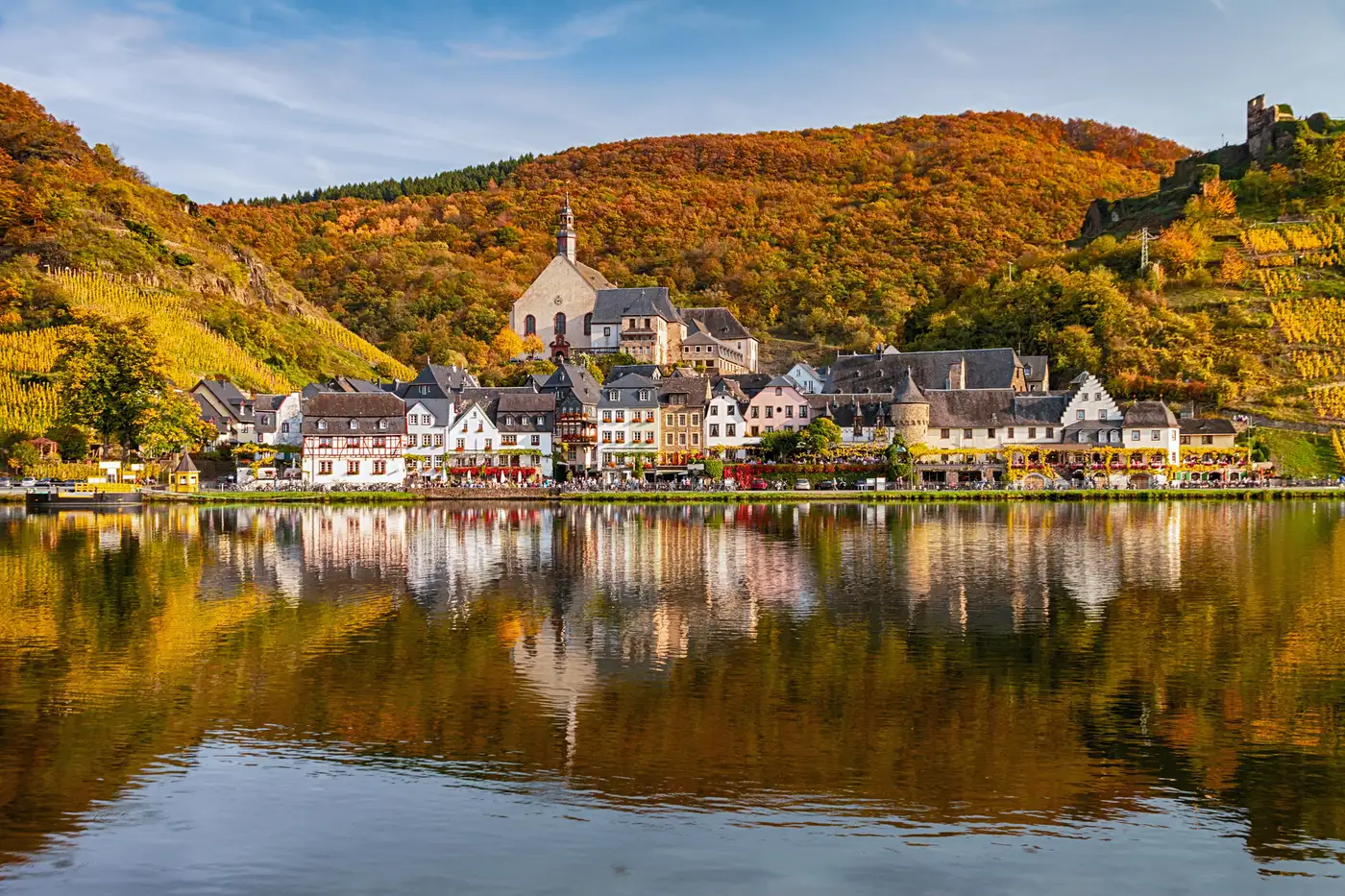
After a break for lunch in Koblenz, the coach follows the Moselle upstream to Cochem, our first valley town. This is our initial encounter with the landscape that will define the coming days: the river bending in great loops between terraced vineyard slopes, small villages clustered at the water's edge, and on virtually every defensible promontory, a castle. In spring the vineyards are an almost luminous green; come September those same slopes will be ripening toward the harvest, the vines heavy with fruit.
This evening, a stroll along the Moselle promenade introduces Cochem's medieval character — and dinner at a traditional restaurant with river views provides our first taste of the valley's hospitality.
Overnight in Cochem.
Included Meal(s): Breakfast and Dinner - Day 3:Cochem: The Castle and the RiverReichsburg Cochem does what medieval castles were designed to do: it announces power. Perched above the town on a conical hill, its towers and battlements visible from everywhere below, it was built to project authority over the river trade passing beneath it — the tolls extracted from wine and goods barges represented, for centuries, the economic engine of the region. The castle's current appearance owes more to 19th-century romantic reconstruction than to medieval authenticity, but the site is genuinely ancient, and the view from the ramparts — the Moselle looping between its vineyards, the town clustered below — makes the logic of the location unmistakable.
A guided tour leads us through the reconstructed interiors before the afternoon takes a different perspective entirely: a one-hour panoramic cruise on the Moselle itself. What the castle showed us from above, the river now shows from within — the terraced slopes rising on both banks, the villages appearing around each bend, the water reflecting the sky. It's the same landscape, experienced from its centre rather than its heights. The river that built all of this — the commerce, the castles, the wine culture — is no longer background; for an hour, it's the point.
Overnight in Cochem.
Included Meal(s): Breakfast and Dinner - Day 4:Beilstein and the Moselle LoopNot far upstream from Cochem, Beilstein has remained so determinedly unchanged that it's become something of an inadvertent museum of itself. The cobblestone lanes, the Baroque monastery church perched above the village square, the ruins of Metternich Castle (yes, that Metternich family — the Austrian statesman who reshaped post-Napoleonic Europe once owned this stretch of the valley) — all of it suggesting a place that commerce and modern development quietly bypassed. It's a gentle morning: a stroll through narrow streets, a visit to the monastery and the castle ruins, and lunch at leisure in a setting that feels genuinely unhurried.
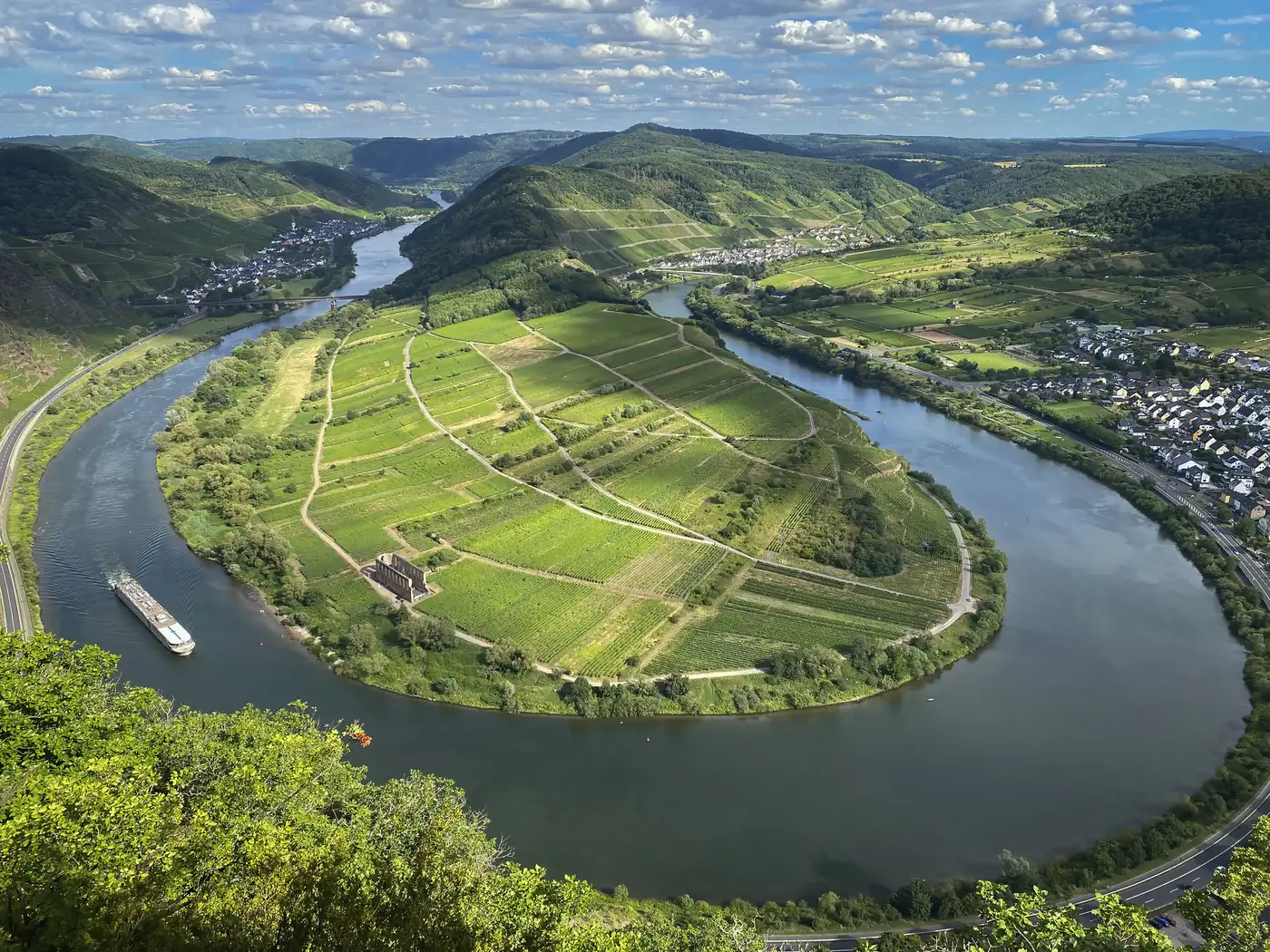
The afternoon shifts the perspective dramatically. The drive to the viewpoint above the Moselschleife — the great loop near Bremm — delivers one of the Moselle's most arresting panoramas. Standing on the heights above Kloster Stuben, the river traces a nearly complete oxbow around a steep peninsula of vines, the geometry almost too perfect to be natural. It is the valley's logic made visible in a single image: the river carving its own path, the vines following every inch of south-facing slope, the whole system in a balance that has taken two thousand years to arrive at.
Overnight in Cochem.
Included Meal(s): Breakfast and Dinner - Day 5:Trier & the Roman Foundation - Bernkastel-KuesEverything we've seen along the Moselle has deep roots, and today we visit those roots directly. Trier is the oldest city in Germany. At the height of the Roman Empire it was the capital of the Western Roman world — a city of 80,000 inhabitants with its own imperial palace, circus, amphitheatre, and public baths. The Romans called it Augusta Treverorum: the city of the Treveri tribe, made magnificent by imperial ambition. It administered an empire from a provincial river bank. The river made it possible.
What survives is extraordinary. The Porta Nigra — the Black Gate — is the largest and best-preserved Roman city gate north of the Alps, its massive sandstone blocks held together by iron clamps rather than mortar, blackened by centuries of urban grime into something that looks almost geological. The Imperial Baths rival anything surviving in Rome itself. The Basilica of Constantine, repurposed as a Protestant church, retains the sheer scale of imperial architecture — 67 metres long, 30 metres high — designed to make individual humans feel appropriately small. It still works.
A specialist Roman heritage guide leads the morning's exploration, turning impressive ruins into a comprehensible civilisation. After lunch in Trier's market square — itself Roman in its bones — Trier Cathedral and the Church of Our Lady show how completely the medieval city absorbed and built upon what came before.
Late afternoon, the coach follows the river upstream to Bernkastel-Kues, our base for the next three nights.
Overnight in Bernkastel-Kues.
Included Meal(s): Breakfast and Dinner - Day 6:Bernkastel-Kues: The Wine CapitalIf Trier represents the Roman foundation of this valley, Bernkastel-Kues represents its medieval flowering — the point at which the wine trade generated enough wealth to produce one of the most beautifully preserved market towns in Germany. A guided walking tour this morning leads through the historic centre: the famous Spitzhäuschen, the precariously leaning "Pointed House" that has been defying gravity since the 17th century; the Renaissance market square surrounded by half-timbered facades; the ruins of Landshut Castle above the town, a reminder that defending the trade routes remained as important as exploiting them.
The afternoon moves from the town to the source of its prosperity. A winery visit and tasting lunch explores what the Moselle actually produces — specifically, why Moselle Riesling occupies a category of its own in the wine world. The steep slate hillsides that make these vineyards so dramatic to look at are also the key to the wine's character: dark slate absorbs heat during the day and releases it at night, extending the growing season and preserving the acidity that balances Riesling's natural sweetness. The result — in a good vintage — is a wine of unusual delicacy and longevity, the river's mineral character somehow present in the glass (non-alcoholic options available).
Overnight in Bernkastel-Kues (dinner on your own this evening).
Included Meal(s): Breakfast and Lunch - Day 7:Traben-Trarbach: Art Nouveau and Underground EmpiresTraben-Trarbach sits downstream from Bernkastel-Kues and tells a different chapter of the Moselle's story — one from the wine trade's 19th-century apex, when the valley's merchants were wealthy enough to commission architecture in the fashionable Art Nouveau style then sweeping Europe. The result is a town of unusual visual character: the organic curves and natural motifs of Jugendstil applied to wine merchant mansions, their elaborately decorated facades a record of prosperity expressed in the international language of the moment.
A guided walking tour explores this architectural heritage, but the day's most distinctive element lies underground. Beneath the town, vast vaulted chambers carved into the hillside once held millions of litres of Riesling awaiting export to markets across Europe. These accessible cellars are an unexpectedly powerful reminder of the industrial scale the wine trade achieved here — and of how much of what the Moselle Valley looks like today is the product of organised, sustained commercial ambition rather than picturesque accident.
Overnight in Bernkastel-Kues.
Included Meal(s): Breakfast and Dinner - Day 8:Bernkastel-Kues, Germany - Luxembourg: The Fortress CountryThe coach departs this morning on a two-hour journey northwest, following the Moselle toward its source as the valley narrows and the landscape shifts toward the rolling, wooded terrain of the Grand Duchy. Luxembourg is easy to underestimate. A country of 2,600 square kilometres and fewer than 700,000 people — smaller than many English counties — it has nonetheless been successfully independent for over a thousand years, hosts the headquarters of the European Court of Justice and the European Investment Bank, and is, on a per-capita basis, one of the wealthiest nations on earth. The geography explains everything: the Alzette and Pétrusse rivers have carved such deep gorges into the plateau that Luxembourg City's old town sits atop a natural fortress that no army managed to conquer for most of its history. Geography, it turns out, is a form of policy.
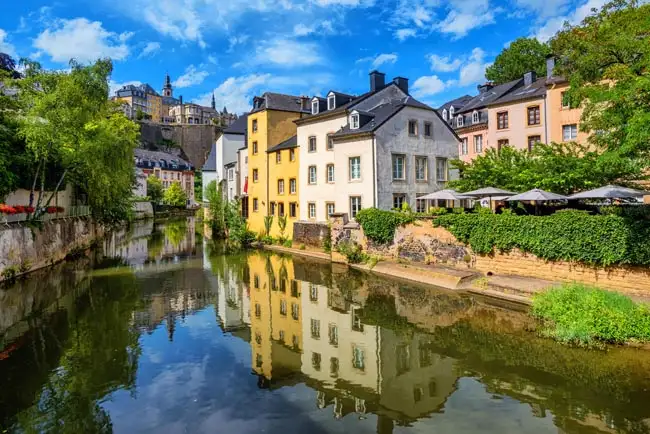
Arriving late morning, the afternoon is spent unlocking the city's layers with a local guide. The upper town — the Place d'Armes, the Place Guillaume II, the Grand Ducal Palace — gives way to the Chemin de la Corniche, a promenade along the cliff edge with the most dramatic views in the city: the deep gorge falling away below, the lower town of Grund far beneath, the old walls and towers framing a UNESCO World Heritage skyline. Descending to Grund by the Pétrusse Express train or the public elevators, we encounter a completely different Luxembourg — intimate, residential, the café terraces occupying the same valley floor that the fortifications above once defended.
The Bock Casemates complete the picture: 17 kilometres of underground galleries tunnelled into the cliff, once housing 35,000 soldiers, today one of Europe's most unusual self-guided experiences. The rock that saved Luxembourg is also what you walk through.
Overnight in Luxembourg City.
Included Meal(s): Breakfast and Dinner - Day 9:Luxembourg: The Kitchen as CultureLuxembourg's culinary identity is a layered thing — French finesse, German heartiness, and a distinctly local sensibility shaped by centuries of being a crossroads. Today's hands-on cooking class pulls that identity into focus, spending a morning learning the techniques and traditions behind Luxembourgish cuisine before sitting down to the lunch we've helped create.
The afternoon is yours — Luxembourg City rewards unhurried independent exploration. The Mudam (Luxembourg's contemporary art museum, housed in a building designed by I.M. Pei), the National Museum of History and Art, or simply the café terraces of the Place d'Armes invite the kind of extended, unscheduled time that travel rarely allows.
The evening is at leisure — a last independent night in the Grand Duchy before the journey takes its final turn north toward Belgium tomorrow.
Overnight: Luxembourg City (dinner on your own).
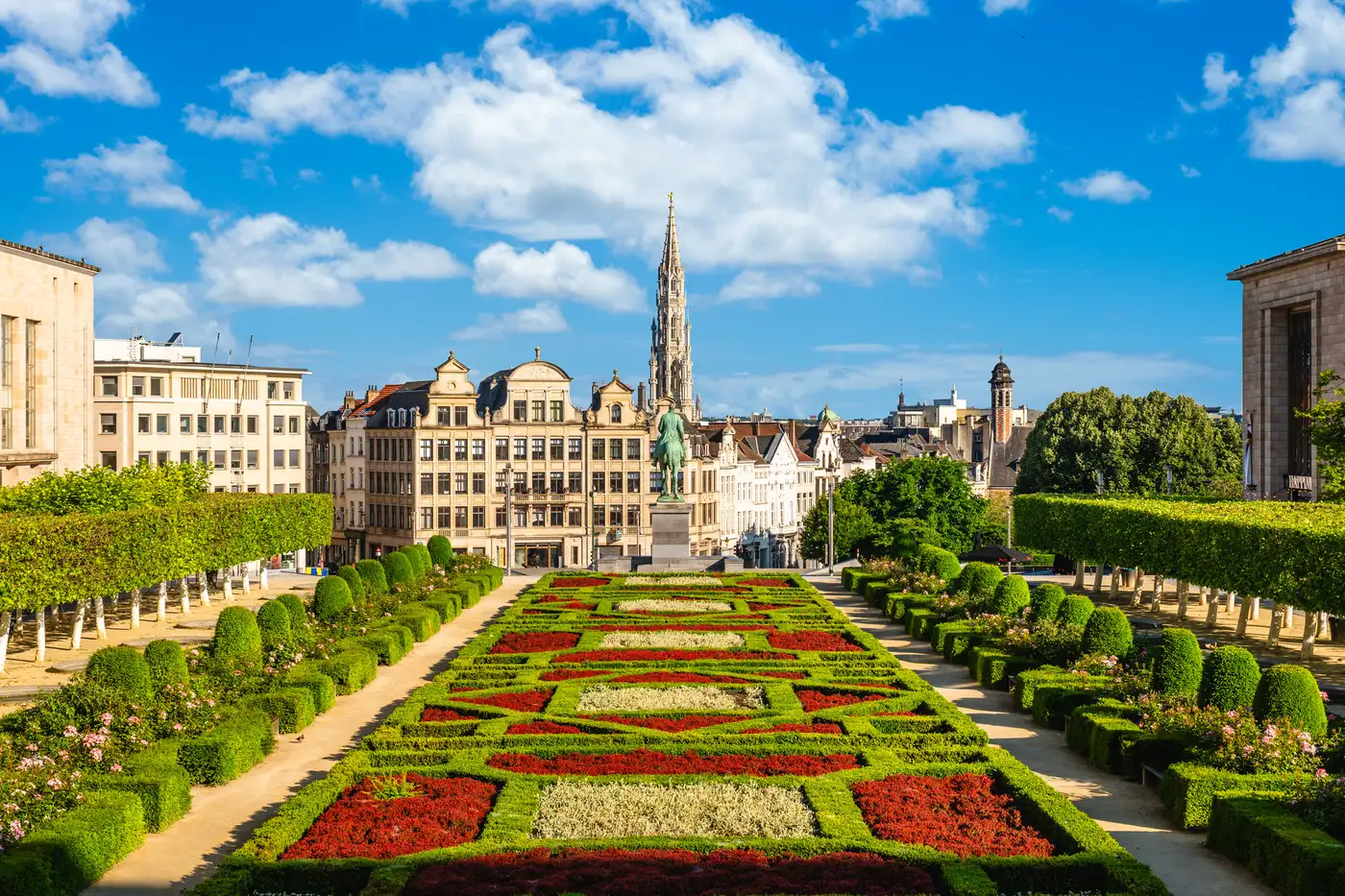
Included Meal(s): Breakfast and Lunch - Day 10:Luxembourg - Brussels, Belgium: The Continent's CapitalThe train north from Luxembourg City this morning covers barely two hours of Belgian countryside before delivering us into the heart of a city that has become, almost by accident, the administrative capital of a united Europe. Brussels was chosen for this role for reasons that say everything about how Europe works: it belonged to a country too small, too carefully balanced between larger neighbours, and too diplomatically nimble to threaten anyone. In that sense it is the logical endpoint of a journey that began in the Roman river valley — another small place that punched, and continues to punch, considerably above its weight.
The afternoon is an introduction to the city on foot. The Grand Place — Brussels' central square, its guildhalls and town hall dripping with gilded Baroque excess — is one of the great urban set pieces in Europe, the kind of space that stops conversation. The covered Galeries Royales Saint-Hubert nearby, built in 1847, was the first shopping arcade in Europe — a vaulted glass passageway of bookshops, chocolatiers, and cafés that has been doing its quiet, elegant work for nearly two centuries.
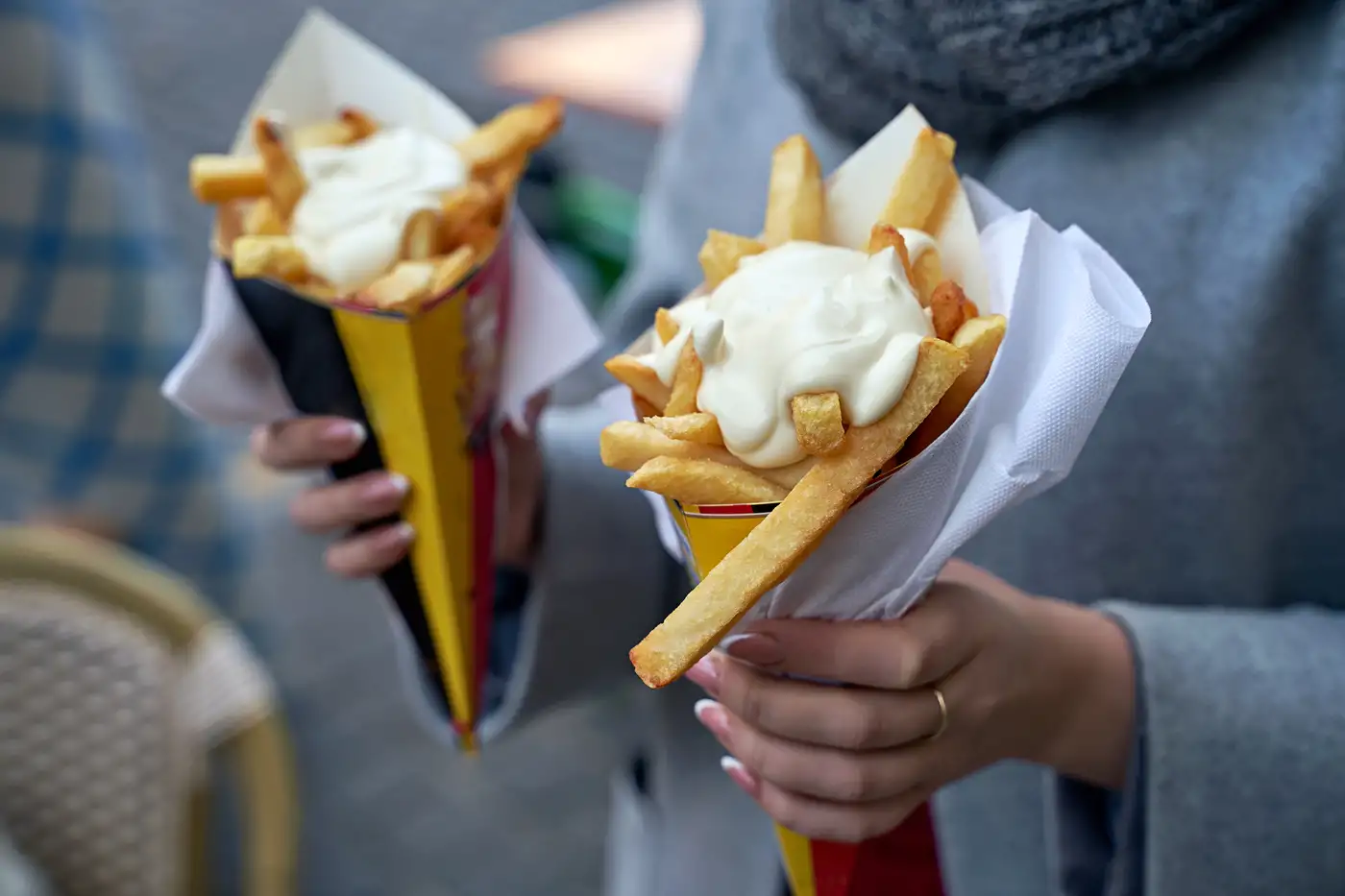
This evening, dinner in Brussels means an initiation into the other great culinary tradition of the Low Countries and a beer culture so deeply embedded in national identity that UNESCO added it to the Intangible Cultural Heritage list in 2016. After the Riesling country and the Luxembourgish kitchen, it is a fitting turn at the table.
Overnight in Brussels.
Included Meal(s): Breakfast and Dinner - Day 11:Bruges: The City That Time CuratedThere is a reason Bruges appears on more European bucket lists than almost any other city of its size. In the 14th and 15th centuries it was one of the wealthiest cities in the world — the northern terminus of Mediterranean trade routes, where Italian banking houses established their northern offices and Flemish masters produced paintings of extraordinary refinement for wealthy merchant patrons. Then the River Zwin silted up, the trade moved to Antwerp, and Bruges simply stopped. The 19th century that industrialised and rebuilt most of Europe largely bypassed it. What we see today is not a reconstruction — it is a medieval commercial city in a state of remarkable, almost uncanny preservation.
Our morning train from Brussels takes just over an hour, and a short walk from the station delivers us into the Markt — the great central square where the medieval Belfry rises 83 metres above the city, its carillon of 47 bells having marked the hours of Bruges life since the 13th century. A guided walking tour moves through the city's layers: the Burg square with its Basilica of the Holy Blood; the canal network that once carried the merchandise of half the known world; the almshouse courtyards and beguinages where medieval civic charity left its quiet mark on the urban fabric.
Lunch is at leisure — Bruges rewards time spent without a programme. The Groeningemuseum for those drawn to the Flemish Primitives, the brewery visits, the chocolatiers, or simply the canals on foot, the light falling on the water the way it falls in the paintings. Return train to Brussels at your leisure; to maximize flexibility, we do not include a group dinner this evening.
Overnight in Brussels.
Included Meal(s): Breakfast - Day 12:Brussels: The European Idea and a Final AfternoonA full day in Brussels reveals a city of considerably more depth and character than its reputation as a bureaucratic capital might suggest. This morning, a guided walk through the European Quarter — the glass and steel district around the Berlaymont building, headquarters of the European Commission — offers something quietly profound for travellers who have spent nearly two weeks moving through the aftermath of Roman empire, medieval rivalry, and the fortress logic of small sovereignties. This is not merely an administrative zone but a physical expression of an idea: that the nations of a continent that spent centuries at war with each other could choose, deliberately and painstakingly, to build something together. The arc from Trier to Brussels — from the empire that first unified this part of the world by conquest to the union that chose to do it by consent — closes here, on foot, in the morning light.
The afternoon belongs to us. The Sablon district — antique shops, chocolate ateliers, and the Church of Our Lady of the Sablon framing one of the city's most elegant squares — rewards unhurried browsing. The Galeries Royales Saint-Hubert offer a vaulted glass corridor of bookshops, praliniers, and cafés. The Grand Place terraces invite a final coffee or Belgian beer, the guildhall facades catching the afternoon light. For those who prefer to range further, the comic strip art trail or the Royal Museums of Fine Arts are within easy reach.
This evening, our farewell dinner — the last shared table of the journey. Brussels does this well: the restaurant culture is serious, the ingredients exceptional, and there is something entirely fitting about ending a journey through the river valleys and small nations of northern Europe at a table in the city that, more than any other, represents what those nations eventually chose to build together.
Overnight in Brussels.
Included Meal(s): Breakfast and Dinner - Day 13:Departure The Journey CompleteDepartures from Brussels Zaventem Airport.*
Our open-jaw routing — Frankfurt arrival, Brussels departure — means we leave from a different city than we arrived in, which is as it should be. We have travelled in one direction: from the Roman foundations of the Moselle, through the medieval wine country, across the fortress duchy, to the capital of a united continent. The river, somewhere behind us, is still running north.
* A note on departure transfers: Brussels is one of those rare exceptions where we happily set aside our usual policy on pre-arranged airport transfers. The train from Brussels Central to Zaventem Airport runs every ten minutes, takes under twenty minutes, depositing you directly beneath the departures hall. It is faster, cheaper, and more flexible than a taxi, and your Tour Leader will make sure you're fully briefed before the journey ends.
Bon Voyage!
Included Meal(s): Breakfast
Countries Visited: Belgium, Germany and Luxembourg
*The red tour trail on the map does not represent the actual travel path.
Book This Tour
- Final payment: Due 90 days prior to departure.
- Deposit: A non-refundable $500 CAD Deposit is required at booking.
- Optional Single Supplement: $2700 CAD (number of singles limited).
(View options forsingle travellers) - Transfering Tour or Date: Transferring to another tour or tour date is only permissible outside of 120 days prior to departure and is subject to a $100 CAD change fee.
(Read our cancellation policy) - Please refer to the note specific to SINGLE SUPPLEMENT pricing in the 'Accommodation' section under "Info & Inclusions"
Prices below are per person, twin-sharing costs in Canadian Dollars (CAD). Pricing does not include airfare to/from the tour and any applicable taxes.
Frequently Asked Questions
- What is the maximum number of participants on a trip?Most of our tours carry a maximum of 18 participants; some tours (ie hiking tours) top out at 16. In the event that we do not achieve our minimum complement by our 90-day deadline, we may offer group members the option of paying a "small-group surcharge" as an alternative to cancellation. If all group members agree, we will confirm the trip at existing numbers; this surcharge is refundable in the event that we ultimately achieve our regular minimum. If the small group surcharge is not accepted, we will offer a refund of your deposit or a different trip of your choice.
- Can I extend my tour either at the beginning or end? What about stopovers?Yes, you can extend your tour either at the beginning or the end and we can book accommodation in our tour hotel. Stopovers are often permitted, depending on air routing. Stopovers usually carry a "stopover" fee levied by the airline.
- How do I make a reservation? How and when do I pay?The easiest way to make a reservation is via our website; during office hours, you are also more than welcome to contact us by telephone.
A non-refundable deposit is payable at the time of booking; if a reservation is made within 90 days, full payment is required. Some trips require a larger deposit. If international airline bookings require a non-refundable payment in order to secure space or the lowest available fare, we will require an increase in deposit equal to the cost of the ticket(s).
Early enrolment is always encouraged as group size is limited and some trips require greater preparation time.
Once we have received your deposit, we will confirm your space and send you a confirmation package containing your trip itinerary, any visa/travel permit related documents, invoice, clothing and equipment recommendations, general information on your destination(s), and forms for you to complete, sign and return to us. Your air e-tickets (if applicable), final hotel list, final trip itinerary, and instructions on how to join your tour, will be sent approximately 2-3 weeks prior to departure. - What about cancellations, refunds, and transfers?Please review our cancellation policy page for details.
- I am a single who prefers my own room. What is a single supplement?All of our tours have a single supplement for those who want to be guaranteed their own room at each location.
This supplement is a reflection of the fact that most hotels around the world do not discount the regular twin-share rate for a room by 50% for only one person occupying a room. Most hotels will give a break on the price, but usually in the range of 25-30% of the twin-share rate. This difference, multiplied by each night, amounts to the single supplement.
The conventional amount can also vary from country to country and some destinations are more expensive than others for single occupancy. In order to be "single friendly," the supplements we apply are not a profit centre for us and we do our best to keep them as reasonable as possible.
On most tours we limit the number of singles available, not to be punitive, but rather because many hotels allow for only a limited number of singles; some smaller hotels at remote locations also have a limited number of single rooms available.
Please note that most single rooms around the world are smaller than twin-share rooms and will likely have only one bed. - Do you have a shared accommodation program?Yes! If you are single traveller and are willing to share, we will do our best to pair you with a same-gender roommate. Please note that should we fail to pair you, we will absorb the single supplement fee and you will default to a single room at no extra charge.