Tourcode: GY1
- Popular
- Off The Beaten Path
- History
- Overview
- Info & Inclusions
- Itinerary
- Map & Hotels
- Photos
- Dates & Prices
- 12 Days
- Max Group Size 18
- Flight-seeing over Kaieteur Falls, the world's highest single-drop waterfall
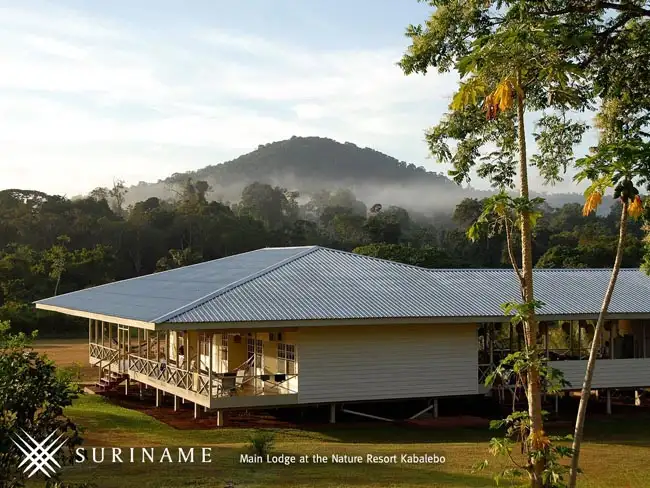
- Three nights at remote Kabalebo Nature Resort, home to 250+ bird species
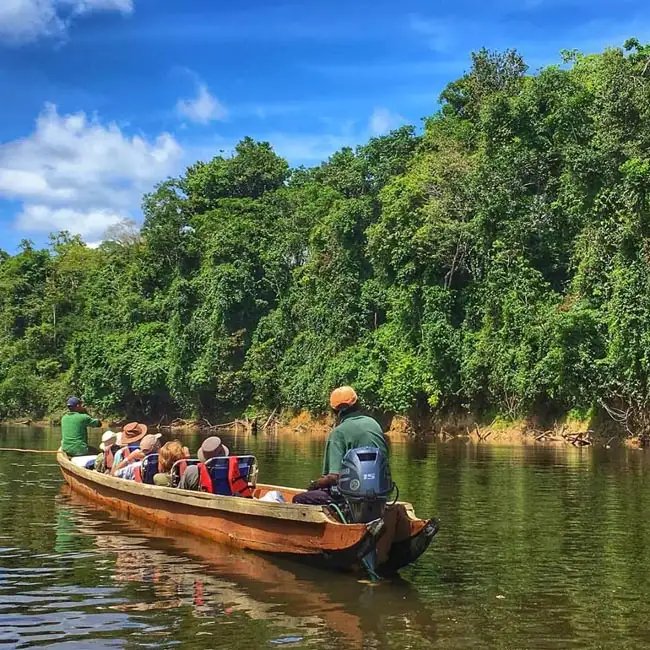
- Essequibo River motorboat excursion to Sloth Island for wildlife spotting
- Guided tour of the Ariane Space Centre
- Full-day excursion to the infamous Îles du Salut penal colony
- Exploring Paramaribo's UNESCO-listed colonial centre
- Singles friendly (view options for single travellers)
Water is the other constant. It shapes everything here — the Dutch-engineered seawall holding Georgetown above the Atlantic, the Potaro River gathering itself before the long drop at Kaieteur, the Kabalebo winding through territories where the forest has never been cleared. We travel this region the way it has always been travelled: by river, by boat, by the logic of water. And at the end, off the coast of French Guiana, the Îles du Salut rise from the Caribbean — where the channel that once kept prisoners from swimming to freedom now frames one of the most quietly haunting views in South America.
This is not an easy corner of the world to reach, nor a polished one. But what it offers — in wilderness, in history, in sheer human strangeness — is available nowhere else.
- MealsSavour authentic flavours with included daily breakfasts and dinners at hotels or handpicked local restaurants—immersing you in local cuisine without worrying about reservations or budgets.
- Transport & Logistics
Private air-conditioned coaches and included internal ferries and flights—ensuring hassle-free travel so you can focus entirely on the discoveries ahead.
"Adventures Abroad tour leader's management and guest services managed the tour with great skill and dedication. The tour leader was on top of every move and transfer. We have not experienced any issues with logistics and had a great time."
~ JULIA O"The tour leader did an excellent job coordinating some difficult travel logistics, power outage issues and resolving problems and dealing with guests who had unrealistic expectations."
~ CYNTHIA COLLINS - Expert Guidance
Unlock insider secrets at every landmark with your full-time Tour Leader and expert local guides , all gratuities covered—no hidden tipping surprises—so you immerse fully in your destination's stories, worry-free. (Except for the tips to your tour leader at the end of your tour.)
"Amazing tour guide. Our tour guide was very well organized, Her passion, knowledge, and enthusiasm completely transformed the travel experience into something truly unforgettable..."
~ MELANIE LEMAIRE"Highly recommend every trip with Adventures Abroad. It's a well organized and well thought out adventure. The tour leaders are friendly, knowledgeable and experienced professionals. Highly recommend this company."
~ SUSAN WALL - Sightseeing & EntrancesAll entrance fees for sites visited as per the itinerary—no hidden costs—so you can explore ancient ruins and excursions with complete peace of mind.
- AccommodationsUnwind in clean, well-located 3 to 4-star hotels with private en suite facilities—handpicked for comfort and convenience after each day's discoveries—so you can rest easy knowing your stay supports the real adventure, not steals the spotlight.
- Small Group
Discover the world in small groups of up to 18 travellers plus your expert Tour Leader—unlocking spontaneity, off-the-beaten-path adventures, and genuine connections at a relaxed pace, free from crowds.
"Looking Forward to My Next Adventure The best feature of the Adventures tour was the small size that allowed the group to quickly load up, let everyone get acquainted within the first 24 hours, capitalize on unplanned surprises along..."
~ PHILIP BLENSKI"Good value for a great time I have traveled with Adventures Abroad for over 20 years now. Well thought out, interesting itineraries and the other travelers congenial and friendly. The price always seems fair and overall a..."
~ Trusted Customer - Airport Transfers For Land & Air CustomersWe handle hassle-free airport transfers for all our land and air tour customers—plus early arrivals or late departures when you book extra hotel nights directly with us for added peace of mind.
- International airfare to/from the tour.
- Tour Leader gratuity, some lunches, drinks, personal items (phone, laundry, etc), departure taxes, domestic and international air taxes (if applicable).
- Airport transfers for Land Only customers.
- Optional trip cancellation insurance.
- Seasonality and Weather:
Overall, while the Guianas can be visited year-round, the period from November to March offers a balance of warm weather and occasional rainfall, making it a suitable time for travellers who are prepared for tropical conditions.
What you can expect:
• Warm-hot temperatures: Expect average temperatures around 25-30°C (77-86°F)
• High humidity: The tropical climate ensures high humidity levels, making it feel even warmer.
• Frequent rainfall: While the rains are generally shorter and less intense compared to the main rainy season (April-June), expect occasional showers and thunderstorms. - Transport and Travel Conditions:
Local land transport provided by air-conditioned bus, minibus, and/or taxi. Kaieteur Falls and Kabalebo flights via light charter aircraft.
For our nights at Kabalebo, you must bring a smaller bag max weight 7 kg/15 lbs due to the nature of the light aircraft used. Larger bags will be kept securely during this time.
This tour is not strenuous per se, but our "2" level rating refers to the ambitious nature of the itinerary, the remote locations covered, the tropical heat/humidity, and several activities (ie jungle walks) that one must be prepared for in order to fully enjoy all elements of this trip.
One must also be mindful of the nature of the places we visit within this region, one of the least-visited corners of this continent. Tourist-related infrastructure, facilities, and service levels are not well-developed, and you will no doubt experience some "rough edges" and things that don't work as efficiently as one would expect or hope. While every effort is made to ensure that you get the most out of your experience, comfortably and safely, in these three out-of-the-way places, one must pack one's sense of adventure in order to enjoy the unique attributes of each destination for what they are.
Am I suitable for this tour? Please refer to our self-assessment form - Activity Level: 2
These are particularly busy tours that feature a lot of moving around, sometimes by train and short journeys on local transport. Walking tours of towns and cities are leisurely but you should be prepared to be on your feet for several hours. Some of our cultural trips that occur at high altitude and/or require greater independence with baggage handling (at hotels, airports, train stations) also fall into this category.
To learn more about the Activity levels, please visit our tour styles page. - Accommodation:
Well-located, air-conditioned, mid-range (3 & 4 star) hotels/resorts with en suite toilet and bath throughout. Single rooms are limited in number and likely smaller than doubles. Porter service is sometimes available though you should be independent with your luggage, especially at airports and some hotels which may NOT have elevators. Please note that Wifi, though available in theory, may be weak or suffer from outages. Please note that internet is a chargeable service at Kabalebo owing to the cost of the satellite uplink.
Maximum 3 single rooms available (additional singles may be available upon request)
Please click on "Map & Hotels" for more details. - Staff and Support:
Tour Leader, driver/s, and local step on guides. - Group Size:
Maximum 18 (plus Tour Leader)
- Day 1:Arrival in GeorgetownToday we arrive in Georgetown, capital of Guyana and one of South America's lesser-known destinations.
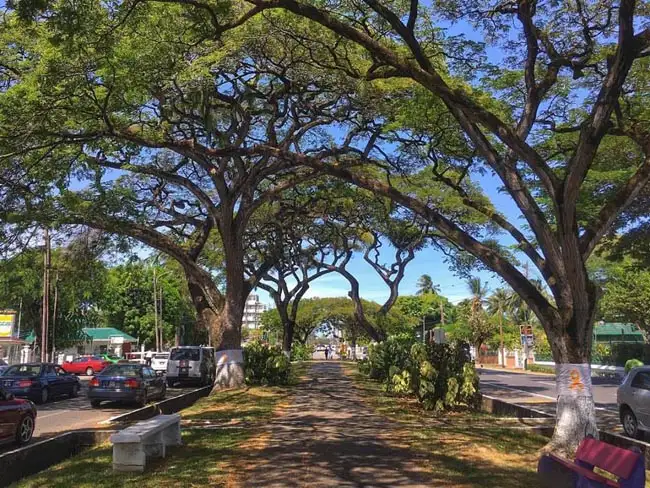
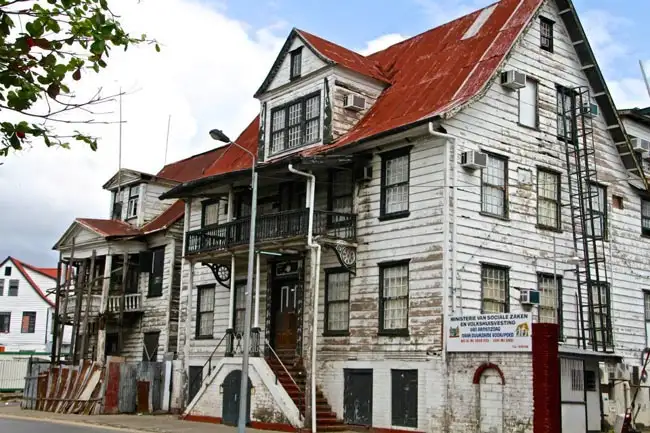
Georgetown announces itself before you've left the airport. The city sits below sea level — held there by a seawall and drainage system the Dutch engineered in the 18th century and the British inherited without fully understanding. Wide tree-lined avenues open onto wooden colonial buildings of considerable scale, their white paintwork going gently to seed in the tropical heat.
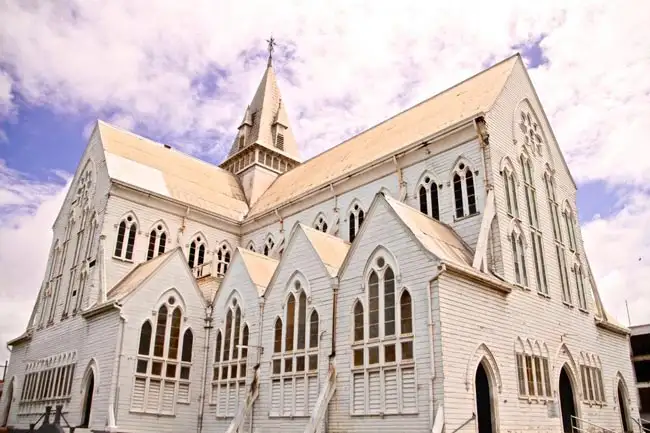
Named for King George III, Georgetown is the most British city in South America. St George's Cathedral soars above the rooftops in white-painted hardwood, one of the tallest wooden structures on earth, its Victorian Gothic ambition intact despite the humidity that slowly consumes everything here. The streets around it preserve the colonial grid: wide, shaded, and quiet in the particular way of cities whose builders have long since departed.
This evening we gather for our first dinner together.
Overnight in Georgetown. 
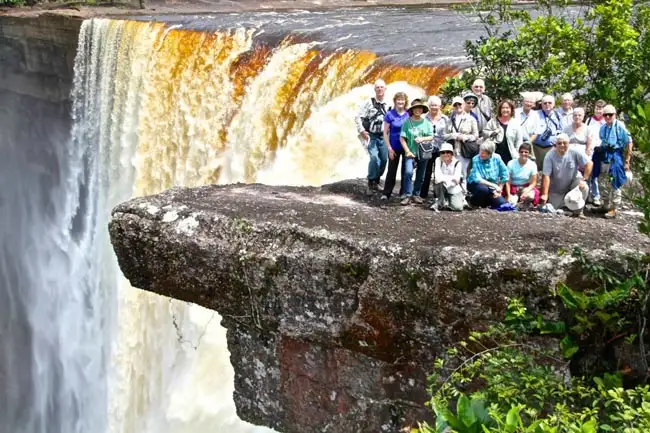
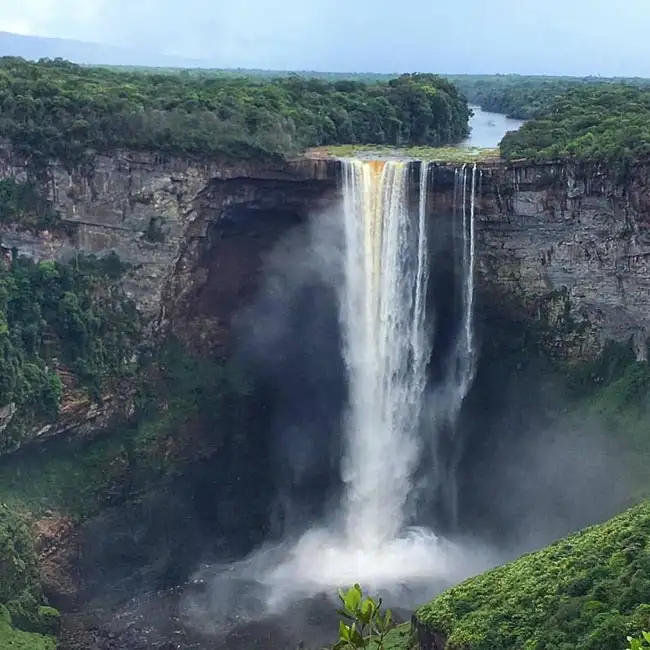
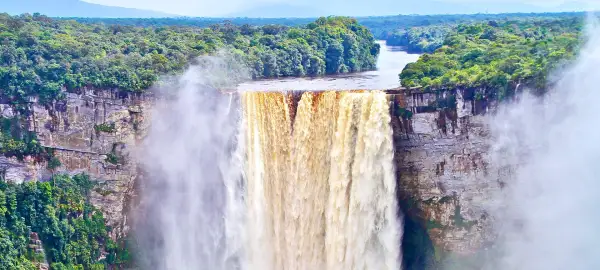
Included Meal(s): Dinner, if required - Day 2:Georgetown - Fly to Kaieteur Falls - Riverside ResortLong before the British named this country and the Dutch engineered its coastline, a Patamona chief named Kaie paddled to the edge of the world to save his people. The legend holds that he canoed over the precipice willingly — an offering to Makonaima, the Great Spirit — to turn aside the Caribishi who threatened to destroy his tribe. What he went over was 224 metres/741 ft of free-falling water, the highest single-drop waterfall on earth.
We fly into Guyana's interior this morning — roughly an hour and a half by light aircraft — and our pilot circles Kaieteur before landing, giving passengers on both sides a view of the Potaro River as it gathers, narrows, and then simply disappears over the sandstone plateau into the gorge below. On the ground, a trail winds through tropical vegetation to a series of viewpoints where the scale of the thing becomes real in a way the aerial view doesn't quite prepare you for.
After our time at the falls we fly onward to a landing strip at the edge of the Essequibo — one of the great rivers of South America, wide enough in places to lose sight of the far bank — where a boat takes us downstream to our jungle resort for the night. The river is bronze in the late afternoon light, the forest unbroken on both sides. The empire-built coast already feels very far away.
NOTE: For our time here and later at Kabalebo in Suriname, please pack a smaller collapsible overnight bag due to light aircraft weight restrictions. Your larger baggage will be securely stored.
Overnight at our jungle resort. 
Included Meal(s): Breakfast and Dinner - Day 3:Riverside Resort - Sloth Island - Georgetown TouringThis morning we travel by motorboat to Sloth Island, a wildlife sanctuary mid-river, for wildlife spotting before continuing to Fort Zeelandia to visit the fort and museum. The Dutch built forts the way they built cities: systematically, with an eye on the water, and with the intention of staying. They didn't stay, but the forts remain.
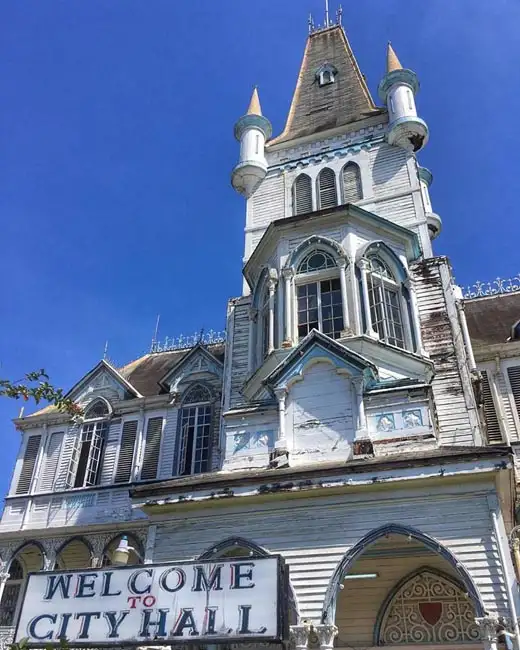
Back in Georgetown by afternoon, we spend several hours with the city on foot. The Dutch legacy is most legible at the waterfront, where the seawall and canal system that keeps Georgetown above the Atlantic reveal themselves as a feat of hydraulic engineering that the tropics have been quietly contesting ever since. The Stabroek Market's iron clock tower presides over the waterfront chaos; the Parliament building and the colonial-era Red House anchor the civic centre. St George's Cathedral needs no introduction after last night, but seen in daylight its scale is newly astonishing — all that ambition, expressed in wood.
We visit the Walter Roth Museum of Anthropology, where Guyana's indigenous peoples — the Patamona, the Arawak, the Wapishana among others — are given context beyond the colonial narrative that tends to dominate the rest of the city. We finish at the National Park, whose waterways are home to West Indian manatees — slow, vast, improbably gentle creatures that surface without drama and submerge the same way, leaving barely a ripple.
Tonight dinner is on your own — a chance to find your own corner of this quietly extraordinary city.
Overnight in Georgetown. 
Included Meal(s): Breakfast and Lunch - Day 4:Georgetown, Guyana - Fly to Paramaribo, SurinameParamaribo stops you in your tracks before you've worked out why. The streets are Dutch — the proportions, the brick, the relationship between building and canal — but the faces, the food, the sound of the city are Caribbean. Suriname absorbed the Dutch colonial project and then filled it with everyone else: enslaved Africans, indentured labourers from India and Java, Sephardic Jews fleeing the Inquisition via Brazil, Maroons who escaped the plantations and built their own nations in the interior. The result is a city that shouldn't cohere and somehow does.
The evidence is most startling at the centre of town, where the Neveh Shalom Synagogue and the Keizerstraat Mosque stand on the same block — not tolerating each other at a distance, but genuinely neighbouring, sharing the street the way longtime residents share a fence. Both communities have been here for centuries. The sand floors of the synagogue, a Sephardic tradition, were laid by people who arrived here having already fled one continent; the mosque serves a community whose ancestors were brought from Java under Dutch colonial labour contracts. That these two institutions ended up next to each other is one of colonial geography's more unexpected outcomes.
We explore the UNESCO-listed inner city on foot — the Presidential Palace and its stately Palm Garden, the waterfront at Independence Square, the black-and-white colonial facades that give Paramaribo its distinctive graphic quality. Fort Zeelandia has been converted into a museum; its exhibits on Surinamese history quietly acknowledge what the fort was actually built to protect, and for whom.
This evening we dine together — the last night of relative urban comfort before three days in the deep interior.
Overnight in Paramaribo. 
Included Meal(s): Breakfast and Dinner - Day 5:Paramaribo - Fly to Kabalebo Nature ResortThe plane(s) that takes us to Kabalebo this morning carries only a handful of passengers. There is no other way in — no road reaches this part of Suriname's interior, no river is navigable all the way from the coast. The lodge sits at the confluence of the Kabalebo and Corantijn rivers, deep in a stretch of Amazon rainforest so intact that the word "untouched" is for once not hyperbole. The name Kabalebo comes from the Carib Amerindian language: arch in the river.
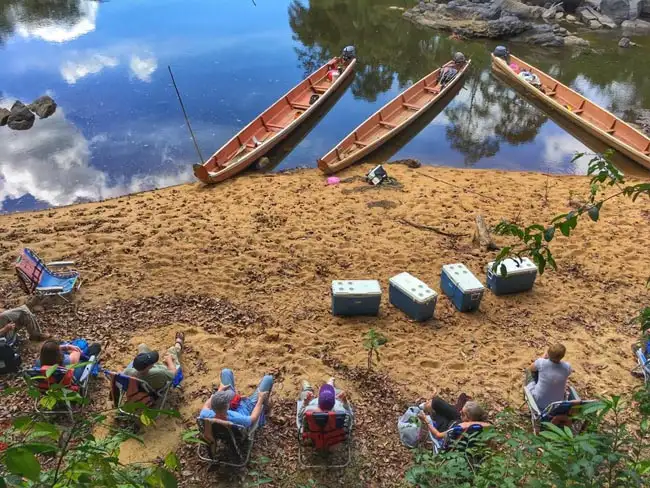
After lunch we ease into the forest on its own terms. This afternoon might mean a walk along trails where our guides identify medicinal plants by touch and smell, explaining uses that predate every colonial pharmacopoeia ever written. Or we take to the water by dugout canoe — long pirogues with outboard motors that go quiet when something worth watching appears on the bank.
NOTE: For our time here, pack a smaller collapsible overnight bag due to light aircraft weight restrictions. Your larger baggage will be securely stored.
Overnight at Kabalebo Nature Resort. 
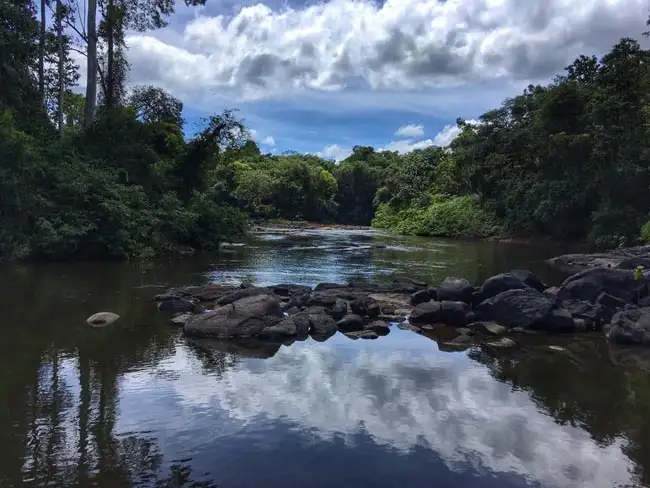
Included Meal(s): Breakfast, Lunch and Dinner - Day 6:Kabalebo Nature ResortThe river is our road today. We travel by boat to reach one of the area's waterfalls — Kilotri Falls when conditions permit — passing through forest that reveals itself slowly, in layers: the canopy first, then the mid-story, then the understorey where the light barely reaches and the undergrowth is a different world entirely. Our guides move through it with the ease of long familiarity.
The birds here reward patience. Scarlet macaws and blue-and-yellow macaws work the canopy in pairs — macaws, like many things in this forest, mate for life. Caracaras pick the riverbanks. Aracaris move through the middle story in loose noisy groups. The Buff-throated Saltator, if you're lucky, will sit still long enough to be properly appreciated.
A packed lunch on the river, then the afternoon at whatever pace suits you. Those who want more forest take more forest; those who prefer to sit on the lodge deck with binoculars and let the forest come to them will not be disappointed.
Optional: Those preferring a less strenuous day can enjoy shorter forest walks near the lodge and a leisurely afternoon boat ride.
Overnight at Kabalebo Nature Resort. 
Included Meal(s): Breakfast, Lunch and Dinner - Day 7:Kabalebo Nature ResortBy the third day the forest has settled into familiarity. The sounds that kept you alert two days ago have become familiar enough to notice their variations — which birds call at dawn, which fall silent at midday, what the river sounds like when the wind picks up upstream.
Today we follow the river in both directions. Upstream the Kabalebo narrows toward fishing territory, the current stronger, the forest closing in on both sides. Downstream the engines go quiet and the boat drifts, which is when the wildlife appears — caimans, river otters, the occasional giant river otter if fortune is with us, and always the birds: Blue-headed Parrots moving in flocks, Black Skimmers working the surface with that improbable lower mandible, the Buff-throated Saltator reconsidered in better light than yesterday.
The lodge's landscaped paths offer a quieter alternative for those who prefer to spend the morning on foot, and the river has shallow spots away from the jetty where a swim is possible under the guidance of people who know which spots are safe and which are not — a distinction worth respecting in Amazonian water.
Overnight at Kabalebo Nature Resort. 
Included Meal(s): Breakfast, Lunch and Dinner - Day 8:Kabalebo - Fly to Paramaribo, Suriname - Kourou, French GuianaWe leave Kabalebo the way we arrived — by light aircraft, the forest canopy unrolling beneath us until the coast reasserts itself and Paramaribo reappears below.
From Paramaribo we transfer to the Marowijne River at Albina, where a boat crosses into French Guiana. This is one of the more quietly remarkable border crossings in the world. On the Suriname side: a former Dutch colony, independent since 1975, finding its own way. On the French side: an overseas département of the French Republic, which is to say a fully integrated part of France — and therefore of the European Union — situated on the northeastern shoulder of South America. The euro is the currency. French is the language of government. The tricolore flies. It is the 21st Century and France is still here, not as a colonial memory but as a current administrative fact, and the jungle begins immediately behind the customs post.
We continue by road to Kourou.
Overnight in Kourou. 
Included Meal(s): Breakfast and Dinner - Day 9:Kourou: Ariane Space Centre & CayenneThe road to the Centre Spatial Guyanais passes through tropical forest, and then the forest opens and there are rockets — actual rockets, on actual launch pads, under an equatorial sky. Ariane launch vehicles have placed roughly two thirds of all Western satellites into orbit from this precise patch of South American jungle. The reason is simple physics: proximity to the equator gives rockets a rotational boost that saves fuel and increases payload capacity. France looked at its map, noticed it had territory on the equator, and built a spaceport.
This morning we visit the Ariane Space Center for a guided tour. Ariane rockets, whose path over the Atlantic is tracked from Devil's Island, have put two-thirds of all Western satellites into space. This base is French Guiana's biggest source of income. Launch schedules at the Centre Spatiale Guyanaise are closely-held secrets, so our schedule may be amended on short notice. The usual visit includes a bus tour criss-crossing the facility, with stops at assembly buildings and control centres.
This afternoon we drive to Cayenne, French Guiana's capital and chief port — a city that wears its Creole culture in colour, literally, the building facades running from ochre to turquoise to a particular shade of coral that seems designed to hold the light. Avenue Général de Gaulle is the main commercial artery; Place des Palmistes and Place de Grenoble anchor the civic centre, where the Hôtel de Ville built by Jesuits in the 1890s still presides with quiet authority. The Musée Départemental frames the afternoon with context — indigenous history, colonial settlement, and the penal system whose most infamous chapter we visit tomorrow.
NOTE: As tour dates are published before rocket launch schedules are known, a launch could impact our plans if security lockdowns curtail our visit. Though unlikely, if this happens we will substitute other sightseeing.
Overnight in Kourou. 
Included Meal(s): Breakfast and Dinner - Day 10:Kourou & Iles du SalutToday we enjoy a full-day excursion to the former penal colony on the Iles du Salut (Isles of Salvation). The islands appear on the horizon as the catamaran clears the harbour — three low shapes in the Caribbean, green and improbably beautiful from a distance. This is the view that greeted arriving convicts for over a century.
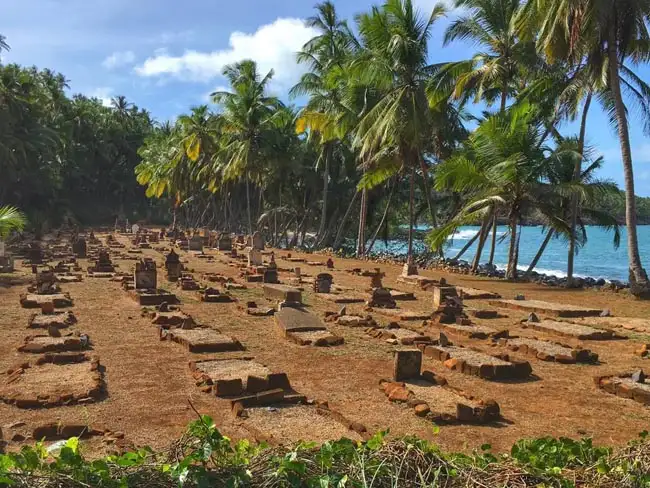
The Îles du Salut — Isles of Salvation, a name whose irony was not lost on the more than 30,000 prisoners who died here — served France as a dumping ground for those it could not rehabilitate and would not execute: political prisoners, repeat offenders, the incorrigible and the inconvenient. Devil's Island itself, the smallest of the three and still inaccessible to visitors, held the most famous prisoner of all — Alfred Dreyfus, a French army officer convicted of treason on the basis of forged evidence in a case that split France along every fault line it possessed.
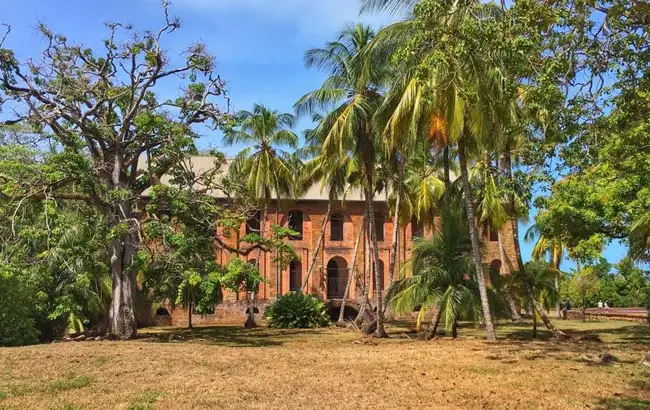
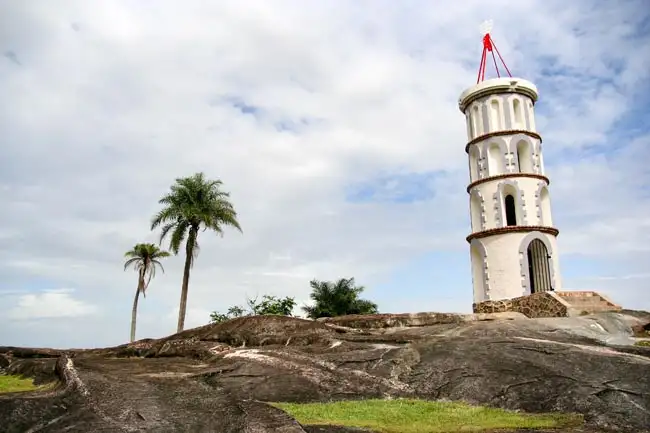
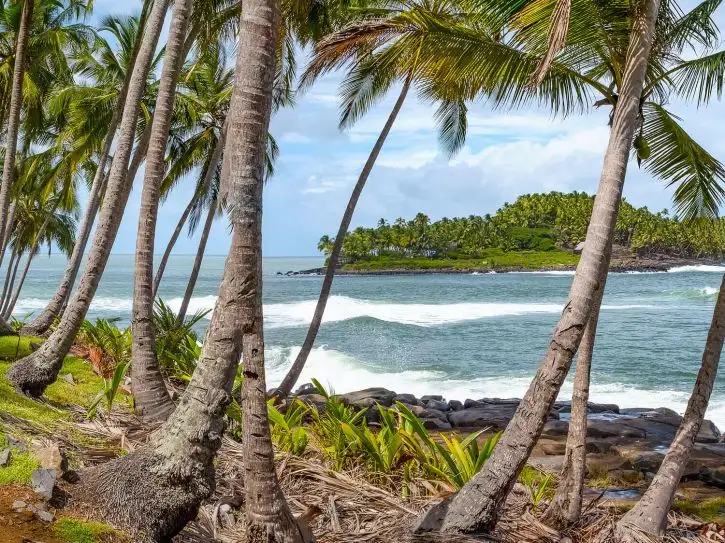
Île Royale is where we spend our time. The cells, guards' quarters, and administration blocks have been converted into a hotel and small museum; the history is legible in the stonework if you know where to look. Stone-cut steps climb under palms to viewpoints over turquoise water where sharks once patrolled for bodies.
We return to Kourou by catamaran.
Overnight in Kourou. 
Included Meal(s): Breakfast, Lunch and Dinner - Day 11:Kourou, French Guiana - Paramaribo, SurinameThe road back to Paramaribo retraces yesterday's ground in reverse — French Guiana giving way to Suriname at the Marowijne River, the euro yielding to the Surinamese dollar, the tricolore to a different flag entirely. Though it may seem logical to fly onward from Cayenne, the lack of and high changeability of flights, and the inconvenience of the available schedules, mostly through Paris, result in this overland route.
On the Suriname River approach to Paramaribo, look to the right. Half-submerged in the water sits the rusted hull of a German cargo vessel, scuttled here during the Second World War to prevent its bauxite cargo — Suriname was then one of the world's primary bauxite sources, the raw material of aluminium, and therefore of aircraft, and therefore of enormous strategic value — from reaching Allied hands.
We cross the bridge into Paramaribo for the last time.
Overnight in Paramaribo. 
Included Meal(s): Breakfast and Dinner - Day 12:Departure from ParamariboAfter breakfast we say our farewells and depart Paramaribo — three countries, two colonial languages, one waterfall, and a stretch of Amazon jungle that sees very few visitors. Time well spent.
Bon voyage! Tot ziens! 
Included Meal(s): Breakfast
Countries Visited: French Guiana, Guyana and Suriname
*The red tour trail on the map does not represent the actual travel path.
Book This Tour
- Final payment: Due 90 days prior to departure.
- Deposit: A non-refundable $500 CAD Deposit is required at booking.
- Internal Flight Taxes: An extra $252 CAD applies for taxes and fees on tour flights. The internal airfares are included, but taxes are listed separately as they may change. Exceptions are noted in Red.
- Optional Single Supplement: $1960 CAD (number of singles limited).
(View options forsingle travellers) - Transfering Tour or Date: Transferring to another tour or tour date is only permissible outside of 120 days prior to departure and is subject to a $100 CAD change fee.
(Read our cancellation policy)
Prices below are per person, twin-sharing costs in Canadian Dollars (CAD). Pricing does not include airfare to/from the tour and any applicable taxes.
Tourcode: GY1
Frequently Asked Questions
- What is the maximum number of participants on a trip?Most of our tours carry a maximum of 18 participants; some tours (ie hiking tours) top out at 16. In the event that we do not achieve our minimum complement by our 90-day deadline, we may offer group members the option of paying a "small-group surcharge" as an alternative to cancellation. If all group members agree, we will confirm the trip at existing numbers; this surcharge is refundable in the event that we ultimately achieve our regular minimum. If the small group surcharge is not accepted, we will offer a refund of your deposit or a different trip of your choice.
- Can I extend my tour either at the beginning or end? What about stopovers?Yes, you can extend your tour either at the beginning or the end and we can book accommodation in our tour hotel. Stopovers are often permitted, depending on air routing. Stopovers usually carry a "stopover" fee levied by the airline.
- How do I make a reservation? How and when do I pay?The easiest way to make a reservation is via our website; during office hours, you are also more than welcome to contact us by telephone.
A non-refundable deposit is payable at the time of booking; if a reservation is made within 90 days, full payment is required. Some trips require a larger deposit. If international airline bookings require a non-refundable payment in order to secure space or the lowest available fare, we will require an increase in deposit equal to the cost of the ticket(s).
Early enrolment is always encouraged as group size is limited and some trips require greater preparation time.
Once we have received your deposit, we will confirm your space and send you a confirmation package containing your trip itinerary, any visa/travel permit related documents, invoice, clothing and equipment recommendations, general information on your destination(s), and forms for you to complete, sign and return to us. Your air e-tickets (if applicable), final hotel list, final trip itinerary, and instructions on how to join your tour, will be sent approximately 2-3 weeks prior to departure. - What about cancellations, refunds, and transfers?Please review our cancellation policy page for details.
- I am a single who prefers my own room. What is a single supplement?All of our tours have a single supplement for those who want to be guaranteed their own room at each location.
This supplement is a reflection of the fact that most hotels around the world do not discount the regular twin-share rate for a room by 50% for only one person occupying a room. Most hotels will give a break on the price, but usually in the range of 25-30% of the twin-share rate. This difference, multiplied by each night, amounts to the single supplement.
The conventional amount can also vary from country to country and some destinations are more expensive than others for single occupancy. In order to be "single friendly," the supplements we apply are not a profit centre for us and we do our best to keep them as reasonable as possible.
On most tours we limit the number of singles available, not to be punitive, but rather because many hotels allow for only a limited number of singles; some smaller hotels at remote locations also have a limited number of single rooms available.
Please note that most single rooms around the world are smaller than twin-share rooms and will likely have only one bed. - Do you have a shared accommodation program?Yes! If you are single traveller and are willing to share, we will do our best to pair you with a same-gender roommate. Please note that should we fail to pair you, we will absorb the single supplement fee and you will default to a single room at no extra charge.