Small Group Experiential Travel
19 Day China by Rail Tour

19 Day China by Rail Tour

From the Imperial Heartland to the Cosmopolitan Coast
Tour Code
CT1
When To Go
Apr, Oct
Start
Beijing (PEK)
End
Shanghai (PVG)
Countries Visited (1)
China
Overnight In (9)
Shanghai, Beij...More >
Activity Level
2 - Moderate?
Tour Type
Cultural?
  • Overview
  • Info & Inclusions
  • Itinerary
  • Map & Hotels
  • Photos
  • Dates & Prices
Highlights
  • Max Group Size 18
  • Accessing major sites and special, off-the-beaten path gems using China's efficient high-speed rail network
  • Three major urban centres (Beijing, Xi'an & Shanghai) well-spaced with lesser known, fascinating locations, many of them Unesco sites
  • Delicious authentic meals
  • Charming & comfortable accommodations
  • Expert guiding and leadership
  • Singles friendly
    (view options for single travellers)


Description
China has been rewiring itself. Over the past two decades, an extraordinary network of high-speed rail has stitched together cities that once required exhausting flights to connect — and in doing so, it has made possible a completely different kind of China journey: one where the travel itself becomes part of the experience, the landscape unfolding outside the window rather than disappearing thirty thousand feet below.

This itinerary follows that network from the imperial heartland to the cosmopolitan coast. From Beijing's dynastic monuments and Pingyao's remarkably intact merchant city, through Xi'an — eastern terminus of the Silk Road and capital of thirteen dynasties — to the Buddhist cave sculptures of Luoyang and the martial legacy of Shaolin, the journey moves through successive layers of Chinese civilization before the landscape shifts entirely. South of Zhengzhou, the wheat plains give way to the karst towers of Guilin, the Li River, and the dreamlike scenery of Yangshuo. The final chapter belongs to Hangzhou's thousand-year-old lake culture and Shanghai's electrifying collision of imperial China and global modernity.

Eight overnight cities. Nineteen days. One internal flight. The rest by rail — and not despite the distances, but because of them.
Price Includes
  •  
    Meals
    Savour authentic flavours with included daily breakfasts and most dinners at hotels or handpicked local restaurants—immersing you in local cuisine without worrying about reservations or budgets.
  •  
    Transport & Logistics

    Private air-conditioned coaches and included internal ferries and flights—ensuring hassle-free travel so you can focus entirely on the discoveries ahead.

    "Adventures Abroad tour leader's management and guest services managed the tour with great skill and dedication. The tour leader was on top of every move and transfer. We have not experienced any issues with logistics and had a great time."
    ~ JULIA O

    "The tour leader did an excellent job coordinating some difficult travel logistics, power outage issues and resolving problems and dealing with guests who had unrealistic expectations."
    ~ CYNTHIA COLLINS

  •  
    Expert Guidance

    Unlock insider secrets at every landmark with your full-time Tour Leader and expert local guides , all gratuities covered—no hidden tipping surprises—so you immerse fully in your destination's stories, worry-free. (Except for the tips to your tour leader at the end of your tour.)

    "Amazing tour guide. Our tour guide was very well organized, Her passion, knowledge, and enthusiasm completely transformed the travel experience into something truly unforgettable..."
    ~ MELANIE LEMAIRE

    "Highly recommend every trip with Adventures Abroad. It's a well organized and well thought out adventure. The tour leaders are friendly, knowledgeable and experienced professionals. Highly recommend this company."
    ~ SUSAN WALL

  •  
    Sightseeing & Entrances
    All entrance fees for sites visited as per the itinerary—no hidden costs—so you can explore ancient ruins and excursions with complete peace of mind.
  •  
    Accommodations
    Unwind in clean, well-located 3 to 4-star hotels with private en suite facilities—handpicked for comfort and convenience after each day's discoveries—so you can rest easy knowing your stay supports the real adventure, not steals the spotlight.
  •  
    Small Group

    Discover the world in small groups of up to 18 travellers plus your expert Tour Leader—unlocking spontaneity, off-the-beaten-path adventures, and genuine connections at a relaxed pace, free from crowds.

    "Looking Forward to My Next Adventure The best feature of the Adventures tour was the small size that allowed the group to quickly load up, let everyone get acquainted within the first 24 hours, capitalize on unplanned surprises along..."
    ~ PHILIP BLENSKI

    "Good value for a great time I have traveled with Adventures Abroad for over 20 years now. Well thought out, interesting itineraries and the other travelers congenial and friendly. The price always seems fair and overall a..."
    ~ Trusted Customer

  •  
    Airport Transfers For Land & Air Customers
    We handle hassle-free airport transfers for all our land and air tour customers—plus early arrivals or late departures when you book extra hotel nights directly with us for added peace of mind.


Exclusions
  • International airfare to/from the tour.
  • Tour Leader gratuities, most lunches, drinks, personal items (phone, laundry, etc), and international (if applicable) air taxes, visa fees, and any excursions referenced as 'optional'.
  • Airport transfers for "Land Only" customers.
  • Optional trip cancellation insurance - see "Resources" tab


Trip Info
  • Seasonality and Weather:
    Our dates are carefully selected to avoid both the bitter northern winters and the oppressive heat and humidity of summer, landing instead in the mild, green sweet spot of spring and fall. We also sidestep China's major national holidays, when crowds swell, accommodation prices rise, and the great sites lose much of their appeal.

    In March and April expect cool to warm conditions, with highs in the range of 14–18°C (58–66°F), warming as we move south. May departures sit just ahead of summer's heat, though temperatures will be edging toward 27°C in Beijing and Shanghai. Fall runs a degree or two warmer than spring, with harvest-season produce at its best in local markets. Rain is possible at any time — a light layer is always worth packing.
  • Transport and Travel Conditions:

    China's high-speed rail network is the backbone of this tour, and deliberately so. Trains connect city centres to city centres, eliminating the hours lost to distant airports, check-in queues, and urban traffic. All our rail journeys are daytime and none are overnight — the landscape passing outside the window is part of the experience, not dead time.

    Our seats are second class, which on Chinese high-speed trains means a reclining seat with a fold-down table and power outlet — comfortable for the relatively short durations involved. First class offers a wider seat but little else, at considerably higher cost; our travellers consistently find second class more than adequate.

    A word on luggage: porters are available at hotels but cannot be guaranteed at stations. Packing light is strongly advised — guests should be prepared to manage their own bags on and off trains. Between rail journeys, we travel by private air-conditioned coach, with occasional local taxis for short hops.

    This is an ambitious itinerary with full days of sightseeing, significant walking, and varied terrain including cobbled surfaces and stairs. Guests should come prepared for an active program — the rewards are proportionate to the effort.


    Am I suitable for this tour? Please refer to our self-assessment form
  • Activity Level: 2
    These are particularly busy tours that feature a lot of moving around, sometimes by train and short journeys on local transport. Walking tours of towns and cities are leisurely but you should be prepared to be on your feet for several hours. Some of our cultural trips that occur at high altitude and/or require greater independence with baggage handling (at hotels, airports, train stations) also fall into this category.

    To learn more about the Activity levels, please visit our tour styles page.
  • Accommodation:
    Hotels used on tour are modern, comfortable, well-located, air-conditioned, 4-star properties with en suite bath/toilet. Single rooms are limited in number and possibly smaller than twins. Porters are generally available (see 'Inclusions').

    Please click on the "Map & Hotels" tab on this page for more information.
  • Staff and Support:
    Tour Leader throughout, local drivers, local guide/s at various locations.
  • Group Size:
    Maximum 18 plus Tour Leader
View / Print Itinerary

  • Day 1: 
    Arrival in Beijing
    Welcome to Beijing — capital of the People's Republic of China, and the place where this journey begins.

    Few cities carry their history as visibly as Beijing. For more than seven centuries it has served as the seat of imperial power, and the weight of that legacy is present everywhere: in the vast axial geometry of its boulevards, the ochre walls of its palace complexes, and the sense that the city was designed not merely to house a government but to embody one. Today it is home to twenty million people and expanding still, yet the imperial order persists beneath the modern surface — a palimpsest of dynasties written in stone and tile.

    This evening we gather with fellow travellers for our first meal together.

    Overnight in Beijing.


    Included Meal(s): Dinner, if required
  • Day 2: 
    Beijing: Forbidden City & Hutong Tour
    We begin at Tian'anmen Square, the vast ceremonial heart of the Chinese capital. Originally laid out in 1651 and dramatically expanded in 1958 to its present 40.5 hectares, this is one of the world's great public spaces — each flagstone numbered so that parade units can align with precision. The square's dimensions speak to an enduring Chinese architectural instinct: that scale itself is a form of authority.

    From here we walk to the Forbidden City, the supreme expression of that instinct. For five centuries this immense complex of palaces, pavilions, courtyards, and vermillion gates was closed to all but the imperial household and those summoned to serve it. The emperors of the Ming and Qing dynasties administered an empire of hundreds of millions from within these walls — a world unto itself, now open as the Palace Museum and still capable of producing genuine awe.

    This afternoon we trade imperial grandeur for human scale, joining a traditional rickshaw for a tour through Beijing's hutongs — the narrow residential lanes that survived the sweeping reconstructions of the twentieth century. These intimate corridors of grey-tiled courtyard houses offer a very different Beijing: neighbourly, unhurried, built to the measure of daily life rather than dynastic ambition. We visit a local family in their home to hear something of how the city is actually lived.

    Today we include lunch, with your evening free for optional activities — your Tour Leader can suggest possibilities.

    Overnight in Beijing.


    Included Meal(s): Breakfast and Lunch
  • Day 3: 
    Beijing: Great Wall & Summer Palace
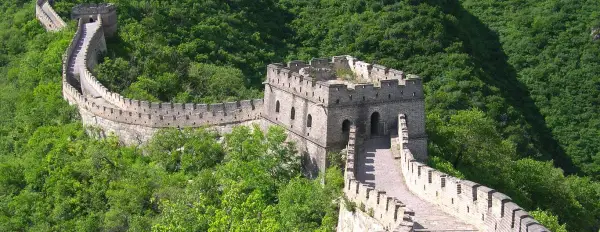
    This morning we travel north of the city to the Great Wall — and whatever one expects, the reality tends to exceed it. Rising and falling with the ridges of the northern hills, the wall extends in both directions until it dissolves into haze, a structure so insistently present in the landscape that it feels geological rather than man-made.

    Its origins lie in the Warring States Period (403–221 BC), when rival kingdoms raised separate earthworks along their borders. China's unification under the First Qin Emperor transformed these fragments into a single continuous rampart: 300,000 men — soldiers, conscripted labourers, and political prisoners — were set to work connecting the segments into one continuous fortification of stone and rammed earth. What they built was not only a defensive barrier but a statement about the nature of empire: this is where China ends, and the world beyond begins.

    We have generous time to walk and explore before returning to the city.

    This afternoon we visit the Summer Palace, set around a vast ornamental lake in the northwestern suburbs. Created as a retreat from Beijing's summer heat, the palace reached its present opulent scale in 1888 when Empress Dowager Cixi redirected funds intended for the Chinese Navy to complete her own vision. It is an extraordinary place — part imperial residence, part landscape painting made real, with willow-lined causeways, marble bridges, and hillside pavilions that together compose a scene Chinese artists had been rehearsing for centuries.

    Overnight in Beijing.


    Included Meal(s): Breakfast and Dinner
  • Day 4: 
    Beijing - Train to Pingyao
    This morning we make our way to the station for our first rail journey — and with it, a shift in both geography and era. As Beijing's suburbs give way to the broad agricultural plains of Hebei and then the loess highlands of Shanxi, we are moving into a part of China that formed the economic backbone of imperial civilization long before the coastal cities rose to prominence.

    Pingyao, our destination after approximately four hours, is the finest surviving example of a Ming and Qing dynasty walled city in China. Unusually, it was never demolished and rebuilt; commerce moved on, the city was bypassed by modernisation, and in being bypassed it was preserved. The result is a place of rare coherence: cobbled streets, courtyard residences, guild halls and temples, all contained within a perimeter wall nearly six and a half kilometres long and over twelve metres high.

    We begin our sightseeing this afternoon. Pingyao's particular significance lies in finance rather than politics — during the Qing dynasty, Shanxi merchants developed trade networks that stretched across Central Asia, and Pingyao became the unlikely capital of Chinese banking. The Rishengchang Exchange Shop, established in the eighteenth century and regarded as China's first formal bank, pioneered the use of draft notes that allowed merchants to move wealth across vast distances without carrying silver. We visit Rishengchang, walk Ming-Qing Street with its traditional-style shopfronts, and tour the Armed Escort Company Museum — a vivid reminder that moving money in dynastic China required considerable muscle as well as ingenuity.

    A note on bags: porters are generally not available at train stations. Guests should be prepared to manage their own luggage on and off trains.

    Overnight in Pingyao.


    Included Meal(s): Breakfast and Dinner
  • Day 5: 
    Pingyao - Train to Xi'an
    The morning belongs to Pingyao at its best — early, before the day-trippers arrive from the cities, when the lanes are quiet and the grey-tiled rooftops catch the first light. We visit the Confucian Temple, originally built during the reign of Emperor Taizong and notable for being not a memorial but an active family temple: this was, in the beginning, simply the ancestral home of Confucius's line, later elevated by the reverence of an entire civilization.

    Depending on train schedules, there is free time for independent wandering before we board our afternoon service to Xi'an — a journey of approximately three hours southwest through the Shanxi highlands.

    Xi'an arrives like a weight settling into place. This is the city where Chinese civilization consolidated itself — capital of thirteen imperial dynasties, more than any other city in the country, and the eastern terminus of the Silk Road. It was from the Wei River valley here that the First Qin Emperor unified China in 221 BC, setting in motion the political and cultural continuity that has defined the country for two millennia. To arrive in Xi'an is to arrive at the source.

    Overnight in Xi'an.


    Included Meal(s): Breakfast and Dinner
  • Day 6: 
    Xi'an: Terracotta Warriors & City Touring
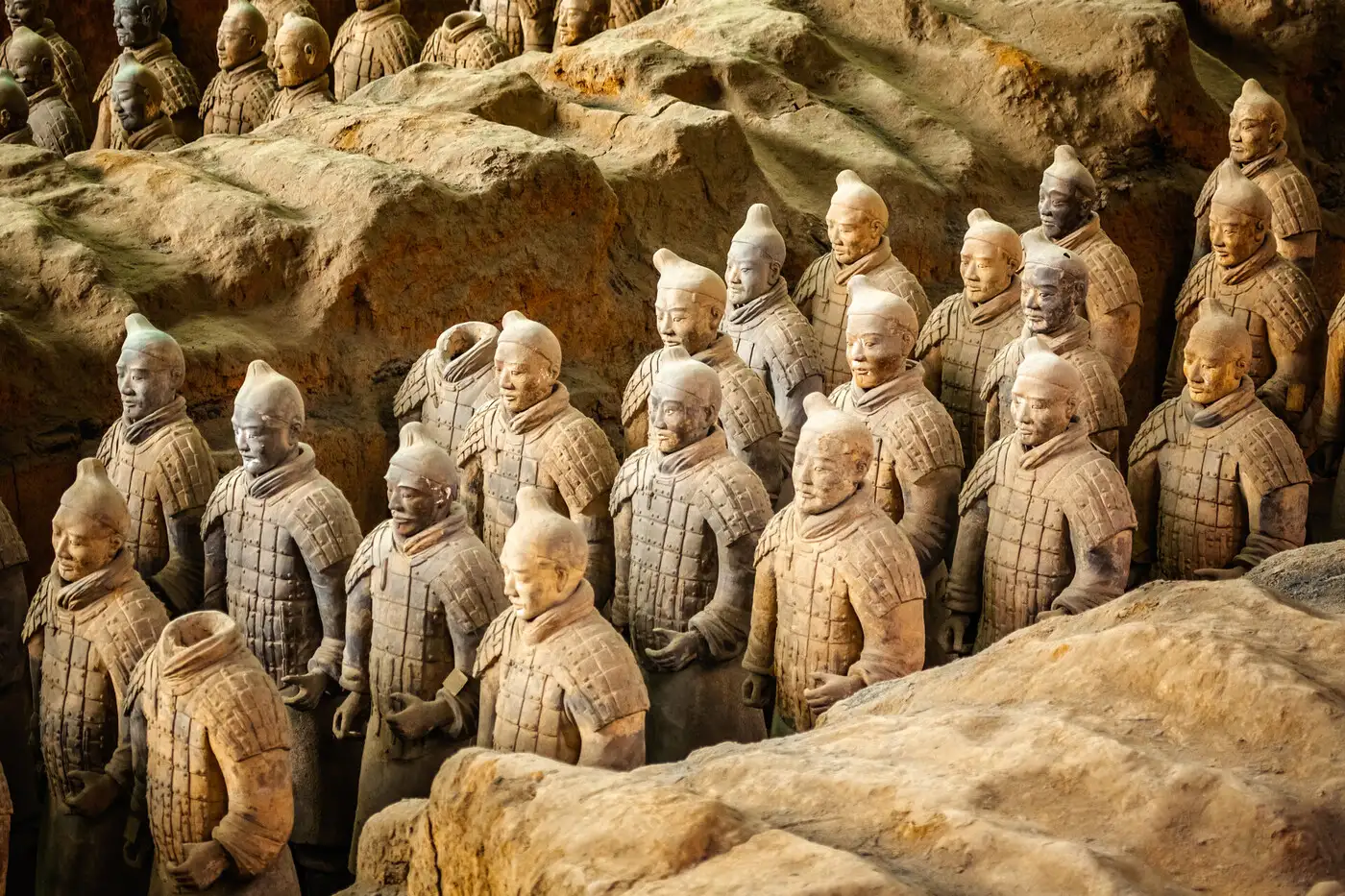
    The discovery that changed our understanding of the ancient world happened almost by accident. In 1974, farmers digging a well in Lintong County, thirty kilometres east of Xi'an, struck terracotta. What they had found was the funerary army of Qin Shi Huangdi — an estimated 8,000 life-size warriors, each individually modelled with distinct features, arranged in battle formation to guard the emperor in perpetuity. We visit pits 1, 2, and 3 in sequence, moving from the sheer scale of the main chamber to the more intimate detail of the smaller excavations. Two thousand years underground have done little to diminish their authority.

    Returning toward the city, we stop at the Big Wild Goose Pagoda, a Tang Dynasty Buddhist tower built in 652 to house scriptures brought overland from India by the pilgrim monk Xuanzang — one of the great journeys of the ancient world, and an early reminder that Xi'an was always a place where ideas arrived from elsewhere.

    This afternoon we visit the Great Mosque in the heart of the Muslim Quarter. Founded in AD 742 during the Tang Dynasty and expanded across successive dynasties, it is among the largest mosques in China — and one of the most architecturally distinctive, built entirely in Chinese rather than Arabic style, with tiered pavilions and moon gates replacing domes and minarets. It stands as eloquent evidence of the Silk Road's deeper legacy: not just the movement of goods, but the transplanting of faith.

    Overnight in Xi'an.


    Included Meal(s): Breakfast and Dinner
  • Day 7: 
    Xi'an - Train to Luoyang
    This morning we visit Han Yangling, the museum built over the tomb of Emperor Jing Di, who ruled in the second century BC. Opened in 2005, it is among the most sensitively designed archaeological museums in China — visitors walk on glass floors above the open pits, looking directly down at hundreds of small terracotta figures arranged exactly as they were buried. Unlike the martial grandeur of the Qin warriors, these figures are intimate in scale: court ladies, domestic animals, officials with articulated arms that have long since decayed, leaving eerily empty shoulders. They speak of a dynasty confident enough to contemplate the afterlife with something close to tenderness.

    Mid-afternoon, we board the train for Luoyang — approximately ninety minutes east along the Wei and Yellow River corridor.

    Luoyang was the dynastic capital that preceded Xi'an's dominance and outlasted it: capital of thirteen dynasties, including the Eastern Han and Tang, and for centuries one of the largest and most prosperous cities in the world. Little of that medieval fabric survives above ground, but what remains is extraordinary.

    Overnight in Luoyang.


    Included Meal(s): Breakfast and Dinner
  • Day 8: 
    Luoyang: Area Touring
    Twelve kilometres south of Luoyang, where the Yi River cuts through limestone cliffs, the emperors and aristocrats of the Northern Wei and Tang dynasties carved their devotion directly into the rock. The Longmen Grottoes — Dragon's Gate, named for the twin hills that frame the river's passage — contain more than 100,000 Buddhist images across 2,345 caves, ranging from fingernail-sized votive figures to a seventeen-metre seated Vairocana Buddha whose serene, broad face is said to have been modelled on Empress Wu Zetian herself. Construction spanned four centuries, from the late fifth to the early ninth, each dynasty adding its own theological emphasis and aesthetic sensibility to the cliff face.

    Walking the riverside path, with the carvings rising on one side and the Yi River on the other, is one of the more quietly overwhelming experiences on this journey. These are not museum exhibits but acts of faith, executed at enormous effort, in the open air, for the benefit of a deity — and the accumulated intention of all those centuries of devotion still registers.

    Overnight in Luoyang.


    Included Meal(s): Breakfast and Dinner
  • Day 9: 
    Luoyang - Shaolin Temple - Zhengzhou
    After breakfast, a two-hour drive through the forested Song Shan mountains brings us to Shaolin — a place so thoroughly absorbed into global popular culture that arriving here carries a slight sense of disorientation. The monastery is real, the history is genuine, and the kung fu is not a performance tradition invented for tourists: Shaolin's warrior monks developed their martial discipline over fifteen centuries as a legitimate spiritual practice, the body trained alongside the mind as a path toward enlightenment.

    We tour the temple complex — visiting the Hall of Heavenly Kings, the Guanyin Hall with its remarkable frescoes of fighting monks, the ancient Pagoda Forest where the monastery's abbots are interred, and the Dharma Cave where Bodhidharma, the Indian monk who founded Chan (Zen) Buddhism, is said to have meditated for nine years facing a wall. A live martial arts demonstration by the resident monks gives the training its proper physical context: this is discipline pursued to a degree that seems to exceed what bodies should be capable of.

    We then take a cable car up nearby San Huang Zhai Mountain for sweeping views over the Song Shan range, before transferring by road to Zhengzhou for the night.

    Overnight in Zhengzhou


    Included Meal(s): Breakfast and Dinner
  • Day 10: 
    Zhengzhou - Train to Guilin
    Today's rail journey is the longest of the tour at approximately six hours — and it earns its length. Departing mid-morning, we cross the Yellow River on its wide northern plain and then move steadily south through the transitional landscapes of central China: wheat fields giving way to rice paddies, the flat agricultural heartland gradually yielding to the more complex, water-carved terrain of the south. By the time the karst formations begin to appear outside the window — first singly, then in clusters — the geography has shifted entirely. We have crossed, almost imperceptibly, from the China of emperors to the China of painters.

    Guilin has been a subject of Chinese landscape art for over a thousand years. The Li River, the limestone towers, the mist: these are not romantic embellishments but plain descriptions of a place that genuinely looks the way classical Chinese painting looks, because classical Chinese painting was, in part, looking at this. Founded in 314 BC in the Qin Dynasty, the city became a significant regional centre after the construction of the Lingqu Canal — one of the ancient world's great feats of hydraulic engineering, joining two river systems and providing a water route from central China to the south.

    This evening we take a stroll along Zhengyang Pedestrian Street, easing into the warmer, more languid pace of Guilin.

    Overnight in Guilin.


    Included Meal(s): Breakfast and Dinner
  • Day 11: 
    Guilin & Longsheng
    This morning we visit Reed Flute Cave, a spectacular natural cavern whose stalactite and stalagmite formations have been inspiring Chinese poets since the Tang Dynasty, and Fubo Hill, which rises abruptly from the city's edge to offer panoramic views of the limestone landscape in all directions.

    This afternoon we travel to the Longsheng area, where the mountains are terraced from base to summit in rice paddies that have been carved, maintained, and extended over seven centuries. The Dragon's Backbone Rice Terraces — Longji Titian — are a feat of agricultural engineering that rivals anything on this tour in sheer accumulated human effort, their curving contour lines following the topography with a precision and elegance that is, in its own way, as moving as stone carving. We view the terraces from a high vantage point and visit a Yao minority village — the Yao people, one of China's fifty-five officially recognised ethnic minorities, have farmed this landscape since the Yuan Dynasty, maintaining customs, dress, and agricultural traditions that predate the current era by centuries.

    We also visit a working tea plantation in the area before returning to Guilin.

    Overnight in Guilin.


    Included Meal(s): Breakfast and Dinner
  • Day 12: 
    Guilin - Li River Cruise to Yangshuo
    The Li River cruise from Guilin to Yangshuo is eighty-three kilometres of scenery that has no real equivalent on earth. The boat moves slowly, which is the right speed for this landscape: karst towers rising sheer from the river's banks, their reflections doubling in still water; bamboo groves leaning over the current; water buffalo in the shallows; fishermen on narrow bamboo rafts with their trained cormorants resting on the poles. The Luogu Rapids pass with a sound the local tradition likens to gongs and drums. Villages appear and disappear.

    The sensation, repeated by virtually everyone who makes this journey, is of travelling through a painting — not metaphorically, but almost literally. The landscape around Yangshuo is depicted on the Chinese twenty yuan note alongside Mao Zedong, which is the country's way of declaring it a national treasure. The painters were not imagining this; they were transcribing it.

    Yangshuo itself, where the cruise ends, is a lively small town surrounded by its spectacular limestone scenery — good cafés, interesting street food, and a relaxed energy that makes a welcome contrast to the pace of the past several days. We have free time to explore this afternoon.

    Overnight in Yangshuo


    Included Meal(s): Breakfast and Dinner
  • Day 13: 
    Yangshuo Area
    This morning we visit a local farming family in their home, set among the karst hills just outside the town. Rural life in this corner of China moves to rhythms shaped more by the landscape than by the calendar — small plots worked between the limestone outcrops, the river still a practical resource as well as a scenic one. It is a quiet, grounding counterpoint to the dynastic spectacle of the past week.

    The afternoon is yours: hire a bicycle and ride out through rice paddies and villages with the peaks rising on all sides, wander West Street's mix of local commerce and international café culture, or simply sit with the view.

    This evening we attend the Impressions Liu Sanjie performance on the Li River — a large-scale outdoor spectacle directed by Zhang Yimou, the filmmaker perhaps best known internationally for the Beijing Olympics opening ceremony. Using the actual river and mountains as stage and backdrop, with hundreds of performers and a lighting design of considerable ingenuity, it is a theatrical experience unlike any other: half-mythology, half-landscape, entirely memorable.

    Overnight in Yangshuo.


    Included Meal(s): Breakfast and Dinner
  • Day 14: 
    Yangshuo - Guilin - Fly to Hangzhou
    This morning, time permitting, we visit Elephant Trunk Hill — Guilin's most recognizable landmark, a limestone formation that descends into the Li River with the unmistakable profile its name describes — before transferring to the airport for our flight to Hangzhou.

    This is the tour's single internal flight, and the reason for it is straightforward: the journey south to Hangzhou involves crossing mountain terrain that rail has not yet efficiently bridged. From the air the transition from the karst south to the Yangtze Delta is visible in a single descent — green hills giving way to the waterways and low-lying plains of China's wealthiest and most intensively cultivated region.

    Hangzhou has been considered one of China's most beautiful cities since the Southern Song Dynasty made it their capital in 1127. Marco Polo, passing through in the thirteenth century, declared it the finest city in the world — a superlative that even accounting for medieval hyperbole suggests something genuinely exceptional. Since 2011, the West Lake Cultural Landscape has been recognised as a UNESCO World Heritage Site.

    Overnight in Hangzhou.


    Included Meal(s): Breakfast and Dinner
  • Day 15: 
    Hangzhou Area Touring
    West Lake is not a natural feature so much as a civilizational project — shaped, planted, and maintained by successive dynasties over more than a thousand years into its present form of causeways, islands, willow-banked shores, and pavilions placed with the deliberateness of brushstrokes. This morning's cruise moves across it at a pace suited to contemplation, past the Three Pools Mirroring the Moon and the willow-trailed Bai Causeway — the latter named for the Tang poet Bai Juyi, who governed Hangzhou in the ninth century and loved the lake enough to write about it obsessively. We also visit Flower Harbour, where the Red Carp Pond continues a tradition of ornamental fish-keeping that began in the Southern Song Dynasty: an arrangement of water, stone, and living colour that embodies classical Chinese aesthetics as precisely as any garden.

    This afternoon we visit Lingyin Temple in the forested hills west of the lake — one of China's most significant Chan Buddhist monasteries, founded in AD 328 by an Indian monk who, legend holds, recognised the hill behind it as a fragment of an Indian sacred mountain that had flown here of its own accord. The surrounding cliffs of Feilai Feng are carved with hundreds of Buddhist figures, many of them from the tenth to fourteenth centuries, their expressions ranging from serene to frankly joyful in a way that distinguishes the southern Chan tradition from the more austere schools of the north.

    Overnight in Hangzhou.


    Included Meal(s): Breakfast and Dinner
  • Day 16: 
    Hangzhou - Shanghai
    A two-hour drive this morning through the landscapes of the Yangtze Delta — flat, intensively farmed, laced with waterways — delivers us into a city that requires a different frame of reference entirely.

    Shanghai does not ask to be measured against dynastic time. It was a modest fishing town until the Treaty of Nanking in 1842 opened it as a treaty port, and what followed was one of the most rapid urban transformations in history: within decades it had become Asia's most cosmopolitan city, a place where French concession boulevards and American jazz clubs and British merchant banks and Russian émigré cabarets existed within walking distance of each other, and where Chinese entrepreneurs built fortunes in the interstices of the foreign settlements. The Bund's Art Deco and neoclassical facades record that era in stone; Pudong's towers, visible across the river, record what came after. Shanghai wears its contradictions with remarkable confidence.

    Overnight in Shanghai.


    Included Meal(s): Breakfast and Dinner
  • Day 17: 
    Shanghai: City Touring
    We begin at the Shanghai World Financial Center in Pudong, ascending to the 94th-floor observation deck for a view that makes Shanghai's scale finally legible: the Huangpu River below, the Bund's historical frontage on the opposite bank, and the entire spread of the world's most populous metropolitan area extending in every direction to the horizon.

    From Pudong we cross to the Bund itself — the embankment whose name derives, via Anglo-Indian usage, from a Persian word for an earthen levee. The first British merchant firm opened here in 1846; by the 1930s it had become the most valuable stretch of real estate in Asia, lined with the headquarters of banks, trading houses, and hotel companies whose confidence in Shanghai's permanence was expressed in the grandeur of their buildings. That confidence proved misplaced in certain respects, but the buildings remain.

    This afternoon we explore Yu Garden, a private classical garden established in 1559 by a Ming Dynasty official as a retreat for his elderly parents — intimate, layered, its rocks and pavilions and pools arranged according to principles of aesthetic surprise that reward slow looking. The adjacent Yuyuan Bazaar offers a livelier counterpoint: street stalls selling xiao long bao, pigeon egg dumplings, and cold spiced noodles alongside every variety of craft and souvenir.

    This evening, a one-hour cruise on the Huangpu River views the Pudong skyline in full nocturnal display — lit in shifting colours, its towers reflected in the water, the Bund's composed historical presence on the opposite bank.

    Overnight in Shanghai.


    Included Meal(s): Breakfast and Dinner
  • Day 18: 
    Shanghai Touring & Leisure Time
    This morning we visit the Shanghai Museum at People's Park, housed in a building whose form deliberately invokes a bronze ding tripod — one of the defining ritual objects of Chinese antiquity. The collection it contains spans five thousand years: bronzes, ceramics, jade, coins, furniture, calligraphy, and painting gathered across fourteen galleries with a depth and care that reflects Shanghai's ambition to be not just China's wealthiest city but its most culturally serious. The painting and calligraphy collections in particular repay time.

    From here we walk to East Nanjing Road — a pedestrianised kilometre of department stores, street food vendors, and people-watching of the highest order, where the commercial energy that has driven Shanghai since the mid-nineteenth century is still entirely legible.

    The afternoon and evening are yours: Shanghai's restaurants, markets, jazz bars, and contemporary art spaces offer as much as anyone could want from a final night. Our farewell dinner this evening marks the end of a journey that has covered, in nineteen days and by every means the country offers, something genuinely essential about China.

    Overnight in Shanghai.


    Included Meal(s): Breakfast and Dinner
  • Day 19: 
    Departure
    Departure from Shanghai.

    BON VOYAGE!


    Included Meal(s): Breakfast
Regions Visited: Far East
Countries Visited: China


*The red tour trail on the map does not represent the actual travel path.

Excellent
Overall Rating
4.7
Extend Your Trip
This tour is part of a series that can be upgraded to make for a longer trip.
Book Your Tour Here
Fast and easy

Book This Tour

Book your unforgettable adventure today! For any questions or advice, don't hesitate to contact us.

Have questions?

1-800-665-3998
  • Final payment: Due 90 days prior to departure.
  • Deposit: A non-refundable $500 CAD Deposit is required at booking.
  • Optional Single Supplement: $1960 CAD (number of singles limited).
    (View options for
    single travellers
    )
  • Transfering Tour or Date: Transferring to another tour or tour date is only permissible outside of 120 days prior to departure and is subject to a $100 CAD change fee.
    (Read our cancellation policy)
Choose your departure date:

Prices below are per person, twin-sharing costs in Canadian Dollars (CAD). Pricing does not include airfare to/from the tour and any applicable taxes.


2026
2027
  • 01: 
    Can Adventures Abroad book my flights?
    Yes! We have full-service in-house air department with years of experience booking our passengers to far-flung places around the world from any place that has an airport. Travelling from Los Angeles to Rome? No problem. Travelling from Deer Lake, Newfoundland to Antananarivo? Also not a problem!


    • 01: 
      Can Adventures Abroad get better deals than I can online?
      Here’s the clear answer: Usually, no.


      Booking your flights with us is super convenient—it’s like one-stop shopping! Plus, we’ll take care of you if something goes wrong, like a canceled flight or missed connection. We include airport transfers at your destination when you book flights through us. Some routes to less common destinations can be hard to find on your own or through online search engines. Which usually only show popular routes. Let us make it easy for you!
    • 02: 
      Why should I book my flights with Adventures Abroad?
      • Included airport transfers: Enjoy a smoother trip with airport transfers provided when you book flights with us.
      • Peace of mind: Feel confident knowing we’ve got you covered during your trip.
      • Help with disruptions: If your travel plans change, we assist with rebooking flights and updating our partners and staff at your destination.
      • Avoid stress and confusion: Booking with us means you won’t have to deal directly with airlines or ticket sellers if issues arise.
  • 02: 
    Does the group fly together on a set route and airline?
    Unlike with some companies, you are not obliged to fly with a particular airline on "bulk" group flights. Because our travellers are coming from (usually) across North America, everyone who flies with us receives a custom air quotation that best serves their situation and preferences—we do not have "set" routings on only a limited number of airlines.


    While fare and convenience are always at the top of the list of criteria, we can work with you to find the option that suits you best.
  • 03: 
    When should my flights be quoted / booked?
    Everyone wants to know their flight details early. To get the best fares and routes, book your tour and pay your deposit as soon as possible. This helps us confirm the tour early. Booking 8-12 months ahead takes some trust, but it’s the best way to plan with so many factors involved. We can’t always provide exact flight costs more than 6 months out or before the tour is confirmed. But we almost always find a solution that works for our travellers.

If you are booking more than one person with different addresses and separate billing, please book each person individually.

7 or more travellers - Please contact us to book.
Single Travellers -
(View options)
Deposit Due Today: $500 CAD
Reserve Your Spot

Frequently Asked Questions

  •  
    What is the maximum number of participants on a trip?
    Most of our tours carry a maximum of 18 participants; some tours (ie hiking tours) top out at 16. In the event that we do not achieve our minimum complement by our 90-day deadline, we may offer group members the option of paying a "small-group surcharge" as an alternative to cancellation. If all group members agree, we will confirm the trip at existing numbers; this surcharge is refundable in the event that we ultimately achieve our regular minimum. If the small group surcharge is not accepted, we will offer a refund of your deposit or a different trip of your choice.
  •  
    Can I extend my tour either at the beginning or end? What about stopovers?
    Yes, you can extend your tour either at the beginning or the end and we can book accommodation in our tour hotel. Stopovers are often permitted, depending on air routing. Stopovers usually carry a "stopover" fee levied by the airline.
  •  
    How do I make a reservation? How and when do I pay?
    The easiest way to make a reservation is via our website; during office hours, you are also more than welcome to contact us by telephone.

    A non-refundable deposit is payable at the time of booking; if a reservation is made within 90 days, full payment is required. Some trips require a larger deposit. If international airline bookings require a non-refundable payment in order to secure space or the lowest available fare, we will require an increase in deposit equal to the cost of the ticket(s).

    Early enrolment is always encouraged as group size is limited and some trips require greater preparation time.

    Once we have received your deposit, we will confirm your space and send you a confirmation package containing your trip itinerary, any visa/travel permit related documents, invoice, clothing and equipment recommendations, general information on your destination(s), and forms for you to complete, sign and return to us. Your air e-tickets (if applicable), final hotel list, final trip itinerary, and instructions on how to join your tour, will be sent approximately 2-3 weeks prior to departure.
  •  
    What about cancellations, refunds, and transfers?
    Please review our cancellation policy page for details.
  •  
    I am a single who prefers my own room. What is a single supplement?
    All of our tours have a single supplement for those who want to be guaranteed their own room at each location.

    This supplement is a reflection of the fact that most hotels around the world do not discount the regular twin-share rate for a room by 50% for only one person occupying a room. Most hotels will give a break on the price, but usually in the range of 25-30% of the twin-share rate. This difference, multiplied by each night, amounts to the single supplement.

    The conventional amount can also vary from country to country and some destinations are more expensive than others for single occupancy. In order to be "single friendly," the supplements we apply are not a profit centre for us and we do our best to keep them as reasonable as possible.

    On most tours we limit the number of singles available, not to be punitive, but rather because many hotels allow for only a limited number of singles; some smaller hotels at remote locations also have a limited number of single rooms available.

    Please note that most single rooms around the world are smaller than twin-share rooms and will likely have only one bed.
  •  
    Do you have a shared accommodation program?
    Yes! If you are single traveller and are willing to share, we will do our best to pair you with a same-gender roommate. Please note that should we fail to pair you, we will absorb the single supplement fee and you will default to a single room at no extra charge.

Share:
 DATES & PRICES
This website uses cookies to ensure you get the best experience on our website.
Additional Cookie Details.


Got it