In his latest blog post, Dale Dunlop, The Maritime Explorer, explores the history, culture, and natural attractions of Darwin – Gateway to the Northern Territory. If you are interested in what Adventures Abroad has to offer, please check out our Small Group Tours Down Under.
In the last two posts from the March 2026 tour of Australia with Adventures Abroad, we spent some quality time in Cairns travelling to the Great Barrier Reef, riding the Kuranda Railway, exploring the world's oldest rainforest and descending back to earth on the Skyrail. All in all, it was one of the nicest small cities I have ever visited, but it is time to move on. In this post we'll fly to Darwin, the capital of the Northern Territory where we'll visit a quality museum before heading to one of the most remote spots on the continent, Kakadu National Park. It promises to be yet another great Aussie adventure so I hope you'll come along.
There is only one direct flight a day from Cairns to Darwin which takes about 2 hours and 40 minutes, so much of today will be consumed by travel, but we will still have time for a brief tour of Darwin and then a visit to the Museum and Art Gallery of the Northern Territory.
History of Darwin
The Darwin area is known as Garrmalang to the Larrakia, aka the Saltwater People, who have been living here for at least 65,000 years, this being one of the first places on the continent to be populated by our species. The first Europeans to set foot in the area were Dutch explorers in the 17th century who mapped much of the northwest coast of Australia and left their mark with names like Arnhem Land that are still in use today.
Around the same time, Macassan traders from Sulawesi in the Indonesian archipelago began visiting the area to collect sea cucumbers, although some historians believe these visits may have started as early as 1000. The bottom line was that the Larrakia people were well aware of the existence of peoples other than other Aboriginal tribes for a long time before the HMS Beagle sailed into the bay where Darwin is situated in 1839, over fifty years after European settlement was starting thousands of kilometres away in Sydney Harbour. This was the same ship that Charles Darwin had spent five years on circumnavigating the globe and gathering specimens and ideas that culminated in his Theory of Evolution. With that in mind, Captain Stokes named the bay after Darwin.
It wasn't until 30 years later that the first European settlement was established on the bay in 1869 and named after British Prime Minister Lord Palmerston. Population growth was minimal for the next 42 years, when the name was changed to Darwin at the same time as the new Commonwealth government took over administration from the state of South Australia and created the Northern Territory. The two most important events of the 20th century for Darwin were both tragedies.
On February 19, 1942, the same fleet that had attacked Pearl Harbour just over two months earlier launched a surprise attack on Darwin that killed 243 people and devastated what was then a town of around 2,000 people. There were actually more bombs dropped on Darwin than at Pearl Harbour. There were 58 more raids during WWII and these have left an indelible scar on the minds of all Australians.
Then on Christmas Day 1974, Cyclone Tracy destroyed over 70% of the buildings in Darwin and killed 41 people. I have a clear recollection of that event because a fellow high school classmate and friend who was working there at the time suffered a broken back, which left him hospitalized for months before he could return to Canada. The city that exists today largely dates from the post-Tracy period.
Despite these setbacks, Darwin has begun to grow quite substantially and today has a population of nearly 150,000 people. The economy is driven mostly by government spending on administration and defence as well as the processing of offshore oil and gas. Unlike Cairns, Darwin is not primarily a tourist destination and it is not on most Australian itineraries.
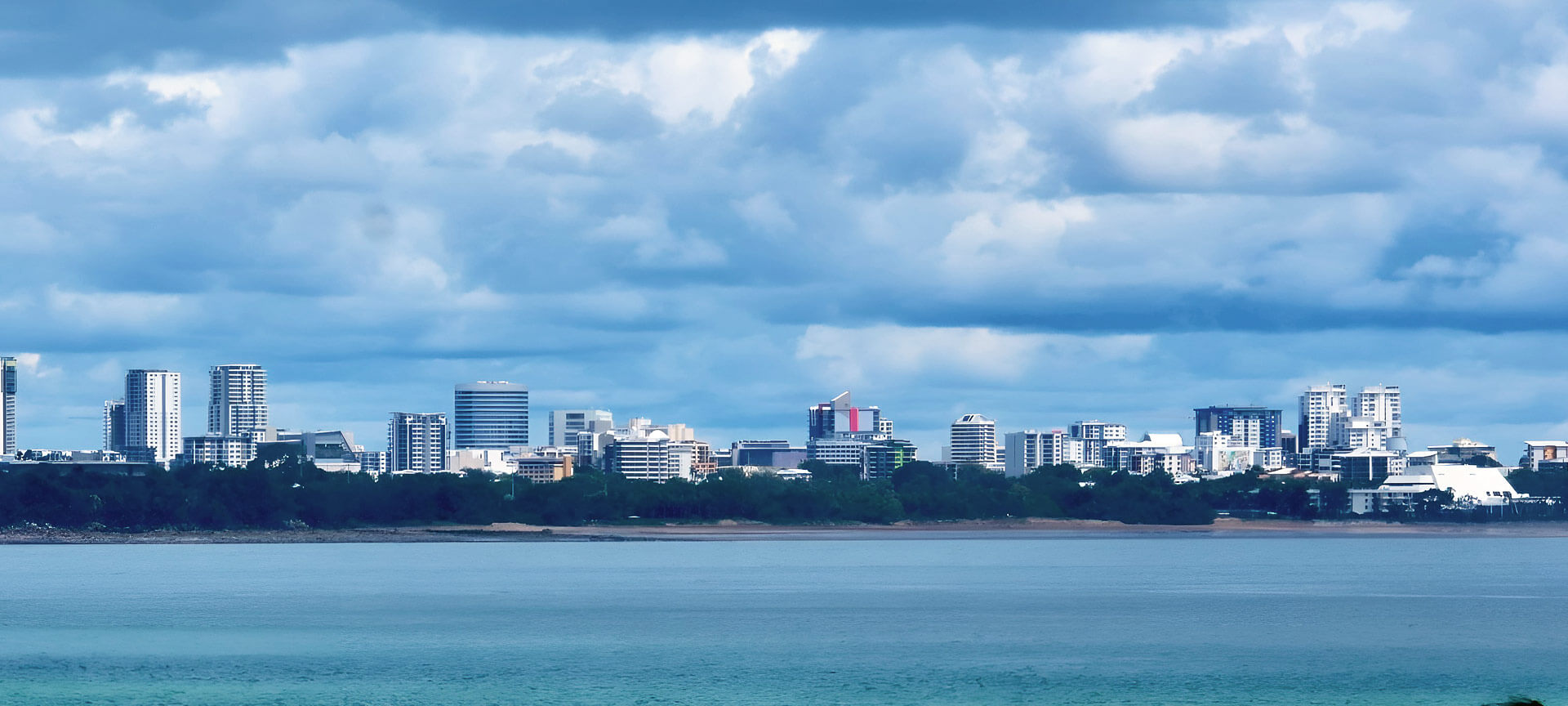
After landing at the small airport, we were met by our local guide Mel, as in Mel from the Spice Girls and not the Mel from Mel's Diner. Heading into the city, we stopped in a park for this look at Darwin from across the bay.

This is where I saw another life lister, a little friar bird, which is the smallest member of the honeyeater species, although this guy's preference seemed to be for bread.

Museum and Art Gallery of the Northern Territory

This is a large wall hanging outside the Museum and Art Gallery of the Northern Territory and as you can see, it promises a potpourri of different delights inside. Let's go inside and check it out.

This affable looking creature is Sweetheart, an alpha male crocodile who once terrorized fishermen with his attacks on their boats in the 1970s. Although he did upend a number of boats, he never actually killed anyone (that we know of). He is only one of the many things on display in this museum that can kill you in the Northern Territory, including sharks, snakes, spiders and even plants.
There were even more in prehistoric times, like this Itchyhauraus, which once roamed the vast inland Eromanga Sea in great numbers over 100 million years ago.

Or how about the largest bird that ever lived? We know Canada Geese can get very cranky if you get too close to them, but this guy, which was a member of the goose family, takes that to a whole new level.

Here is a reconstruction of, what is now believed to have been the largest bird to have ever walked the earth, looked like. Unlike the giant moas of New Zealand, which were still around when humans arrived, the thunderbirds were long extinct before the first Indigenous people arrived and we can't be blamed for their demise.

There is an entire room dedicated to Cyclone Tracy and this damaged vehicle pretty well sums up how the people of Darwin feel about her.

One of the most interesting displays was a huge room with almost two dozen full size ships associated with the Darwin area, including these three examples of Macassan trading vessels that would travel 1,400 km (930 miles) from Sulawesi to trade for sea cucumbers.

This is the Vivienne, the past pearling ship or lugger as they were properly called, to ply the waters around Darwin right up until the 1960's.

In the same room you'll find a skeleton of a pygmy blue whale, which is about as oxymoronic as jumbo shrimp. As you can see from this photo with our guide Brandi McCarthy, there was nothing pygmy about this whale.

After checking into the Hilton Garden Inn, there was time for a walk on the Darwin Esplanade, which was just across the street. These unusual looking park benches were installed during WWII and were meant to look like anti-aircraft installations to approaching enemy aircraft. The fact that Darwin did get attacked 59 times makes me question their effectiveness, but they do provide a nice canopy to block out Darwin's piercing sunlight.

This is a real piece of artillery, but it was no more effective against the Japanese attacks than the ersatz pieces we just saw. It was salvaged from the wreck of the USS Peary, an American destroyer that was sunk in Darwin harbour during that February 19, 1942 attack with the loss of 88 crew members. Today it is pointed at the spot where the ship went down.

For dinner that night, Brandi bought a $5 membership at the Darwin Services Club, which is roughly akin to a Canadian Legion, except the food is a lot better. That permitted her to bring the lot of us as her guests and I had the best meat pie I've had in ages. I got addicted to these in New Zealand and was glad to find them almost as popular in Australia. Doesn't that mushroom and steak pie look mouth-watering?

The next morning we headed out early for what I thought was the most unexpected and truly marvellous one day outing of the entire trip, Kakadu National Park, which I'll describe in the next post.
We did return to Darwin from Kakadu and had a chance to do a little more sightseeing before flying to Alice Springs the next day.
One of the best legacies of the British Empire (and yes, you nay-sayers, there are plenty) is the tradition of creating botanic gardens as places of quiet refuge and contemplation. We've already visited the Royal Botanic Gardens in Melbourne on this tour and while the George Brown Darwin Botanic Gardens are nowhere near as impressive, they are still well worth a visit.
Coming to the entrance, Mel mentioned that the gardens were famous for the giant python that lived in a tree under which you needed to pass to get to the front gate. That brought a little nervousness from a few of us until we looked up and discovered that the resident python was made of silicon.

What was not fake were the astonishing blue water lilies Nymphaea violacea that are native to the Northern Territory and provided sustenance to the Indigenous people of the area. If there is a better looking water lily anywhere, I've yet to see it.

Unfortunately, it started to rain so Alison and I took shelter in Eva's Cafe, which is located in a restored Wesleyan church. Burrito bowls may have originated in the United States, San Francisco in particular; they are now popular around the world and this one from Eva's really hit the spot.

Our last stop in Darwin takes us to the Stokes Hill Wharf, where we find this mural on the side of a container depicting the February 19, 1942 Japanese attack on Darwin.

It perfectly captures the looks of surprise and horror on the faces of the unprepared Darwinians and reminds us how these indomitable Aussies have overcome extreme adversity not once, but twice to make Darwin a symbol of rebirth and resilience.
View all